



 Chat with AI
Exam 1: The Equity Method of Accounting for Investments

Exam 1: The Equity Method of Accounting for Investments121 Questions
Exam 2: Consolidation of Financial Information117 Questions
Exam 3: Consolidations-Subsequent to the Date of Acquisition124 Questions
Exam 4: Consolidated Financial Statements and Outside Ownership117 Questions
Exam 5: Consolidated Financial Statementsintra-Entity Asset Transactions127 Questions
Exam 6: Variable Interest Entities, Intra-Entity Debt, Consolidated Cash Flows, and Other Issues115 Questions
Exam 7: Foreign Currency Transactions and Hedging Foreign Exchange Risk93 Questions
Exam 8: Translation of Foreign Currency Financial Statements97 Questions
Exam 9: Partnerships: Formation and Operation88 Questions
Exam 10: Partnerships: Termination and Liquidation73 Questions
Exam 11: Accounting for State and Local Governments, Part I78 Questions
Exam 12: Accounting for State and Local Governments, Part II49 Questions
Select questions type


On January 1, 2013, Jackie Corp. purchased 30% of the voting common stock of Rob Co., paying $2,000,000. Jackie properly accounts for this investment using the equity method. At the time of the investment, Rob's total stockholders' equity was $3,000,000. Jackie gathered the following information about Rob's assets and liabilities whose book values and fair values differed: Book Value Fair Value Buildings (20-year life) \ 1,000,000 \ 1,500,000 Equipment (5-year life) 2,500,000 3,000,000 Franchises (10-year life) 0 500,000 Any excess of cost over fair value was attributed to goodwill, which has not been impaired. Rob Co. reported net income of $300,000 for 2013, and paid dividends of $100,000 during that year. What is the balance in Jackie Corp's Investment in Rob Co. account at December 31, 2013?
(Multiple Choice)
4.8/5  (75)
(75) How would a change be made from the fair value method to the equity method of accounting for investments?
(Essay)
5.0/5 (80)
(80) Clancy Incorporated, sold $210,000 of its inventory to Reid Company during 2013 for $350,000. Reid sold $224,000 of this merchandise in 2013 with the remainder to be disposed of during 2014. Assume Clancy owns 30% of Reid and applies the equity method. What journal entry will be recorded at the end of 2013 to defer the unrealized intra-entity profits?
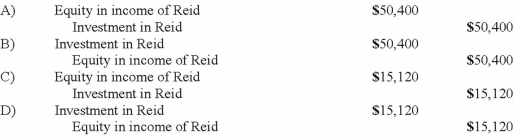
(Multiple Choice)
4.9/5 (81)
(81) Dodge, Incorporated acquires 15% of Gates Corporation on January 1, 2013, for $105,000 when the book value of Gates was $600,000. During 2013 Gates reported net income of $150,000 and paid dividends of $50,000. On January 1, 2014, Dodge purchased an additional 25% of Gates for $200,000. Any excess cost over book value is attributable to goodwill with an indefinite life. The fair-value method was used during 2013 but Dodge has deemed it necessary to change to the equity method after the second purchase. During 2014 Gates reported net income of $200,000 and reported dividends of $75,000. The income reported by Dodge for 2013 with regard to the Gates investment is
(Multiple Choice)
4.9/5 (84)
(84) On January 1, 2013, Spark Corp. acquired a 40% interest in Cranston Inc. for $250,000. On that date, Cranston's balance sheet disclosed net assets of $430,000. During 2013, Cranston reported net income of $100,000 and paid cash dividends of $30,000. Spark sold inventory costing $40,000 to Cranston during 2013 for $50,000. Cranston used all of this merchandise in its operations during 2013. Any excess cost over fair value is attributable to an unamortized trademark with a 20 year remaining life.
Required:
Prepare all of Spark's journal entries for 2013 to apply the equity method to this investment.
(Essay)
4.9/5 (68)
(68) On January 4, 2012, Trycker, Inc. acquired 40% of the outstanding common stock of Inkblot Co. for $2,400,000. This investment gave Trycker the ability to exercise significant influence over Inkblot. Inkblot's assets on that date were recorded at $8,000,000 with liabilities of $2,000,000. There were no other differences between book and fair values. During 2012, Inkblot reported net income of $500,000 and paid dividends of $300,000. The fair value of Inkblot at December 31, 2012 is $7,000,000. Trycker elects the fair value option for its investment in Inkblot.
At what amount will Inkblot be reflected in Trycker's December 31, 2012 balance sheet?
(Multiple Choice)
4.7/5 (81)
(81) Atlarge Inc. owns 30% of the outstanding voting common stock of Ticker Co. and has the ability to significantly influence the investee's operations and decision making. On January 1, 2013, the balance in the Investment in Ticker Co. account was $402,000. Amortization associated with the purchase of this investment is $8,000 per year. During 2013, Ticker earned income of $108,000 and paid cash dividends of $36,000. Previously in 2012, Ticker had sold inventory costing $28,800 to Atlarge for $48,000. All but 25% of this merchandise was consumed by Atlarge during 2012. The remainder was used during the first few weeks of 2013. Additional sales were made to Atlarge in 2013; inventory costing $33,600 was transferred at a price of $60,000. Of this total, 40% was not consumed until 2014. What was the balance in the Investment in Ticker Co. account at the end of 2013?
(Multiple Choice)
4.7/5 (73)
(73) How does the use of the equity method affect the investor's financial statements?
(Essay)
4.8/5 (73)
(73) Acker Inc. bought 40% of Howell Co. on January 1, 2012 for $576,000. The equity method of accounting was used. The book value and fair value of the net assets of Howell on that date were $1,440,000. Acker began supplying inventory to Howell as follows: Howell reported net income of $100,000 in 2012 and $120,000 in 2013 while paying $40,000 in dividends each year. What is the Equity in Howell Income that should be reported by Acker in 2013?
(Multiple Choice)
4.8/5 (81)
(81) On January 2, 2013, Heinreich Co. paid $500,000 for 25% of the voting common stock of Jones Corp. At the time of the investment, Jones had net assets with a book value and fair value of $1,800,000. During 2013, Jones incurred a net loss of $60,000 and paid dividends of $100,000. Any excess cost over book value is attributable to goodwill with an indefinite life.
Required:
1) Prepare a schedule to show the amount of goodwill from Heinrich's investment in Jones.
2) Prepare a schedule to show the balance in Heinreich's investment account at December 31, 2013.
(Essay)
4.7/5 (88)
(88) On January 3, 2013, Roberts Company purchased 30% of the 100,000 shares of common stock of Thomas Corporation, paying $1,500,000. There was no goodwill or other cost allocation associated with the investment. Roberts has significant influence over Thomas. During 2013, Thomas reported income of $300,000 and paid dividends of $100,000. On January 4, 2014, Roberts sold 15,000 shares for $800,000. What was the balance in the investment account before the shares were sold?
(Multiple Choice)
4.7/5 (84)
(84) On January 1, 2012, Dawson, Incorporated, paid $100,000 for a 30% interest in Sacco Corporation. This investee had assets with a book value of $550,000 and liabilities of $300,000. A patent held by Sacco having a book value of $10,000 was actually worth $40,000 with a six year remaining life. Any goodwill associated with this acquisition is considered to have an indefinite life. During 2012, Sacco reported income of $50,000 and paid dividends of $20,000 while in 2013 it reported income of $75,000 and dividends of $30,000. Assume Dawson has the ability to significantly influence the operations of Sacco. The amount allocated to goodwill at January 1, 2012, is
(Multiple Choice)
4.9/5 (81)
(81) On January 1, 2012, Dawson, Incorporated, paid $100,000 for a 30% interest in Sacco Corporation. This investee had assets with a book value of $550,000 and liabilities of $300,000. A patent held by Sacco having a book value of $10,000 was actually worth $40,000 with a six year remaining life. Any goodwill associated with this acquisition is considered to have an indefinite life. During 2012, Sacco reported income of $50,000 and paid dividends of $20,000 while in 2013 it reported income of $75,000 and dividends of $30,000. Assume Dawson has the ability to significantly influence the operations of Sacco. The equity in income of Sacco for 2012, is
(Multiple Choice)
4.9/5 (74)
(74) Cayman Inc. bought 30% of Maya Company on January 1, 2013 for $450,000. The equity method of accounting was used. The book value and fair value of the net assets of Maya on that date were $1,500,000. Maya began supplying inventory to Cayman as follows: Cost to Transfer Amount Held by Year Maya Price Cayman at Year-End 2013 \ 30,000 \ 45,000 \ 9,000 2014 \ 48,000 \ 80,000 \ 20,000 Maya reported net income of $100,000 in 2013 and $120,000 in 2014 while paying $40,000 in dividends each year. What is the Equity in Maya Income that should be reported by Cayman in 2013?
(Multiple Choice)
4.9/5 (81)
(81) On January 4, 2012, Harley, Inc. acquired 40% of the outstanding common stock of Bike Co. for $2,400,000. This investment gave Harley the ability to exercise significant influence over Bike. Bike's assets on that date were recorded at $10,500,000 with liabilities of $4,500,000. There were no other differences between book and fair values. During 2012, Bike reported net income of $500,000. For 2013, Bike reported net income of $800,000. Dividends of $300,000 were paid in each of these two years.
How much income did Harley report from Bike for 2012?
(Multiple Choice)
4.9/5 (91)
(91) For each of the following numbered situations below, select the best letter answer concerning accounting for investments:
Correct Answer: Verified
Premises:
Responses:
(Matching)
4.7/5 (79)
(79) Which statement is true concerning unrealized profits in intra-entity inventory transfers when an investor uses the equity method?
(Multiple Choice)
4.9/5 (80)
(80) Tower Inc. owns 30% of Yale Co. and applies the equity method. During the current year, Tower bought inventory costing $66,000 and then sold it to Yale for $120,000. At year-end, only $24,000 of merchandise was still being held by Yale. What amount of intra-entity inventory profit must be deferred by Tower?
(Multiple Choice)
4.8/5 (81)
(81) On January 4, 2013, Watts Co. purchased 40,000 shares (40%) of the common stock of Adams Corp., paying $800,000. There was no goodwill or other cost allocation associated with the investment. Watts has significant influence over Adams. During 2013, Adams reported income of $200,000 and paid dividends of $80,000. On January 2, 2014, Watts sold 5,000 shares for $125,000. What was the balance in the investment account after the shares had been sold?
(Multiple Choice)
4.9/5 (81)
(81) Cayman Inc. bought 30% of Maya Company on January 1, 2013 for $450,000. The equity method of accounting was used. The book value and fair value of the net assets of Maya on that date were $1,500,000. Maya began supplying inventory to Cayman as follows: Cost to Transfer Amount Held by Year Maya Price Cayman at Year-End 2013 \ 30,000 \ 45,000 \ 9,000 2014 \ 48,000 \ 80,000 \ 20,000 Maya reported net income of $100,000 in 2013 and $120,000 in 2014 while paying $40,000 in dividends each year. What is the balance in Cayman's Investment in Maya account at December 31, 2014?
(Multiple Choice)
4.8/5 (81)
(81) 
Filters
- Essay(0)
- Multiple Choice(0)
- Short Answer(0)
- True False(0)
- Matching(0)