



 Chat with AI
Exam 10: Partnerships: Termination and Liquidation

Exam 1: The Equity Method of Accounting for Investments121 Questions
Exam 2: Consolidation of Financial Information117 Questions
Exam 3: Consolidations-Subsequent to the Date of Acquisition124 Questions
Exam 4: Consolidated Financial Statements and Outside Ownership117 Questions
Exam 5: Consolidated Financial Statementsintra-Entity Asset Transactions127 Questions
Exam 6: Variable Interest Entities, Intra-Entity Debt, Consolidated Cash Flows, and Other Issues115 Questions
Exam 7: Foreign Currency Transactions and Hedging Foreign Exchange Risk93 Questions
Exam 8: Translation of Foreign Currency Financial Statements97 Questions
Exam 9: Partnerships: Formation and Operation88 Questions
Exam 10: Partnerships: Termination and Liquidation73 Questions
Exam 11: Accounting for State and Local Governments, Part I78 Questions
Exam 12: Accounting for State and Local Governments, Part II49 Questions
Select questions type


As of January 1, 2013, the partnership of Canton, Yulls, and Garr had the following account balances and percentages for the sharing of profits and losses:
Cash \ 80,000 Noncash assets 205,000 Liabilities 47,000 Canton, capital (30\%) 138,000 Yulls, capital (40\%) 119,500 Garr, capital (30\%) (19,500) The partnership incurred losses in recent years and decided to liquidate. The liquidation expenses were expected to be $10,000.
How much of the existing cash balance could be distributed safely to partners at this time?

Free
(Essay)
4.9/5  (68)
(68) Correct Answer: Verified
The amount of cash that could be distributed to partners at this time = current cash balance $80,000 - liabilities $47,000 - estimate for liquidation expenses $10,000 = $23,000.
The Henry, Isaac, and Jacobs partnership was about to enter liquidation with the following account balances:  Estimated expenses of liquidation were $5,000. Henry, Isaac, and Jacobs shared profits and losses in a ratio of 2:4:4. Before liquidating any assets, the partners determined the amount of cash available for safe payments. How should the amount of safe cash payments be distributed?
Free
(Multiple Choice)
4.8/5 (63)
(63) Correct Answer:Verified
VerifiedD
On January 1, 2013, the partners of Won, Cadel, and Dax (who shared profits and losses in the ratio of 5:3:2, respectively) decided to liquidate their partnership. The trial balance at this date was as follows:
 The partners planned a program of piecemeal conversion of the business assets to minimize liquidation losses. All available cash, less an amount retained to provide for future expenses, was to be distributed to the partners at the end of each month. A summary of liquidation transactions follows:
 Prepare a schedule to calculate the safe payments to be made to the partners at the end of March.
The partners planned a program of piecemeal conversion of the business assets to minimize liquidation losses. All available cash, less an amount retained to provide for future expenses, was to be distributed to the partners at the end of each month. A summary of liquidation transactions follows: Prepare a schedule to calculate the safe payments to be made to the partners at the end of March.Free
(Essay)
4.9/5 (84)
(84) Correct Answer:Verified
Verified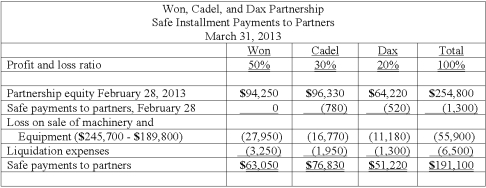
A local partnership has assets of cash of $5,000 and a building recorded at $80,000. All liabilities have been paid. The partners' capital accounts are as follows Harry $40,000, Landers $30,000 and Waters 15,000. The partners share profits and losses 4:4:2. If the building is sold for $50,000, how much cash will Harry receive in the final settlement?
(Multiple Choice)
4.7/5 (85)
(85) A provision for an equitable distribution of assets during liquidation.
(Multiple Choice)
4.9/5 (79)
(79) A local partnership was in the process of liquidating and reported the following capital balances: Justice, capital ( 40\% share of all profits and losses) \ 23,000 Zobart, capital (35\%) 22,000 Douglass, capital (25\%) (14,000) Douglass indicated that the $14,000 deficit would be covered by a forthcoming contribution. However, the two remaining partners asked to receive the $31,000 that was then in the cash account. How much of this money should Justice receive?
(Multiple Choice)
4.9/5 (81)
(81) The Keaton, Lewis, and Meador partnership had the following balance sheet just before entering liquidation:  Keaton, Lewis, and Meador share profits and losses in a ratio of 2:4:4. Noncash assets were sold for $180,000. Liquidation expenses were $10,000. Assume that Lewis was personally insolvent and could not contribute any assets to the partnership, while Keaton and Meador were both solvent. What amount of cash would Keaton have received from the distribution of partnership assets?
 (Multiple Choice)
4.8/5 (86)
(86) The balance sheet of Rogers, Dennis & Berry LLP prior to liquidation included the following:
Cash \ 40,000 Noncash assets 80,000 Liabilities 20,000 Loan Payable to Rogers 10,000 Rogers, Capital 35,000 Dennis, Capital 30,000 Berry, Capital 25,000 The three partners shared net income and losses in a 5:3:2 ratio, respectively. Noncash assets were sold for $60,000. Creditors were paid in full, partners were paid $35,000, and the balance of cash was retained pending future developments.
Determine the cash to be retained and prepare a schedule to distribute $35,000 cash to the partners.
(Essay)
4.8/5 (72)
(72) The Abrams, Bartle, and Creighton partnership began the process of liquidation with the following balance sheet:  Abrams, Bartle, and Creighton share profits and losses in a ratio of 3:2:5. Liquidation expenses are expected to be $12,000. After the liquidation expenses of $12,000 were paid and the noncash assets sold, Creighton had a deficit of $8,000. For what amount were the noncash assets sold?
 (Multiple Choice)
4.9/5 (84)
(84) Hardin, Sutton, and Williams have operated a local business as a partnership for several years. All profits and losses have been allocated in a 3:2:1 ratio, respectively. Recently, Williams has undergone personal financial problems, and is insolvent. To satisfy Williams' creditors, the partnership has decided to liquidate.
The following balance sheet has been produced:
 During the liquidation process, the following transactions take place:
- Noncash assets are sold for $116,000.
- Liquidation expenses of $12,000 are paid. No further expenses are expected.
- Safe capital distributions are made to the partners.
- Payment is made of all business liabilities.
- Any deficit capital balances are deemed to be uncollectible.
Prepare journal entries to record the actual liquidation transactions.
During the liquidation process, the following transactions take place:
- Noncash assets are sold for $116,000.
- Liquidation expenses of $12,000 are paid. No further expenses are expected.
- Safe capital distributions are made to the partners.
- Payment is made of all business liabilities.
- Any deficit capital balances are deemed to be uncollectible.
Prepare journal entries to record the actual liquidation transactions. (Essay)
4.9/5 (58)
(58) As of January 1, 2013, the partnership of Canton, Yulls, and Garr had the following account balances and percentages for the sharing of profits and losses:
Cash \ 80,000 Noncash assets 205,000 Liabilities 47,000 Canton, capital (30\%) 138,000 Yulls, capital (40\%) 119,500 Garr, capital (30\%) (19,500) The partnership incurred losses in recent years and decided to liquidate. The liquidation expenses were expected to be $10,000.
What would be the maximum amount Garr might have to contribute to the partnership to eliminate a deficit balance in his account?
(Essay)
4.8/5 (77)
(77) The partners of Donald, Chief & Berry LLP decided to liquidate on August 1, 2013. The balance sheet of the partnership is as follows, with the profit and loss ratio of 25%, 45%, and 30%, respectively.
 The disposal of Other Assets with a carrying amount of $200,000 realized $140,000, and all available cash was distributed.
Prepare the journal entry for Donald, Chief & Berry LLP on August 1, 2013, to record the realization of Other Assets.
The disposal of Other Assets with a carrying amount of $200,000 realized $140,000, and all available cash was distributed.
Prepare the journal entry for Donald, Chief & Berry LLP on August 1, 2013, to record the realization of Other Assets. (Essay)
4.8/5 (87)
(87) On January 1, 2013, the partners of Won, Cadel, and Dax (who shared profits and losses in the ratio of 5:3:2, respectively) decided to liquidate their partnership. The trial balance at this date was as follows:
 The partners planned a program of piecemeal conversion of the business assets to minimize liquidation losses. All available cash, less an amount retained to provide for future expenses, was to be distributed to the partners at the end of each month. A summary of liquidation transactions follows:
 Prepare a schedule to calculate the safe installment payments to be made to the partners at the end of February.
The partners planned a program of piecemeal conversion of the business assets to minimize liquidation losses. All available cash, less an amount retained to provide for future expenses, was to be distributed to the partners at the end of each month. A summary of liquidation transactions follows: Prepare a schedule to calculate the safe installment payments to be made to the partners at the end of February. (Essay)
4.8/5 (75)
(75) The partners of Donald, Chief & Berry LLP decided to liquidate on August 1, 2013. The balance sheet of the partnership is as follows, with the profit and loss ratio of 25%, 45%, and 30%, respectively.
DONALD, CHIEF, & BERRY LLP
Balance Sheet
August 1, 2013
Assets Labilities \& Partners' Capital Cash Trade accounts payable \ 130,000 Loan receivable from Donald 40,000 Loan payable to Chief 60,000 Other assets 500,000 Donald, capital 140,000 Chief, capital 160,000 Berry, capital 110,000 Total \ 600,000? Total \ 600,000 The disposal of Other Assets with a carrying amount of $200,000 realized $140,000, and all available cash was distributed.
Prepare the journal entry for Donald, Chief & Berry LLP on August 1, 2013, to record payment of liabilities.
(Essay)
4.7/5 (82)
(82) The Amos, Billings, and Cleaver partnership had two assets: (1) cash of $40,000 and (2) an investment with a book value of $110,000. The ratio for sharing profits and losses is 2:1:1. The balances in the capital accounts were:
Amos, capital: $45,000
Billings, capital: $75,000
Cleaver, capital: $30,000
Required:
If the investment was sold for $80,000, how much cash would each partner have received?
(Essay)
5.0/5 (75)
(75) A local partnership has assets of cash of $130,000 and land recorded at $700,000. All liabilities have been paid and the partners are all personally insolvent. The partners' capital accounts are as follows Roberts, $500,000, Ferry, $300,000 and Mones, $30,000. The partners share profits and losses 5:3:2. If the land is sold for $450,000, how much cash will Roberts receive in the final settlement?
(Multiple Choice)
4.8/5 (76)
(76) A partnership held three assets: Cash, $13,000; Land, $45,000; and a Building, $65,000. There were no recorded liabilities. The partners anticipated that expenses required to liquidate their partnership would amount to $6,000. Capital balances were as follows:
King, Capital: $32,700
Murphy, Capital: 36,400
Madison, Capital: 26,000
Pond, Capital: 27,900
The partners shared profits and losses 30:30:20:20, respectively.
Required:
Prepare a proposed schedule of liquidation, showing how cash could be safely distributed to the partners at this time.
(Essay)
4.9/5 (85)
(85) Hardin, Sutton, and Williams have operated a local business as a partnership for several years. All profits and losses have been allocated in a 3:2:1 ratio, respectively. Recently, Williams has undergone personal financial problems, and is insolvent. To satisfy Williams' creditors, the partnership has decided to liquidate.
The following balance sheet has been produced:
 During the liquidation process, the following transactions take place:
- Noncash assets are sold for $116,000.
- Liquidation expenses of $12,000 are paid. No further expenses are expected.
- Safe capital distributions are made to the partners.
- Payment is made of all business liabilities.
- Any deficit capital balances are deemed to be uncollectible.
Compute safe cash payments after the noncash assets have been sold and the liquidation expenses have been paid.
During the liquidation process, the following transactions take place:
- Noncash assets are sold for $116,000.
- Liquidation expenses of $12,000 are paid. No further expenses are expected.
- Safe capital distributions are made to the partners.
- Payment is made of all business liabilities.
- Any deficit capital balances are deemed to be uncollectible.
Compute safe cash payments after the noncash assets have been sold and the liquidation expenses have been paid. (Essay)
4.9/5 (67)
(67) On January 1, 2013, the partners of Won, Cadel, and Dax (who shared profits and losses in the ratio of 5:3:2, respectively) decided to liquidate their partnership. The trial balance at this date was as follows:
 The partners planned a program of piecemeal conversion of the business assets to minimize liquidation losses. All available cash, less an amount retained to provide for future expenses, was to be distributed to the partners at the end of each month. A summary of liquidation transactions follows:
 Prepare a schedule to calculate the safe payments to be made to the partners at the end of January.
The partners planned a program of piecemeal conversion of the business assets to minimize liquidation losses. All available cash, less an amount retained to provide for future expenses, was to be distributed to the partners at the end of each month. A summary of liquidation transactions follows: Prepare a schedule to calculate the safe payments to be made to the partners at the end of January. (Essay)
4.9/5 (78)
(78) The partnership of Rayne, Marin, and Fulton was being liquidated by the partners. Rayne was insolvent and did not have enough assets to pay all his personal creditors. Under what conditions might Rayne's personal creditors have claimed some of the partnership assets?
(Essay)
4.9/5 (80)
(80) 
Filters
- Essay(0)
- Multiple Choice(0)
- Short Answer(0)
- True False(0)
- Matching(0)