



 Chat with AI
Exam 10: Partnerships: Termination and Liquidation

Exam 1: The Equity Method of Accounting for Investments121 Questions
Exam 2: Consolidation of Financial Information117 Questions
Exam 3: Consolidations-Subsequent to the Date of Acquisition124 Questions
Exam 4: Consolidated Financial Statements and Outside Ownership117 Questions
Exam 5: Consolidated Financial Statementsintra-Entity Asset Transactions127 Questions
Exam 6: Variable Interest Entities, Intra-Entity Debt, Consolidated Cash Flows, and Other Issues115 Questions
Exam 7: Foreign Currency Transactions and Hedging Foreign Exchange Risk93 Questions
Exam 8: Translation of Foreign Currency Financial Statements97 Questions
Exam 9: Partnerships: Formation and Operation88 Questions
Exam 10: Partnerships: Termination and Liquidation73 Questions
Exam 11: Accounting for State and Local Governments, Part I78 Questions
Exam 12: Accounting for State and Local Governments, Part II49 Questions
Select questions type


What accounting transactions are not recorded by an accountant during partnership liquidation?
(Multiple Choice)
4.8/5  (71)
(71) A local partnership was considering the possibility of liquidation since one of the partners (Ding) was personally insolvent. Capital balances at that time were as follows. Profits and losses were divided on a 4:2:2:2 basis, respectively. Ding, capital \ 60,000 Laurel, capital 67,000 Ezzard, capital 17,000 Tillman, capital 96,000 Creditors of partner Ding filed a $25,000 claim against the partnership's assets. At that time, the partnership held noncash assets reported at $360,000 and liabilities of $120,000. There was no cash on hand at the time. If the assets could be sold for $228,000, what is the minimum amount that Ezzard's creditors would have received?
(Multiple Choice)
4.8/5 (92)
(92) As of January 1, 2013, the partnership of Canton, Yulls, and Garr had the following account balances and percentages for the sharing of profits and losses:
Cash \ 80,000 Noncash assets 205,000 Liabilities 47,000 Canton, capital (30\%) 138,000 Yulls, capital (40\%) 119,500 Garr, capital (30\%) (19,500) The partnership incurred losses in recent years and decided to liquidate. The liquidation expenses were expected to be $10,000.
If the noncash assets are sold for $105,000, what would be the maximum amount of cash that Canton could expect to receive?
(Essay)
5.0/5 (83)
(83) One or more partners may have a negative capital balance often as a result of losses incurred in disposing of assets.
(Multiple Choice)
4.8/5 (82)
(82) Dancey, Reese, Newman, and Jahn were partners who shared profits and losses on a 4:2:2:2 basis, respectively. They were beginning to liquidate their business. At the start of the process, capital balances were as follows: Dancey, capital \ 72,000 Reese, capital 32,000 Newman, capital 52,000 Jahn, capital 24,000 Which one of the following statements is true for a predistribution plan?
(Multiple Choice)
4.9/5 (66)
(66) The Albert, Boynton, and Creamer partnership was in the process of liquidating its assets and going out of business. Albert, Boynton, and Creamer had capital account balances of $80,000, $120,000, and $200,000, respectively, and shared profits and losses in the ratio of 1:3:2. Equipment that had cost $90,000 and had a book value of $60,000 was sold for $24,000 cash.
Required:
Prepare the appropriate journal entry to record the sale of the equipment, distributing any gain or loss directly to the partners.
(Essay)
4.9/5 (77)
(77) The Abrams, Bartle, and Creighton partnership began the process of liquidation with the following balance sheet:  Abrams, Bartle, and Creighton share profits and losses in a ratio of 3:2:5. Liquidation expenses are expected to be $12,000. If the noncash assets were sold for $234,000, what amount of the loss would have been allocated to Bartle?
 (Multiple Choice)
4.9/5 (90)
(90) A partnership had the following account balances: Cash, $91,000; Other Assets, $702,000; Liabilities, $338,000; Polk, Capital (50% of profits and losses), $221,000; Garfield, Capital (30%), $143,000; Arthur, Capital (20%), $91,000. The company liquidated and $10,400 became available to the partners.
Required:
Who would have received the $10,400?
(Essay)
4.9/5 (81)
(81) A schedule should be produced periodically by the accountant to disclose losses and gains that have been incurred, remaining assets and liabilities, and current capital balances.
(Multiple Choice)
4.7/5 (68)
(68) The balance sheet of Rogers, Dennis & Berry LLP prior to liquidation included the following:
Cash \ 40,000 Noncash assets 80,000 Liabilities 20,000 Loan Payable to Rogers 10,000 Rogers, Capital 35,000 Dennis, Capital 30,000 Berry, Capital 25,000 The three partners shared net income and losses in a 5:3:2 ratio, respectively. Noncash assets were sold for $60,000. Creditors were paid in full, partners were paid $35,000, and the balance of cash was retained pending future developments.
Record the journal entry for payment of outstanding liabilities to the creditors.
(Essay)
4.9/5 (84)
(84) The balance sheet of Rogers, Dennis & Berry LLP prior to liquidation included the following:
Cash \ 40,000 Noncash assets 80,000 Liabilities 20,000 Loan Payable to Rogers 10,000 Rogers, Capital 35,000 Dennis, Capital 30,000 Berry, Capital 25,000 The three partners shared net income and losses in a 5:3:2 ratio, respectively. Noncash assets were sold for $60,000. Creditors were paid in full, partners were paid $35,000, and the balance of cash was retained pending future developments.
Record the journal entry for the cash distribution to the partners.
(Essay)
4.7/5 (76)
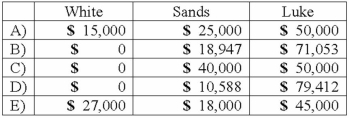
(76) White, Sands, and Luke has the following capital balances and profit and loss ratios: $60,000 (30%); $100,000 (20%); and $200,000 (50%).
The partnership has received a predistribution plan.
How would $90,000 be distributed?
(Multiple Choice)
4.8/5 (98)
(98) Dancey, Reese, Newman, and Jahn were partners who shared profits and losses on a 4:2:2:2 basis, respectively. They were beginning to liquidate their business. At the start of the process, capital balances were as follows: Dancey, capital \ 72,000 Reese, capital 32,000 Newman, capital 52,000 Jahn, capital 24,000 Which one of the following statements is true for a predistribution plan?
(Multiple Choice)
4.8/5 (81)
(81) 
Filters
- Essay(0)
- Multiple Choice(0)
- Short Answer(0)
- True False(0)
- Matching(0)