



 Chat with AI
Exam 21: Managing Liquidity Risk on the Balance Sheet

Exam 1: Introduction42 Questions
Exam 2: Determinants of Interest Rates57 Questions
Exam 3: Interest Rates and Security Valuation62 Questions
Exam 4: The Federal Reserve System, Monetary Policy, and Interest Rates51 Questions
Exam 5: Money Markets52 Questions
Exam 6: Bond Markets54 Questions
Exam 7: Mortgage Markets48 Questions
Exam 8: Stock Markets56 Questions
Exam 9: Foreign Exchange Markets55 Questions
Exam 10: Derivative Securities Markets60 Questions
Exam 11: Commercial Banks: Industry Overview40 Questions
Exam 12: Commercial Banks Financial Statements and Analysis44 Questions
Exam 13: Regulation of Commercial Banks52 Questions
Exam 14: Other Lending Institutions: Savings Institutions, Credit Unions, and Finance Companies55 Questions
Exam 15: Insurance Companies55 Questions
Exam 16: Securities Firms and Investment Banks50 Questions
Exam 17: Investment Companies57 Questions
Exam 18: Pension Funds54 Questions
Exam 19: Types of Risks Incurred by Financial Institutions50 Questions
Exam 20: Managing Credit Risk on the Balance Sheet51 Questions
Exam 21: Managing Liquidity Risk on the Balance Sheet47 Questions
Exam 22: Managing Interest Rate Risk and Insolvency Risk on the Balance Sheet54 Questions
Exam 23: Managing Risk Off the Balance Sheet With Derivative Securities62 Questions
Exam 24: Managing Risk Off the Balance Sheet With Loan Sales and Securitization57 Questions
Select questions type


A bank has $6 million in Treasury bills,$3 million in excess reserves at the Fed,$1 million in vault cash,and an $8 million line of credit on the repo market. The bank has borrowed $6 million in fed funds and $12 million in short-term notes borrowed to finance loans. What is the net liquidity position of the bank and what can you conclude from it?

Free
(Essay)
4.9/5  (70)
(70) Correct Answer: Verified
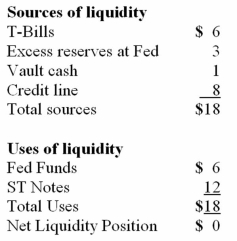 The net liquidity position reveals it is zero. While the bank has all expected liquidity needs covered,it has no contingency funds and it should have a plan prepared detailing how additional funds can be raised at short notice if needed.
Which of the following results in a net liquidity drain?
Free
(Multiple Choice)
4.8/5 (83)
(83) Correct Answer:Verified
VerifiedD
Core deposits include all but which of the following?
Free
(Multiple Choice)
4.9/5 (74)
(74) Correct Answer:Verified
VerifiedE
Using stored liquidity to offset a deposit drain will reduce the size of the bank,but using purchased liquidity to offset the drain will not.
(True/False)
4.8/5 (87)
(87) What are the trade-offs involved between storing liquidity and purchasing liquidity as needed for a bank?
(Essay)
4.9/5 (77)
(77) Explain the relationship between each of the following ratios and liquidity risk.
(Essay)
4.9/5 (79)
(79) Which one of the following situations creates the most liquidity risk?
(Multiple Choice)
4.9/5 (73)
(73) A married couple each has an IRA and deposits at a bank. The couple also has one child. If they had the money,what is the total amount of their accounts that could be insured at one bank?
(Multiple Choice)
4.9/5 (75)
(75) Which one of the following is a source of liquidity risk for a bank?
(Multiple Choice)
5.0/5 (83)
(83) When money market interest rates are higher than deposit rates,using purchased liquidity to replace deposit drains can reduce a bank's profit margin.
(True/False)
4.9/5 (94)
(94) Property and casualty insurers have a greater need for liquidity than life insurers.
(True/False)
4.8/5 (85)
(85) How does reliance on purchased liquidity rather than core deposits affect a bank?
I. Increases the risk of a liquidity crisis
II. Allows the bank to adjust to deposit drains without affecting bank size
III. Increases overall interest sensitivity of the bank's profits to interest rates
(Multiple Choice)
4.9/5 (73)
(73) If a bank's brokered deposits increase $3 million and their savings accounts decrease $1 million,then core deposits decreased.
(True/False)
4.8/5 (81)
(81) The greater the discount required to sell assets quickly,the higher the value of the bank's liquidity index.
(True/False)
4.8/5 (85)
(85) What are the major sources of liquidity risk for a bank?
For a life insurer?
(Essay)
5.0/5 (72)
(72) The Fed now operates the discount window differently than it used to. What are the major changes?
(Essay)
4.9/5 (75)
(75) Closed-end mutual funds have less need to maintain liquid asset holdings than open-end mutual funds.
(True/False)
4.8/5 (72)
(72) We rarely see bank runs since the advent of Federal Deposit Insurance,but runs on life insurers and mutual funds do occur even though claimants have pro rata claims in the event of default. Why do these runs still occur?
(Essay)
4.7/5 (79)
(79) 
Filters
- Essay(0)
- Multiple Choice(0)
- Short Answer(0)
- True False(0)
- Matching(0)