



 Chat with AI
Exam 21: Optimum Currency Areas and the Euro

Exam 1: Introduction41 Questions
Exam 2: World Trade: An Overview25 Questions
Exam 3: Labor Productivity and Comparative Advantage: The Ricardian Model70 Questions
Exam 4: Specific Factors and Income Distribution70 Questions
Exam 5: Resources and Trade: the Heckscher-Ohlin Model66 Questions
Exam 6: The Standard Trade Model48 Questions
Exam 7: External Economies of Scale and the International Location of Production37 Questions
Exam 8: Firms in the Global Economy: Export Decisions, Outsourcing, and Multinational Enterprises69 Questions
Exam 9: The Instruments of Trade Policy74 Questions
Exam 10: The Political Economy of Trade Policy63 Questions
Exam 11: Trade Policy in Developing Countries43 Questions
Exam 12: Controversies in Trade Policy47 Questions
Exam 13: National Income Accounting and the Balance of Payments78 Questions
Exam 14: Exchange Rates and the Foreign Exchange Market: An Asset Approach76 Questions
Exam 15: Money,Interest Rates, and Exchange Rates65 Questions
Exam 16: Price Levels and the Exchange Rate in the Long Run80 Questions
Exam 17: Output and the Exchange Rate in the Short Run116 Questions
Exam 18: Fixed Exchange Rates and Foreign Exchange Intervention81 Questions
Exam 19: International Monetary Systems: An Historical Overview171 Questions
Exam 20: Financial Globalization: Opportunity and Crisis131 Questions
Exam 21: Optimum Currency Areas and the Euro104 Questions
Exam 22: Developing Countries: Growth, Crisis, and Reform116 Questions
Select questions type


Explain why the EMS countries decided to fix their exchange rates against the German DM.
(Essay)
4.9/5  (86)
(86) Compared with inter-regional trade in the he United States,intra-EU trade
(Multiple Choice)
4.9/5 (73)
(73) The credibility theory of the EMS implies in effect that the political costs of violating international exchange rate agreements
(Multiple Choice)
4.8/5 (74)
(74) Using the GG-LL framework,analyze the effect of an increase in the size and frequency of sudden shifts in the demand for a country's exports.
(Essay)
4.8/5 (78)
(78) Discuss the trends and implications of the following graph,especially with respect to the official start of the EMU on January 1,1999. 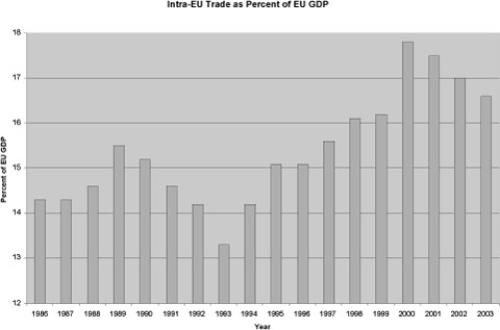
(Essay)
4.8/5 (89)
(89) Is the United States in danger of a sovereign default because,like countries in the euro zone,it has high current account deficits and levels of public debt?
(Essay)
4.8/5 (86)
(86) Which one of the following statements is TRUE for Norway,a non-euro country?
(Multiple Choice)
4.9/5 (69)
(69) What is one way to offset the economic stability loss due to fixed exchange rates?
(Essay)
5.0/5 (74)
(74) Did the 1957 Treaty of Rome turn the EU into a truly unified market?
(Multiple Choice)
4.8/5 (87)
(87) After Norway unilaterally pegs the krone to the euro,domestic money market disturbances will
(Multiple Choice)
4.9/5 (80)
(80) Explain why even owners of capital that cannot be moved can avoid more of the economic stability loss due to fixed exchange rates when Norway's economy is open to capital flows.
(Essay)
4.9/5 (72)
(72) The German central bank in the European Monetary System,1979-1998
(Multiple Choice)
4.7/5 (99)
(99) 
Filters
- Essay(0)
- Multiple Choice(0)
- Short Answer(0)
- True False(0)
- Matching(0)