



 Chat with AI
Exam 20: Economic Growth in the Global Economy

Exam 1: The Role and Method of Economics198 Questions
Exam 2: Economics: Eight Powerful Ideas197 Questions
Exam 3: Scarcity, Trade-Offs, and Production Possibilities189 Questions
Exam 4: Demand, Supply, and Market Equilibrium240 Questions
Exam 5: Markets in Motion and Price Controls228 Questions
Exam 6: Elasticities206 Questions
Exam 7: Market Efficiency and Welfare136 Questions
Exam 8: Market Failure215 Questions
Exam 9: Public Finance and Public Choice64 Questions
Exam 10: Consumer Choice Theory149 Questions
Exam 11: The Firm: Production and Costs198 Questions
Exam 12: Firms in Perfectly Competitive Markets207 Questions
Exam 13: Monopoly and Antitrust189 Questions
Exam 14: Monopolistic Competition and Product Differentiation159 Questions
Exam 15: Oligopoly and Strategic Behavior146 Questions
Exam 16: The Markets for Labor, Capital, and Land177 Questions
Exam 17: Income, Poverty, and Health Care138 Questions
Exam 18: Introduction to Macroeconomics: Unemployment, Inflation, and Economic Fluctuations171 Questions
Exam 19: Measuring Economic Performance147 Questions
Exam 20: Economic Growth in the Global Economy127 Questions
Exam 21: Financial Markets, Saving, and Investment65 Questions
Exam 22: Aggregate Demand and Aggregate Supply163 Questions
Exam 23: The Aggregate Expenditure Model69 Questions
Exam 25: Monetary Institutions182 Questions
Exam 26: The Federal Reserve System and Monetary Policy147 Questions
Exam 27: Issues in Macroeconomic Theory and Policy130 Questions
Exam 28: International Trade182 Questions
Exam 29: International Finance138 Questions
Select questions type


If population is expanding at a faster rate than a country's real output is expanding:
(Multiple Choice)
4.9/5  (76)
(76) Which of the following will not increase the rate of growth in an economy?
(Multiple Choice)
4.8/5 (74)
(74) Which of the following factors contribute to economic growth?
(Multiple Choice)
4.7/5 (80)
(80) Thomas Malthus's predictions did not come to pass because he implicitly assumed that there would be no technological advances and did not foresee that agricultural land was not completely fixed in quantity or quality.
(True/False)
4.8/5 (76)
(76) Exhibit 20-1 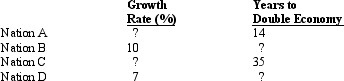 Refer to Exhibit 20-1.Which nation has the lowest growth rate?
 (Multiple Choice)
4.9/5 (74)
(74) It is impossible to have economic growth unless a country or a region has abundant natural resources to sustain the growth.
(True/False)
4.7/5 (72)
(72) Which of the following best describes the relationship between economic growth and literacy?
(Multiple Choice)
4.8/5 (80)
(80) In any country,the population will generally be better off as long as the ____ over time and population ____.
(Multiple Choice)
4.9/5 (83)
(83) If there was an increase in technology other things equal,real GDP growth would ____ and real GDP growth per capita would ____.
(Multiple Choice)
4.9/5 (91)
(91) Over the last several decades,the amount of government investment in U.S.infrastructure in real terms has:
(Multiple Choice)
4.7/5 (72)
(72) Economies of large-scale production may exist in some forms of production,so larger markets associated with greater populations can lead to more efficiently sized production units.
(True/False)
4.8/5 (86)
(86) New growth theorists believe that increased economic growth is primarily driven by:
(Multiple Choice)
4.9/5 (80)
(80) People who make the arguments that economic growth will deplete natural resources make the same assumption Malthus made about resources.What is that assumption?
(Multiple Choice)
4.7/5 (76)
(76) If there was both an increase in technology and an increase in labor force participation,real GDP growth would ____ and real GDP growth per capita would ____.
(Multiple Choice)
4.7/5 (85)
(85) Free trade can promote greater output because of the principle of comparative advantage.
(True/False)
4.7/5 (85)
(85) 
Filters
- Essay(0)
- Multiple Choice(0)
- Short Answer(0)
- True False(0)
- Matching(0)