



 Chat with AI
Exam 20: Economic Growth in the Global Economy

Exam 1: The Role and Method of Economics198 Questions
Exam 2: Economics: Eight Powerful Ideas197 Questions
Exam 3: Scarcity, Trade-Offs, and Production Possibilities189 Questions
Exam 4: Demand, Supply, and Market Equilibrium240 Questions
Exam 5: Markets in Motion and Price Controls228 Questions
Exam 6: Elasticities206 Questions
Exam 7: Market Efficiency and Welfare136 Questions
Exam 8: Market Failure215 Questions
Exam 9: Public Finance and Public Choice64 Questions
Exam 10: Consumer Choice Theory149 Questions
Exam 11: The Firm: Production and Costs198 Questions
Exam 12: Firms in Perfectly Competitive Markets207 Questions
Exam 13: Monopoly and Antitrust189 Questions
Exam 14: Monopolistic Competition and Product Differentiation159 Questions
Exam 15: Oligopoly and Strategic Behavior146 Questions
Exam 16: The Markets for Labor, Capital, and Land177 Questions
Exam 17: Income, Poverty, and Health Care138 Questions
Exam 18: Introduction to Macroeconomics: Unemployment, Inflation, and Economic Fluctuations171 Questions
Exam 19: Measuring Economic Performance147 Questions
Exam 20: Economic Growth in the Global Economy127 Questions
Exam 21: Financial Markets, Saving, and Investment65 Questions
Exam 22: Aggregate Demand and Aggregate Supply163 Questions
Exam 23: The Aggregate Expenditure Model69 Questions
Exam 25: Monetary Institutions182 Questions
Exam 26: The Federal Reserve System and Monetary Policy147 Questions
Exam 27: Issues in Macroeconomic Theory and Policy130 Questions
Exam 28: International Trade182 Questions
Exam 29: International Finance138 Questions
Select questions type


Hong Kong and Japan have achieved relatively high incomes per capita despite lacking an abundance of natural resources.
(True/False)
4.8/5  (87)
(87) Ultimately,productivity growth is the major determinant of a country's standard of living
(True/False)
4.9/5 (66)
(66) Higher levels of savings will result in all of following except:
(Multiple Choice)
4.8/5 (84)
(84) Malthus's gloomy economic outlook for humankind is based on the following principle:
(Multiple Choice)
5.0/5 (80)
(80) An increase in the quantity of labor inputs always leads to economic growth.
(True/False)
4.9/5 (74)
(74) If people began to retire at a later age and there was an increase in the capital stock,real GDP growth would ____ and real GDP growth per capita would ____.
(Multiple Choice)
4.9/5 (76)
(76) If a country's annual growth rate is 2%,then its output will double in approximately ____ years.
(Multiple Choice)
4.8/5 (69)
(69) For a low-income country to develop into a high-income country,____ is (are)needed.
(Multiple Choice)
4.8/5 (75)
(75) Exhibit 20-1 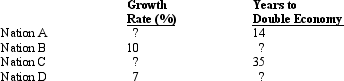 Refer to Exhibit 20-1.Which nation enjoys the highest growth rate?
 (Multiple Choice)
5.0/5 (82)
(82) Most modern economists agree that there is a single factor that can be used to explain economic growth.
(Multiple Choice)
4.9/5 (67)
(67) Economists generally define economic growth as an increase in the nominal income of the population.
(True/False)
4.9/5 (74)
(74) A country will roughly double its GDP in twenty years if its annual growth rate is:
(Multiple Choice)
4.7/5 (92)
(92) The prosperity of a nation today is typically measured by its:
(Multiple Choice)
4.8/5 (87)
(87) 
Filters
- Essay(0)
- Multiple Choice(0)
- Short Answer(0)
- True False(0)
- Matching(0)