



 Chat with AI
Exam 15: Oligopoly and Strategic Behavior

Exam 1: The Role and Method of Economics198 Questions
Exam 2: Economics: Eight Powerful Ideas197 Questions
Exam 3: Scarcity, Trade-Offs, and Production Possibilities189 Questions
Exam 4: Demand, Supply, and Market Equilibrium240 Questions
Exam 5: Markets in Motion and Price Controls228 Questions
Exam 6: Elasticities206 Questions
Exam 7: Market Efficiency and Welfare136 Questions
Exam 8: Market Failure215 Questions
Exam 9: Public Finance and Public Choice64 Questions
Exam 10: Consumer Choice Theory149 Questions
Exam 11: The Firm: Production and Costs198 Questions
Exam 12: Firms in Perfectly Competitive Markets207 Questions
Exam 13: Monopoly and Antitrust189 Questions
Exam 14: Monopolistic Competition and Product Differentiation159 Questions
Exam 15: Oligopoly and Strategic Behavior146 Questions
Exam 16: The Markets for Labor, Capital, and Land177 Questions
Exam 17: Income, Poverty, and Health Care138 Questions
Exam 18: Introduction to Macroeconomics: Unemployment, Inflation, and Economic Fluctuations171 Questions
Exam 19: Measuring Economic Performance147 Questions
Exam 20: Economic Growth in the Global Economy127 Questions
Exam 21: Financial Markets, Saving, and Investment65 Questions
Exam 22: Aggregate Demand and Aggregate Supply163 Questions
Exam 23: The Aggregate Expenditure Model69 Questions
Exam 25: Monetary Institutions182 Questions
Exam 26: The Federal Reserve System and Monetary Policy147 Questions
Exam 27: Issues in Macroeconomic Theory and Policy130 Questions
Exam 28: International Trade182 Questions
Exam 29: International Finance138 Questions
Select questions type


Exhibit 15-3 Prior to the year 2000,the United States considered renewal of Most Favored Nation (MFN)trading status with China annually (Most Favored Nation trading status is now called Normal Trade Relations).Historically,legislators made threats of not renewing MFN status because of alleged human rights abuses in China.The nonrenewable of MFN trading status would likely have triggered retaliatory measures by China.The game below reflects the potential economic gains from trade in a scenario in which China chooses whether to impose trade sanctions against U.S.firms and the United States chooses whether to renew MFN status with China.
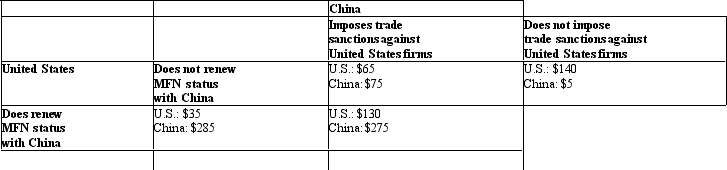 Refer to Exhibit 15-3.Assume that trade negotiators meet to discuss trade policy between the United States and China.If neither party to the negotiation is able to trust the other party,then:
 (Multiple Choice)
4.8/5  (72)
(72) In which market structure is there the greatest degree of mutual dependence between firm in choosing their price and output policies?
(Multiple Choice)
4.9/5 (88)
(88) Which of the following statements characterize an oligopoly market?
(Multiple Choice)
4.8/5 (72)
(72) The maximum possible profit that could be earned by a cartel is:
(Multiple Choice)
4.9/5 (85)
(85) Oligopoly is an industry with a small number of firms producing homogeneous or differentiated goods with minimal barriers to entry.
(True/False)
5.0/5 (88)
(88) A successful cartel ____ supply so that member firms earn ____ profits.
(Multiple Choice)
4.8/5 (74)
(74) Economists believe that oligopolists like American Airlines and the Kellogg Company:
(Multiple Choice)
4.8/5 (66)
(66) A consumer's demand for a product increases because other consumers own it.This is an example of:
(Multiple Choice)
4.7/5 (88)
(88) A large oligopolistic firm that unilaterally makes changes in price which competitors tend to follow is known as a:
(Multiple Choice)
4.7/5 (82)
(82) Collusive behavior guarantees economic profits in the long run for oligopolists.
(True/False)
4.7/5 (85)
(85)  Refer to Exhibit 15-6.In this situation:
Which of the following is characteristic of oligopoly firms,but not of monopolistically competitive firms?
(Multiple Choice)
4.8/5 (82)
(82) Collusion among oligopolists would generally be easiest to achieve in which of the following situations?
(Multiple Choice)
4.9/5 (71)
(71) A basic characteristic of the firms in an oligopoly market structure is that they are:
(Multiple Choice)
4.9/5 (87)
(87) Exhibit 15-4  Refer to Exhibit 15-4.Given the above prisoner's dilemma table,if Bonnie and Clyde each make self-interested decisions in a noncooperative game,how much time will each spend in jail?
 (Multiple Choice)
4.8/5 (87)
(87) 
Filters
- Essay(0)
- Multiple Choice(0)
- Short Answer(0)
- True False(0)
- Matching(0)