



 Chat with AI
Exam 15: Oligopoly and Strategic Behavior

Exam 1: The Role and Method of Economics198 Questions
Exam 2: Economics: Eight Powerful Ideas197 Questions
Exam 3: Scarcity, Trade-Offs, and Production Possibilities189 Questions
Exam 4: Demand, Supply, and Market Equilibrium240 Questions
Exam 5: Markets in Motion and Price Controls228 Questions
Exam 6: Elasticities206 Questions
Exam 7: Market Efficiency and Welfare136 Questions
Exam 8: Market Failure215 Questions
Exam 9: Public Finance and Public Choice64 Questions
Exam 10: Consumer Choice Theory149 Questions
Exam 11: The Firm: Production and Costs198 Questions
Exam 12: Firms in Perfectly Competitive Markets207 Questions
Exam 13: Monopoly and Antitrust189 Questions
Exam 14: Monopolistic Competition and Product Differentiation159 Questions
Exam 15: Oligopoly and Strategic Behavior146 Questions
Exam 16: The Markets for Labor, Capital, and Land177 Questions
Exam 17: Income, Poverty, and Health Care138 Questions
Exam 18: Introduction to Macroeconomics: Unemployment, Inflation, and Economic Fluctuations171 Questions
Exam 19: Measuring Economic Performance147 Questions
Exam 20: Economic Growth in the Global Economy127 Questions
Exam 21: Financial Markets, Saving, and Investment65 Questions
Exam 22: Aggregate Demand and Aggregate Supply163 Questions
Exam 23: The Aggregate Expenditure Model69 Questions
Exam 25: Monetary Institutions182 Questions
Exam 26: The Federal Reserve System and Monetary Policy147 Questions
Exam 27: Issues in Macroeconomic Theory and Policy130 Questions
Exam 28: International Trade182 Questions
Exam 29: International Finance138 Questions
Select questions type


Exhibit 15-2 Two cigarette manufacturers (Firm A and Firm B)are faced with lawsuits from states to recover the health care-related expenses associated with cigarette smoking.Both cigarette firms have evidence that indicates that cigarette smoke causes lung cancer (and other related illnesses).State prosecutors do not have access to the same data used by the cigarette manufacturers,and thus will have difficulty recovering full costs without the help of at least one tobacco firm's evidence.Each firm has been presented with an opportunity to lower their liability in the suit if they cooperate with attorneys representing the states.
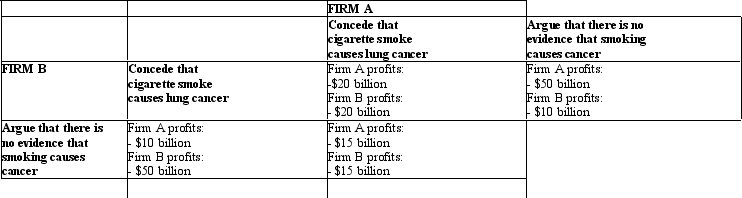 Refer to Exhibit 15-2.If both firms follow a dominant strategy,Firm B's profits (losses)will be:
 (Multiple Choice)
4.8/5  (77)
(77) In which market structure is there clear interdependence between individual firms with regard to prices and sales?
(Multiple Choice)
4.8/5 (86)
(86) Which is the following is true of games,in interactions between oligopolists?
(Multiple Choice)
5.0/5 (80)
(80) When the prisoners follow their dominant strategy and confess,they will be worse off than if both had remained silent-hence,the "prisoners' dilemma."
(True/False)
4.9/5 (84)
(84) The tools of "game theory" are most helpful to economists in markets characterized by:
(Multiple Choice)
5.0/5 (83)
(83) Which of the following is a unique characteristic of the oligopolistic market structure?
(Multiple Choice)
4.8/5 (81)
(81) In a typical cartel agreement,the cartel maximizes profit when it:
(Multiple Choice)
4.8/5 (63)
(63) Which of the following is true for a typical firm in a typical cartel?
(Multiple Choice)
4.9/5 (75)
(75) The key characteristic of oligopoly markets is "interdependence among firms." This means that:
(Multiple Choice)
4.9/5 (82)
(82) A cartel is a group of firms that attempt to collude by coordinating price and output decisions.
(True/False)
4.8/5 (80)
(80) The demand curve faced by an oligopolistic producer depends on how rival firms react to its prices and policies.
(True/False)
4.9/5 (80)
(80) Firms in oligopoly often behave like the prisoners in the prisoners' dilemma,carefully
anticipating the moves of their rivals in an uncertain environment.
(True/False)
5.0/5 (76)
(76) The primary difference between cooperative and noncooperative games is the ability to form contracts.
(True/False)
4.8/5 (74)
(74) 
Filters
- Essay(0)
- Multiple Choice(0)
- Short Answer(0)
- True False(0)
- Matching(0)