



 Chat with AI
Exam 11: The Firm: Production and Costs

Exam 1: The Role and Method of Economics198 Questions
Exam 2: Economics: Eight Powerful Ideas197 Questions
Exam 3: Scarcity, Trade-Offs, and Production Possibilities189 Questions
Exam 4: Demand, Supply, and Market Equilibrium240 Questions
Exam 5: Markets in Motion and Price Controls228 Questions
Exam 6: Elasticities206 Questions
Exam 7: Market Efficiency and Welfare136 Questions
Exam 8: Market Failure215 Questions
Exam 9: Public Finance and Public Choice64 Questions
Exam 10: Consumer Choice Theory149 Questions
Exam 11: The Firm: Production and Costs198 Questions
Exam 12: Firms in Perfectly Competitive Markets207 Questions
Exam 13: Monopoly and Antitrust189 Questions
Exam 14: Monopolistic Competition and Product Differentiation159 Questions
Exam 15: Oligopoly and Strategic Behavior146 Questions
Exam 16: The Markets for Labor, Capital, and Land177 Questions
Exam 17: Income, Poverty, and Health Care138 Questions
Exam 18: Introduction to Macroeconomics: Unemployment, Inflation, and Economic Fluctuations171 Questions
Exam 19: Measuring Economic Performance147 Questions
Exam 20: Economic Growth in the Global Economy127 Questions
Exam 21: Financial Markets, Saving, and Investment65 Questions
Exam 22: Aggregate Demand and Aggregate Supply163 Questions
Exam 23: The Aggregate Expenditure Model69 Questions
Exam 25: Monetary Institutions182 Questions
Exam 26: The Federal Reserve System and Monetary Policy147 Questions
Exam 27: Issues in Macroeconomic Theory and Policy130 Questions
Exam 28: International Trade182 Questions
Exam 29: International Finance138 Questions
Select questions type


A firm's total product of labor curve is represented by the following data: 1 worker can produce 4 units of output; 2 workers,10 units; 3 workers,17 units; 4 workers,25 units; 5 workers,30 units; 6 workers,35 units; 7 workers,38 units; 8 workers,39 units; and 9 workers,38 units.What is the marginal product of the seventh worker? When does the law of diminishing marginal product set in? Under these circumstances would you ever choose to employ nine workers?
(Essay)
4.9/5  (75)
(75) The range in which there is diminishing marginal productivity starts at the point where:
(Multiple Choice)
5.0/5 (77)
(77) Which of the following cost curves is not generally U-shaped?
(Multiple Choice)
4.8/5 (77)
(77) Ray Tucker has run his company,Tucker's Towing and Wrecking,for two years and has made an accounting profit of $34,000 each year.As long as Tucker's Towing continues to make accounting profits,it is rational to remain in the towing business.
(True/False)
4.9/5 (81)
(81) When marginal cost is increasing,average total cost must be increasing.
(True/False)
4.9/5 (92)
(92) Which of the following is consistent with diminishing marginal product?
(Multiple Choice)
4.8/5 (87)
(87) 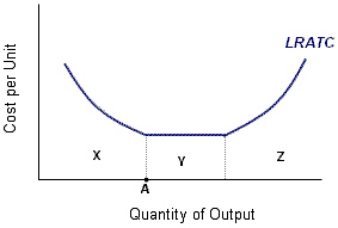 Refer to Exhibit 11-11.Point A refers to:
The change in total cost resulting from a one-unit increase in production is called:
(Multiple Choice)
4.9/5 (81)
(81) A firm replaces a machine by hiring 3 hourly production workers instead.
(Multiple Choice)
4.9/5 (81)
(81) Exhibit 11-10 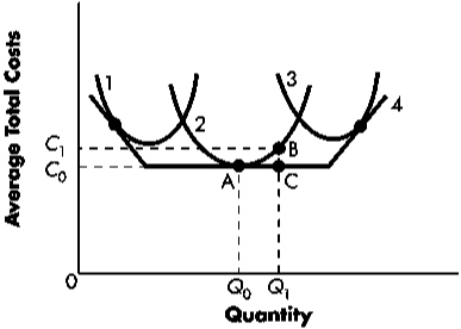 Refer to Exhibit 11-10.How long does it take a firm to get to the long run?
 (Multiple Choice)
4.8/5 (87)
(87) If Randy's fixed cost totals $800 with variable cost per unit of $10 at a quantity of 100 units,what would his average total cost equal?
(Multiple Choice)
4.9/5 (80)
(80) If average total cost equals $15 at 20 units of output and average total cost equals $15 at 21 units of output,then the marginal cost of the 21st unit is ____.
(Multiple Choice)
4.9/5 (78)
(78) Which of the following must be true if the short-run average total cost curve is declining?
(Multiple Choice)
4.9/5 (61)
(61) 
Filters
- Essay(0)
- Multiple Choice(0)
- Short Answer(0)
- True False(0)
- Matching(0)