



 Chat with AI
Exam 10: Consumer Choice Theory

Exam 1: The Role and Method of Economics198 Questions
Exam 2: Economics: Eight Powerful Ideas197 Questions
Exam 3: Scarcity, Trade-Offs, and Production Possibilities189 Questions
Exam 4: Demand, Supply, and Market Equilibrium240 Questions
Exam 5: Markets in Motion and Price Controls228 Questions
Exam 6: Elasticities206 Questions
Exam 7: Market Efficiency and Welfare136 Questions
Exam 8: Market Failure215 Questions
Exam 9: Public Finance and Public Choice64 Questions
Exam 10: Consumer Choice Theory149 Questions
Exam 11: The Firm: Production and Costs198 Questions
Exam 12: Firms in Perfectly Competitive Markets207 Questions
Exam 13: Monopoly and Antitrust189 Questions
Exam 14: Monopolistic Competition and Product Differentiation159 Questions
Exam 15: Oligopoly and Strategic Behavior146 Questions
Exam 16: The Markets for Labor, Capital, and Land177 Questions
Exam 17: Income, Poverty, and Health Care138 Questions
Exam 18: Introduction to Macroeconomics: Unemployment, Inflation, and Economic Fluctuations171 Questions
Exam 19: Measuring Economic Performance147 Questions
Exam 20: Economic Growth in the Global Economy127 Questions
Exam 21: Financial Markets, Saving, and Investment65 Questions
Exam 22: Aggregate Demand and Aggregate Supply163 Questions
Exam 23: The Aggregate Expenditure Model69 Questions
Exam 25: Monetary Institutions182 Questions
Exam 26: The Federal Reserve System and Monetary Policy147 Questions
Exam 27: Issues in Macroeconomic Theory and Policy130 Questions
Exam 28: International Trade182 Questions
Exam 29: International Finance138 Questions
Select questions type


If housing prices have increased for the past 20 years,it is almost certain that prices will increase the following year.
(True/False)
4.9/5  (80)
(80) If the marginal benefit Isaac derives from the consumption of another candy bar is greater than the price of the candy bar,then:
(Multiple Choice)
4.8/5 (85)
(85) Behavioral economists use findings from psychology to explain complex consumer behavior that cannot always be explained by traditional economic models.
(True/False)
4.9/5 (96)
(96) Which of the following violates the law of diminishing marginal utility?
(Multiple Choice)
4.9/5 (75)
(75) If two commodities are perfect complements,the indifference curve is a straight line.
(True/False)
4.8/5 (85)
(85) Rebecca consumes both iced tea and coffee.Iced tea is priced at $1.50 per bottle and coffee at $2.00 per 16-ounce cup.Which of the following marginal utility pairs is consistent with Rebecca's consumer equilibrium at these prices?
(Multiple Choice)
4.7/5 (79)
(79) The total utility from consuming five muffins is 14,24,35,43,and 50 utils,respectively.Marginal utility begins to diminish after consuming the first muffin.
(True/False)
4.7/5 (83)
(83) Exhibit 10-3 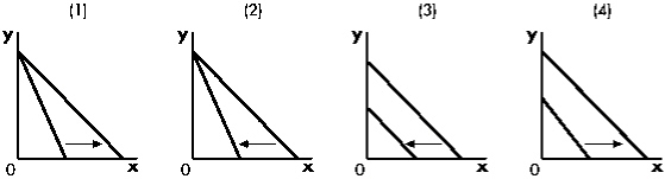 Refer to Exhibit 10-3.Which budget line depicts a decrease in income?
 (Multiple Choice)
4.7/5 (91)
(91) Popeye receives a marginal utility of 12 utils for the last can of spinach consumed.If the price of a can of spinach is 50 cents per can,then the marginal utility per dollar spent on the last can of spinach is equal to:
(Multiple Choice)
4.9/5 (86)
(86) If a consumer is maximizing utility and then the price of Good A increases:
(Multiple Choice)
4.8/5 (94)
(94) As long as a person had to pay a positive price for a good,he would never consume to the point where his total utility was falling with additional consumption.
(True/False)
4.8/5 (73)
(73) Traditional economists base their models of human behavior on simplifying assumptions regarding rationality and decision making.
(True/False)
4.8/5 (79)
(79) A consumer's budget line will shift to the left in a parallel manner if:
(Multiple Choice)
4.7/5 (77)
(77) The total utility from consuming five cups of coffee is 15,27,37,46,and 54 utils,respectively.The marginal utility of the fourth cup of coffee is:
(Multiple Choice)
4.7/5 (78)
(78) 
Filters
- Essay(0)
- Multiple Choice(0)
- Short Answer(0)
- True False(0)
- Matching(0)