



 Chat with AI
Exam 10: Consumer Choice Theory

Exam 1: The Role and Method of Economics198 Questions
Exam 2: Economics: Eight Powerful Ideas197 Questions
Exam 3: Scarcity, Trade-Offs, and Production Possibilities189 Questions
Exam 4: Demand, Supply, and Market Equilibrium240 Questions
Exam 5: Markets in Motion and Price Controls228 Questions
Exam 6: Elasticities206 Questions
Exam 7: Market Efficiency and Welfare136 Questions
Exam 8: Market Failure215 Questions
Exam 9: Public Finance and Public Choice64 Questions
Exam 10: Consumer Choice Theory149 Questions
Exam 11: The Firm: Production and Costs198 Questions
Exam 12: Firms in Perfectly Competitive Markets207 Questions
Exam 13: Monopoly and Antitrust189 Questions
Exam 14: Monopolistic Competition and Product Differentiation159 Questions
Exam 15: Oligopoly and Strategic Behavior146 Questions
Exam 16: The Markets for Labor, Capital, and Land177 Questions
Exam 17: Income, Poverty, and Health Care138 Questions
Exam 18: Introduction to Macroeconomics: Unemployment, Inflation, and Economic Fluctuations171 Questions
Exam 19: Measuring Economic Performance147 Questions
Exam 20: Economic Growth in the Global Economy127 Questions
Exam 21: Financial Markets, Saving, and Investment65 Questions
Exam 22: Aggregate Demand and Aggregate Supply163 Questions
Exam 23: The Aggregate Expenditure Model69 Questions
Exam 25: Monetary Institutions182 Questions
Exam 26: The Federal Reserve System and Monetary Policy147 Questions
Exam 27: Issues in Macroeconomic Theory and Policy130 Questions
Exam 28: International Trade182 Questions
Exam 29: International Finance138 Questions
Select questions type


Exhibit 10-4 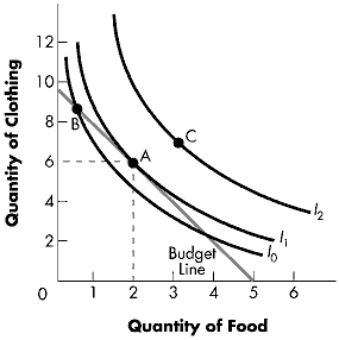 Refer to Exhibit 10-4.Which points are attainable?
 (Multiple Choice)
4.9/5  (90)
(90) Exhibit 10-1 A consumer is faced with choosing between hamburgers and milkshakes that are priced at $2 and $1,respectively.The marginal utility derived from each of the two goods is as follows:
 Refer to Exhibit 10-1.How many hamburgers and milkshakes will be consumed if the consumer maximizes his utility subject to $14 of income each week?
 (Multiple Choice)
4.8/5 (80)
(80) The line joining the old and new optimum points following a pivotal rotation of the budget line is:
(Multiple Choice)
4.9/5 (78)
(78) The price of shrimp is $10.00 per pound and the price of lobster is $15.00 per pound.The marginal utility to Mike of pound of shrimp consumed is 60 utils.If Mike maximizes his satisfaction by consuming both shrimp and lobster,we would expect the marginal utility of the last pound of lobster consumed to equal:
(Multiple Choice)
4.8/5 (86)
(86) The total utility from consuming five donuts is 9,19,30,38,and 45 utils,respectively.Marginal utility begins to diminish after consuming the ____ donut.
(Multiple Choice)
4.8/5 (75)
(75) Suppose Carrie's utility function for clams is as follows: If she consumes 1 clam,she gets 10 units of total utility; for 2 clams,she gets 18 units of total utility; for 3 clams,she gets 24 units of total utility; for 4 clams,she gets 28 units of total utility; for 5 clams,she gets 30 units of total utility; and for 6 clams,she gets 26 units of total utility.
(Multiple Choice)
4.9/5 (85)
(85) Betty spends all her income on wine and brie.Currently she gets 30 utils from the last bottle of wine and 15 utils from the last package of brie.The price of wine is $6 per bottle and the price of brie is $4 per package.
(Multiple Choice)
4.9/5 (77)
(77) The term used to describe a more realistic conception of human problem-solving that assumes less than perfect analysis is:
(Multiple Choice)
5.0/5 (74)
(74) Diminishing marginal utility is best illustrated by which of the following statements?
(Multiple Choice)
4.9/5 (92)
(92) If Tom purchases and consumes an entire Pizza,which of the following is likely to be true?
(Multiple Choice)
4.8/5 (88)
(88) Jason buys only music downloads and food with his weekly income.In response to a decrease in the price of downloads,he buys more downloads and less food.As a result,we would expect:
(Multiple Choice)
4.8/5 (83)
(83) A consumer's budget line will shift to the right in a parallel manner if:
(Multiple Choice)
4.9/5 (80)
(80) Exhibit 10-1 A consumer is faced with choosing between hamburgers and milkshakes that are priced at $2 and $1,respectively.The marginal utility derived from each of the two goods is as follows:
 Refer to Exhibit 10-1.How many hamburgers and milkshakes will be consumed each if the consumer maximizes his utility subject to $11 of income each week?
 (Multiple Choice)
4.8/5 (69)
(69) The budget line is downward sloping,reflecting the fact that you must give up some of one good to get more of the other.
(True/False)
4.9/5 (79)
(79) Exhibit 10-4 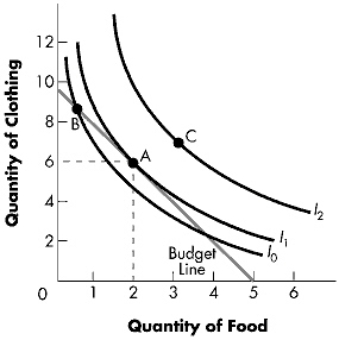 Refer to Exhibit 10-4.Which point represents consumer equilibrium?
 (Multiple Choice)
4.9/5 (82)
(82) In consumer equilibrium,the marginal utility of good A,B and C are 100,300,and 400 respectively.If the price of good A was $35,then the prices of goods B and C,respectively,are:
(Multiple Choice)
4.9/5 (89)
(89) 
Filters
- Essay(0)
- Multiple Choice(0)
- Short Answer(0)
- True False(0)
- Matching(0)