



 Chat with AI
Exam 4: Demand, Supply, and Market Equilibrium

Exam 1: The Role and Method of Economics198 Questions
Exam 2: Economics: Eight Powerful Ideas197 Questions
Exam 3: Scarcity, Trade-Offs, and Production Possibilities189 Questions
Exam 4: Demand, Supply, and Market Equilibrium240 Questions
Exam 5: Markets in Motion and Price Controls228 Questions
Exam 6: Elasticities206 Questions
Exam 7: Market Efficiency and Welfare136 Questions
Exam 8: Market Failure215 Questions
Exam 9: Public Finance and Public Choice64 Questions
Exam 10: Consumer Choice Theory149 Questions
Exam 11: The Firm: Production and Costs198 Questions
Exam 12: Firms in Perfectly Competitive Markets207 Questions
Exam 13: Monopoly and Antitrust189 Questions
Exam 14: Monopolistic Competition and Product Differentiation159 Questions
Exam 15: Oligopoly and Strategic Behavior146 Questions
Exam 16: The Markets for Labor, Capital, and Land177 Questions
Exam 17: Income, Poverty, and Health Care138 Questions
Exam 18: Introduction to Macroeconomics: Unemployment, Inflation, and Economic Fluctuations171 Questions
Exam 19: Measuring Economic Performance147 Questions
Exam 20: Economic Growth in the Global Economy127 Questions
Exam 21: Financial Markets, Saving, and Investment65 Questions
Exam 22: Aggregate Demand and Aggregate Supply163 Questions
Exam 23: The Aggregate Expenditure Model69 Questions
Exam 25: Monetary Institutions182 Questions
Exam 26: The Federal Reserve System and Monetary Policy147 Questions
Exam 27: Issues in Macroeconomic Theory and Policy130 Questions
Exam 28: International Trade182 Questions
Exam 29: International Finance138 Questions
Select questions type


Which of the following would lead to a decrease in the supply of watches?
(Multiple Choice)
4.9/5  (85)
(85) Exhibit 4-1  Refer to Exhibit 4-1.At $4 the quantity demanded in the market would be:
 (Multiple Choice)
4.9/5 (82)
(82) Technological advances in recycling make it possible to produce a greater quantity of paper from a given quantity of recycled newspapers.Predict the likely impact on the supply curve for paper.
(Multiple Choice)
4.8/5 (81)
(81) The quantity of a good demanded tends to increase as its price falls because:
(Multiple Choice)
4.8/5 (91)
(91) If consumers are less willing and able to pay for each level of output than they were previously,then apparently:
(Multiple Choice)
5.0/5 (80)
(80) Increasing government taxation or regulation of an industry generally increases the supply of goods.
(True/False)
4.8/5 (85)
(85) Exhibit 4-7 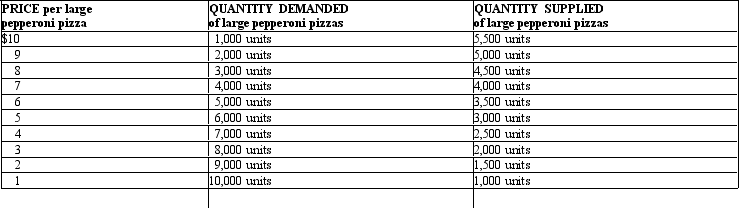 Refer to Exhibit 4-7.What is the equilibrium price in the example?
 (Multiple Choice)
4.9/5 (83)
(83) When the price of automobile insurance increases sharply,the likely impact on the market for automobiles is:
(Multiple Choice)
4.9/5 (79)
(79) The price of automobiles has increased sharply lately.As a result,automobile dealers have noticed that:
(Multiple Choice)
4.8/5 (83)
(83) When the price of a good is lower than the equilibrium price,
(Multiple Choice)
4.9/5 (71)
(71) Exhibit 4-5 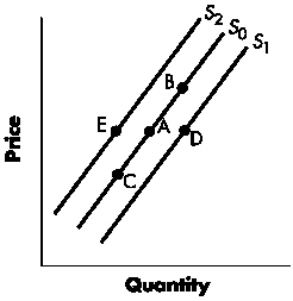 Refer to Exhibit 4-5.A change from Point A to Point E represents a(n):
 (Multiple Choice)
4.8/5 (94)
(94) Exhibit 4-7 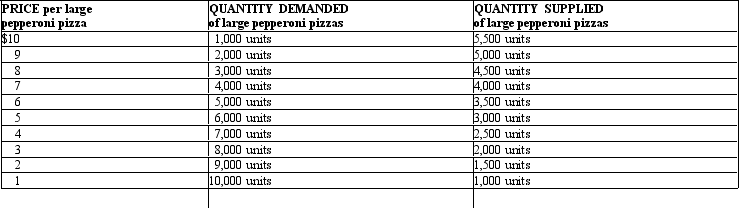 Refer to Exhibit 4-7.At a price of $4,there is a ____ of ____ pizzas
 (Multiple Choice)
4.9/5 (90)
(90) Which of the following would most likely cause a decrease in the current demand for a normal good?
(Multiple Choice)
4.9/5 (84)
(84) Which of the following would increase the quantity of LCD TVs demanded but would not increase the demand for LCD TVs?
(Multiple Choice)
4.8/5 (85)
(85) "Other things equal,when the price of a good rises,the quantity demanded of the good falls,and when the price falls,the quantity demanded rises." This relationship between price and quantity demanded is referred to as
(Multiple Choice)
4.8/5 (78)
(78) The current price of wheat is $10 per bushel,but the equilibrium price of wheat is $5 per bushel.As a result,
(Multiple Choice)
4.9/5 (84)
(84) Explain how both sales and long lines prior to store openings are characteristic of markets in disequilibrium.
(Essay)
4.8/5 (76)
(76) 
Filters
- Essay(0)
- Multiple Choice(0)
- Short Answer(0)
- True False(0)
- Matching(0)