



 Chat with AI
Exam 4: Demand, Supply, and Market Equilibrium

Exam 1: The Role and Method of Economics198 Questions
Exam 2: Economics: Eight Powerful Ideas197 Questions
Exam 3: Scarcity, Trade-Offs, and Production Possibilities189 Questions
Exam 4: Demand, Supply, and Market Equilibrium240 Questions
Exam 5: Markets in Motion and Price Controls228 Questions
Exam 6: Elasticities206 Questions
Exam 7: Market Efficiency and Welfare136 Questions
Exam 8: Market Failure215 Questions
Exam 9: Public Finance and Public Choice64 Questions
Exam 10: Consumer Choice Theory149 Questions
Exam 11: The Firm: Production and Costs198 Questions
Exam 12: Firms in Perfectly Competitive Markets207 Questions
Exam 13: Monopoly and Antitrust189 Questions
Exam 14: Monopolistic Competition and Product Differentiation159 Questions
Exam 15: Oligopoly and Strategic Behavior146 Questions
Exam 16: The Markets for Labor, Capital, and Land177 Questions
Exam 17: Income, Poverty, and Health Care138 Questions
Exam 18: Introduction to Macroeconomics: Unemployment, Inflation, and Economic Fluctuations171 Questions
Exam 19: Measuring Economic Performance147 Questions
Exam 20: Economic Growth in the Global Economy127 Questions
Exam 21: Financial Markets, Saving, and Investment65 Questions
Exam 22: Aggregate Demand and Aggregate Supply163 Questions
Exam 23: The Aggregate Expenditure Model69 Questions
Exam 25: Monetary Institutions182 Questions
Exam 26: The Federal Reserve System and Monetary Policy147 Questions
Exam 27: Issues in Macroeconomic Theory and Policy130 Questions
Exam 28: International Trade182 Questions
Exam 29: International Finance138 Questions
Select questions type


Exhibit 4-9 The diagram below represents the market for butter. 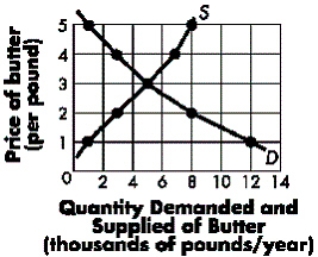 Refer to Exhibit 4-9.If the current price of butter equals $2,you would expect to find:
 (Multiple Choice)
4.8/5  (76)
(76) When there is an excess quantity demanded of a product at the current price,then:
(Multiple Choice)
4.9/5 (75)
(75) According to the substitution effect,an increase in the price of oranges will:
(Multiple Choice)
4.9/5 (81)
(81) If the price of tennis rackets were to increase,we would expect:
(Multiple Choice)
4.8/5 (74)
(74) At the equilibrium price,the quantity of the good that buyers are willing and able to buy
(Multiple Choice)
4.7/5 (81)
(81) If watermelons are normal goods,the demand for them will rise as the income of consumers rises.
(True/False)
5.0/5 (76)
(76) According to the law of supply,when the price of a good increases we would predict that:
(Multiple Choice)
4.8/5 (87)
(87) Which of the following events would cause an upward movement along the demand curve for olives?
(Multiple Choice)
4.7/5 (86)
(86) When the price of corn falls,the market supply of wheat (which can be grown using the same land)is likely to increase.
(True/False)
4.8/5 (70)
(70) If the price of Good A increases and the demand for Good B increases as well,Goods A and B are most likely complements.
(True/False)
4.8/5 (80)
(80) Which of these statements best represents the law of demand?
(Multiple Choice)
4.9/5 (87)
(87) Which of the following relationships reflect the law of supply?
(Multiple Choice)
4.9/5 (85)
(85) If input prices fall,it will lower the cost of production,causing the supply curve to shift to the right.
(True/False)
4.8/5 (90)
(90) Andy views beer and pizza as complements to one another.If the price of pizza decreases,economists would expect:
(Multiple Choice)
4.9/5 (79)
(79) If an increase in the price of Good X causes a decrease in the demand for Good Y,we can conclude that:
(Multiple Choice)
4.9/5 (85)
(85) 
Filters
- Essay(0)
- Multiple Choice(0)
- Short Answer(0)
- True False(0)
- Matching(0)