



 Chat with AI
Exam 5: Risk, Return, and the Historical Record

Exam 1: The Investment Environment58 Questions
Exam 2: Asset Classes and Financial Instruments86 Questions
Exam 3: How Securities Are Traded69 Questions
Exam 4: Mutual Funds and Other Investment Companies72 Questions
Exam 5: Risk, Return, and the Historical Record85 Questions
Exam 6: Capital Allocation to Risky Assets70 Questions
Exam 7: Optimal Risky Portfolios80 Questions
Exam 8: Index Models87 Questions
Exam 9: The Capital Asset Pricing Model83 Questions
Exam 10: Arbitrage Pricing Theory and Multifactor Models of Risk and Return80 Questions
Exam 11: The Efficient Market Hypothesis71 Questions
Exam 12: Behavioral Finance and Technical Analysis54 Questions
Exam 13: Empirical Evidence on Security Returns56 Questions
Exam 14: Bond Prices and Yields129 Questions
Exam 15: The Term Structure of Interest Rates49 Questions
Exam 16: Managing Bond Portfolios84 Questions
Exam 17: Macroeconomic and Industry Analysis90 Questions
Exam 18: Equity Valuation Models130 Questions
Exam 19: Financial Statement Analysis91 Questions
Exam 20: Options Markets: Introduction108 Questions
Exam 21: Option Valuation90 Questions
Exam 22: Futures Markets91 Questions
Exam 23: Futures, Swaps, and Risk Management56 Questions
Exam 24: Portfolio Performance Evaluation83 Questions
Exam 25: International Diversification52 Questions
Exam 26: Hedge Funds49 Questions
Exam 27: The Theory of Active Portfolio Management50 Questions
Exam 28: Investment Policy and the Framework of the Cfa Institute83 Questions
Select questions type


A year ago, you invested $10,000 in a savings account that pays an annual interest rate of 5%.What is your approximate annual real rate of return if the rate of inflation was 3.5% over the year
(Multiple Choice)
4.8/5  (67)
(67) Discuss some reasons why an investor with a longtime horizon might choose to invest in common stocks, even though they have historically been riskier than government bonds or T-bills.
(Essay)
4.8/5 (79)
(79) Over the past year you earned a nominal rate of interest of 10% on your money.The inflation rate was 5% over the same period.The exact actual growth rate of your purchasing power was
(Multiple Choice)
4.7/5 (85)
(85) When assessing tail risk by looking at the 5% worst-case scenario, the VaR is the
(Multiple Choice)
4.8/5 (79)
(79) If the annual real rate of interest is 3.5% and the expected inflation rate is 3.5%, the nominal rate of interest would be approximately
(Multiple Choice)
4.9/5 (93)
(93) You purchase a share of CAT stock for $90.One year later, after receiving a dividend of $4, you sell the stock for $97.What was your holding-period return
(Multiple Choice)
4.8/5 (81)
(81) ________ is a risk measure that indicates vulnerability to extreme negative returns.
(Multiple Choice)
4.8/5 (79)
(79) A year ago, you invested $1,000 in a savings account that pays an annual interest rate of 9%.What is your approximate annual real rate of return if the rate of inflation was 4% over the year
(Multiple Choice)
4.9/5 (70)
(70) If the interest rate paid by borrowers and the interest rate received by savers accurately reflect the realized rate of inflation,
(Multiple Choice)
4.9/5 (89)
(89) When assessing tail risk by looking at the 5% worst-case scenario, the most realistic view of downside exposure would be
(Multiple Choice)
5.0/5 (86)
(86) You have been given this probability distribution for the holding-period return for GM stock: 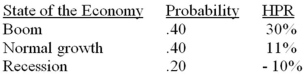 What is the expected holding-period return for GM stock
 (Multiple Choice)
4.9/5 (76)
(76) Which of the following factors would not be expected to affect the nominal interest rate
(Multiple Choice)
4.8/5 (74)
(74) If a portfolio had a return of 12%, the risk-free asset return was 4%, and the standard deviation of the portfolio's excess returns was 25%, the Sharpe measure would be
(Multiple Choice)
4.8/5 (89)
(89) Practitioners often use a ________% VaR, meaning that ________% of returns will exceed the VaR, and ________% will be worse.
(Multiple Choice)
4.8/5 (80)
(80) If an investment provides a 0.78% return monthly, its effective annual rate is
(Multiple Choice)
4.7/5 (72)
(72) Over the past year you earned a nominal rate of interest of 3.6% on your money.The inflation rate was 3.1% over the same period.The exact actual growth rate of your purchasing power was
(Multiple Choice)
4.8/5 (77)
(77) An investment provides a 2% return semi-annually, its effective annual rate is
(Multiple Choice)
4.9/5 (68)
(68) 
Filters
- Essay(0)
- Multiple Choice(0)
- Short Answer(0)
- True False(0)
- Matching(0)