



 Chat with AI
Exam 7: Optimal Risky Portfolios

Exam 1: The Investment Environment58 Questions
Exam 2: Asset Classes and Financial Instruments86 Questions
Exam 3: How Securities Are Traded69 Questions
Exam 4: Mutual Funds and Other Investment Companies72 Questions
Exam 5: Risk, Return, and the Historical Record85 Questions
Exam 6: Capital Allocation to Risky Assets70 Questions
Exam 7: Optimal Risky Portfolios80 Questions
Exam 8: Index Models87 Questions
Exam 9: The Capital Asset Pricing Model83 Questions
Exam 10: Arbitrage Pricing Theory and Multifactor Models of Risk and Return80 Questions
Exam 11: The Efficient Market Hypothesis71 Questions
Exam 12: Behavioral Finance and Technical Analysis54 Questions
Exam 13: Empirical Evidence on Security Returns56 Questions
Exam 14: Bond Prices and Yields129 Questions
Exam 15: The Term Structure of Interest Rates49 Questions
Exam 16: Managing Bond Portfolios84 Questions
Exam 17: Macroeconomic and Industry Analysis90 Questions
Exam 18: Equity Valuation Models130 Questions
Exam 19: Financial Statement Analysis91 Questions
Exam 20: Options Markets: Introduction108 Questions
Exam 21: Option Valuation90 Questions
Exam 22: Futures Markets91 Questions
Exam 23: Futures, Swaps, and Risk Management56 Questions
Exam 24: Portfolio Performance Evaluation83 Questions
Exam 25: International Diversification52 Questions
Exam 26: Hedge Funds49 Questions
Exam 27: The Theory of Active Portfolio Management50 Questions
Exam 28: Investment Policy and the Framework of the Cfa Institute83 Questions
Select questions type


Which of the following statement(s) is(are) false regarding the variance of a portfolio of two risky securities
I. The higher the coefficient of correlation between securities, the greater the reduction in the portfolio variance.
II. There is a linear relationship between the securities' coefficient of correlation and the portfolio variance.
III. The degree to which the portfolio variance is reduced depends on the degree of correlation between securities.
(Multiple Choice)
4.7/5  (76)
(76) When borrowing and lending at a risk-free rate are allowed, which capital allocation line (CAL) should the investor choose to combine with the efficient frontier
I. The one with the highest reward-to-variability ratio.
II. The one that will maximize his utility.
III. The one with the steepest slope.
IV. The one with the lowest slope.
(Multiple Choice)
4.8/5 (92)
(92) Consider the following probability distribution for stocks C and D: 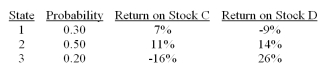 The expected rates of return of stocks C and D are _____ and _____, respectively.
 (Multiple Choice)
4.7/5 (71)
(71) Which of the following statement(s) is(are) false regarding the selection of a portfolio from those that lie on the capital allocation line
I. Less risk-averse investors will invest more in the risk-free security and less in the optimal risky portfolio than more risk-averse investors.
II. More risk-averse investors will invest less in the optimal risky portfolio and more in the risk-free security than less risk-averse investors.
III. Investors choose the portfolio that maximizes their expected utility.
(Multiple Choice)
4.9/5 (70)
(70) Consider the following probability distribution for stocks A and B: 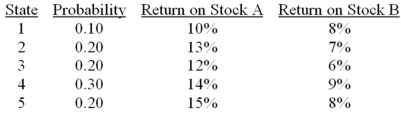 If you invest 40% of your money in A and 60% in B, what would be your portfolio's expected rate of return and standard deviation
 (Multiple Choice)
4.7/5 (86)
(86) In a two-security minimum variance portfolio where the correlation between securities is greater than -1.0
(Multiple Choice)
4.7/5 (71)
(71) Portfolio theory as described by Markowitz is most concerned with:
(Multiple Choice)
4.8/5 (82)
(82) Efficient portfolios of N risky securities are portfolios that
(Multiple Choice)
4.9/5 (95)
(95) A statistic that measures how the returns of two risky assets move together is:
(Multiple Choice)
4.8/5 (85)
(85) Security X has expected return of 14% and standard deviation of 22%.Security Y has expected return of 16% and standard deviation of 28%.If the two securities have a correlation coefficient of 0.8, what is their covariance
(Multiple Choice)
4.8/5 (74)
(74) Given an optimal risky portfolio with expected return of 6% and standard deviation of 23% and a risk free rate of 3%, what is the slope of the best feasible CAL
(Multiple Choice)
5.0/5 (75)
(75) Which of the following statement(s) is(are) true regarding the selection of a portfolio from those that lie on the capital allocation line
I. Less risk-averse investors will invest more in the risk-free security and less in the optimal risky portfolio than more risk-averse investors.
II. More risk-averse investors will invest less in the optimal risky portfolio and more in the risk-free security than less risk-averse investors.
III. Investors choose the portfolio that maximizes their expected utility.
(Multiple Choice)
5.0/5 (74)
(74) Consider two perfectly negatively correlated risky securities A and B.A has an expected rate of return of 12% and a standard deviation of 17%.B has an expected rate of return of 9% and a standard deviation of 14%. The weights of A and B in the global minimum variance portfolio are _____ and _____, respectively.
(Multiple Choice)
4.8/5 (83)
(83) Consider the following probability distribution for stocks A and B: 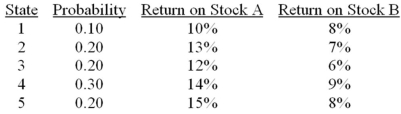 Let G be the global minimum variance portfolio.The weights of A and B in G are __________ and __________, respectively.
 (Multiple Choice)
4.9/5 (81)
(81) The global minimum variance portfolio formed from two risky securities will be riskless when the correlation coefficient between the two securities is
(Multiple Choice)
4.9/5 (75)
(75) Security M has expected return of 17% and standard deviation of 32%.Security S has expected return of 13% and standard deviation of 19%.If the two securities have a correlation coefficient of 0.78, what is their covariance
(Multiple Choice)
4.9/5 (71)
(71) 
Filters
- Essay(0)
- Multiple Choice(0)
- Short Answer(0)
- True False(0)
- Matching(0)