



 Chat with AI
Exam 14: Bond Prices and Yields

Exam 1: The Investment Environment58 Questions
Exam 2: Asset Classes and Financial Instruments86 Questions
Exam 3: How Securities Are Traded69 Questions
Exam 4: Mutual Funds and Other Investment Companies72 Questions
Exam 5: Risk, Return, and the Historical Record85 Questions
Exam 6: Capital Allocation to Risky Assets70 Questions
Exam 7: Optimal Risky Portfolios80 Questions
Exam 8: Index Models87 Questions
Exam 9: The Capital Asset Pricing Model83 Questions
Exam 10: Arbitrage Pricing Theory and Multifactor Models of Risk and Return80 Questions
Exam 11: The Efficient Market Hypothesis71 Questions
Exam 12: Behavioral Finance and Technical Analysis54 Questions
Exam 13: Empirical Evidence on Security Returns56 Questions
Exam 14: Bond Prices and Yields129 Questions
Exam 15: The Term Structure of Interest Rates49 Questions
Exam 16: Managing Bond Portfolios84 Questions
Exam 17: Macroeconomic and Industry Analysis90 Questions
Exam 18: Equity Valuation Models130 Questions
Exam 19: Financial Statement Analysis91 Questions
Exam 20: Options Markets: Introduction108 Questions
Exam 21: Option Valuation90 Questions
Exam 22: Futures Markets91 Questions
Exam 23: Futures, Swaps, and Risk Management56 Questions
Exam 24: Portfolio Performance Evaluation83 Questions
Exam 25: International Diversification52 Questions
Exam 26: Hedge Funds49 Questions
Exam 27: The Theory of Active Portfolio Management50 Questions
Exam 28: Investment Policy and the Framework of the Cfa Institute83 Questions
Select questions type


Which one of the following statements about convertibles is false
I. The longer the call protection on a convertible, the less the security is worth.
II. The more volatile the underlying stock, the greater the value of the conversion feature.
III. The smaller the spread between the dividend yield on the stock and the yield-to-maturity on the bond, the more the convertible is worth.
IV. The collateral that is used to secure a convertible bond is one reason convertibles are more attractive than the underlying stock.
(Multiple Choice)
4.9/5  (75)
(75) If a 7.5% coupon bond is trading for $1,050.00, it has a current yield of
(Multiple Choice)
4.8/5 (70)
(70) Altman's Z scores are assigned based on a firm's financial characteristics and are used to predict
(Multiple Choice)
4.9/5 (73)
(73) A coupon bond that pays interest of $90 annually has a par value of $1,000, matures in nine years, and is selling today at a $66 discount from par value.The yield to maturity on this bond is
(Multiple Choice)
4.9/5 (81)
(81) The bonds of Ford Motor Company have received a rating of "B" by Moody's.The "B" rating indicates
(Multiple Choice)
5.0/5 (81)
(81) If a 7% coupon bond that pays interest every 182 days paid interest 32 days ago, the accrued interest would be
(Multiple Choice)
5.0/5 (88)
(88) A coupon bond that pays interest semi-annually has a par value of $1,000, matures in seven years, and has a yield to maturity of 11%.The intrinsic value of the bond today will be __________ if the coupon rate is 8.8%.
(Multiple Choice)
4.9/5 (86)
(86) A coupon bond pays annual interest, has a par value of $1,000, matures in 12 years, has a coupon rate of 8.7%, and has a yield to maturity of 7.9%.The current yield on this bond is
(Multiple Choice)
4.8/5 (85)
(85) A convertible bond has a par value of $1,000 and a current market value of $850.The current price of the issuing firm's stock is $27 and the conversion ratio is 30 shares.The bond's conversion premium is
(Multiple Choice)
4.9/5 (87)
(87) Three years ago you purchased a bond for $974.69.The bond had three years to maturity, a coupon rate of 8%, paid annually, and a face value of $1,000.Each year you reinvested all coupon interest at the prevailing reinvestment rate shown in the table below.Today is the bond's maturity date.What is your realized compound yield on the bond 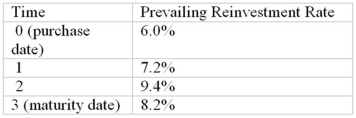
(Multiple Choice)
4.9/5 (82)
(82) You purchased an annual interest coupon bond one year ago with six years remaining to maturity at the time of purchase.The coupon interest rate is 10% and par value is $1,000.At the time you purchased the bond, the yield to maturity was 8%.If you sold the bond after receiving the first interest payment and the bond's yield to maturity had changed to 7%, your annual total rate of return on holding the bond for that year would have been
(Multiple Choice)
4.9/5 (74)
(74) One year ago, you purchased a newly issued TIPS bond that has a 4% coupon rate, five years to maturity, and a par value of $1,000.The average inflation rate over the year was 3.6%.What is the amount of the coupon payment you will receive, and what is the current face value of the bond
(Multiple Choice)
4.9/5 (70)
(70) The ________ is used to calculate the present value of a bond.
(Multiple Choice)
4.9/5 (68)
(68) A coupon bond that pays interest annually has a par value of $1,000, matures in seven years, and has a yield to maturity of 9.3%.The intrinsic value of the bond today will be ______ if the coupon rate is 8.5%.
(Multiple Choice)
4.8/5 (75)
(75) A 12% coupon bond, semi-annual payments, is callable in five years.The call price is $1,120; if the bond is selling today for $1,110, what is the yield to call
(Multiple Choice)
4.8/5 (77)
(77) Consider the following $1,000 par value zero-coupon bonds:  The yield to maturity on bond C is
 (Multiple Choice)
4.9/5 (87)
(87) 
Filters
- Essay(0)
- Multiple Choice(0)
- Short Answer(0)
- True False(0)
- Matching(0)