



 Chat with AI
Exam 32: Nuclear Physics and Nuclear Radiation

Exam 1: Introduction to Physics98 Questions
Exam 2: One-Dimensional Kinematics138 Questions
Exam 3: Vectors in Physics69 Questions
Exam 4: Two-Dimensional Kinematics51 Questions
Exam 5: Newtons Laws of Motion54 Questions
Exam 6: Applications of Newtons Laws104 Questions
Exam 7: Work and Kinetic Energy55 Questions
Exam 8: Potential Energy and Conservation of Energy62 Questions
Exam 9: Linear Momentum and Collisions114 Questions
Exam 10: Rotational Kinematics and Energy60 Questions
Exam 11: Rotational Dynamics and Static Equilibrium69 Questions
Exam 12: Gravity53 Questions
Exam 13: Oscillations About Equilibrium79 Questions
Exam 14: Waves and Sound142 Questions
Exam 15: Fluids103 Questions
Exam 16: Temperature and Heat110 Questions
Exam 17: Phases and Phase Changes93 Questions
Exam 18: The Laws of Thermodynamics90 Questions
Exam 19: Electric Charges, Forces, and Fields75 Questions
Exam 20: Electric Potential and Electric124 Questions
Exam 21: Electric Current and Direct-Current Circuits228 Questions
Exam 22: Magnetism147 Questions
Exam 23: Magnetic Flux and Faradays Law of Induction98 Questions
Exam 24: Alternating-Current Circuits72 Questions
Exam 25: Electromagnetic Waves63 Questions
Exam 26: Geometrical Optics133 Questions
Exam 27: Optical Instruments103 Questions
Exam 28: Physical Optics: Interference and Diffraction119 Questions
Exam 29: Relativity98 Questions
Exam 30: Quantum Physics88 Questions
Exam 31: Atomic Physics97 Questions
Exam 32: Nuclear Physics and Nuclear Radiation137 Questions
Select questions type


The number of radioactive nuclei in a particular sample decreases to one-eighth of its original number in 9 days.What is the half-life of these nuclei?
(Multiple Choice)
4.7/5  (77)
(77) An electron and a positron,both essentially at rest,annihilate each other,emitting two identical photons in the process.What is the wavelength of these photons? The mass of an electron or positron is 9.11 × 10⁻³¹ kg.(h = 6.626 × 10⁻³⁴ J ∙ s,c = 3.00 × 10⁸ m/s)
(Multiple Choice)
4.7/5 (81)
(81) The isotope  U is radioactive and decays in a series to
 Th.In this series,the particles ejected from the nucleus are
U is radioactive and decays in a series to
Th.In this series,the particles ejected from the nucleus are (Multiple Choice)
4.7/5 (85)
(85) The neutral helium atom,  He,has a mass of 4.002603 u,a neutron has a mass of 1.008665 u,a proton has a mass of 1.007277 u,and a neutral hydrogen atom has a mass of 1.007825 u.What is the binding energy of the
 He nucleus? (1 u = 931.5 MeV/c2)
He,has a mass of 4.002603 u,a neutron has a mass of 1.008665 u,a proton has a mass of 1.007277 u,and a neutral hydrogen atom has a mass of 1.007825 u.What is the binding energy of the
He nucleus? (1 u = 931.5 MeV/c2) (Multiple Choice)
4.8/5 (86)
(86) The atomic number of an atom is equal to the number of what particles in the nucleus?
(Multiple Choice)
4.9/5 (75)
(75) 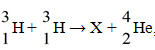 ,what is X?
Consider the nuclear reaction: 7Li + 1p → 4He + 4He.The known atomic masses are
7Li: 7.016005 u  He: 4.002603 u
1p: 1.007825 u
What is the Q-value (or reaction energy)of this reaction? (1 u = 931.5 MeV/c2)
He: 4.002603 u
1p: 1.007825 u
What is the Q-value (or reaction energy)of this reaction? (1 u = 931.5 MeV/c2) (Multiple Choice)
5.0/5 (79)
(79) A beryllium-8 nucleus at rest undergoes double alpha decay as follows:  Be →
 He +
 He
The known atomic masses are:
 He: 4.002603 u
 Be: 8.005305 u
What is the kinetic energy of each departing alpha particle? (1 u = 931.5 MeV/c2)
Be →
He +
He
The known atomic masses are:
He: 4.002603 u
Be: 8.005305 u
What is the kinetic energy of each departing alpha particle? (1 u = 931.5 MeV/c2) (Multiple Choice)
4.8/5 (80)
(80) A radioactive source emits 2.4-MeV neutrons at the rate of 7,100 neutrons per second.The number of atoms in the source is  What is the activity of the source,in curies (Ci)? (1.00 Ci = 3.70 × 10¹⁰ Bq)
 (Multiple Choice)
4.8/5 (61)
(61) Consider the nuclear reaction  N +
 He →
 O +
 H.The known atomic masses are
 N: 14.003074 u
 He: 4.002603 u
 H: 1.007825 u
 O: 16.999131 u
What is the Q-value (or reaction energy)of this reaction? (1 u = 931.5 MeV/c2)
N +
He →
O +
H.The known atomic masses are
N: 14.003074 u
He: 4.002603 u
H: 1.007825 u
O: 16.999131 u
What is the Q-value (or reaction energy)of this reaction? (1 u = 931.5 MeV/c2) (Multiple Choice)
4.8/5 (84)
(84) The following masses are known:  N 1.008665 u
 H 1.007825 u
 Ra 226.025403 u
What is the binding energy of
 Ra? (1 u = 931.5 MeV/c2)
N 1.008665 u
H 1.007825 u
Ra 226.025403 u
What is the binding energy of
Ra? (1 u = 931.5 MeV/c2) (Multiple Choice)
4.8/5 (74)
(74) A thallium source with a half-life of 3.7 years was certified at 10 kBq ten years ago.What is its activity now?
(Multiple Choice)
4.9/5 (83)
(83) The stability of  Cl with respect to alpha,beta-plus and beta-minus decay is to be determined.The following atomic masses are known:
 He: 4.002603 u
 P: 31.973907 u
 S: 35.967081 u
 Cl: 35.968307 u
 Ar: 35.967546 u
The
 Cl nucleus is
Cl with respect to alpha,beta-plus and beta-minus decay is to be determined.The following atomic masses are known:
He: 4.002603 u
P: 31.973907 u
S: 35.967081 u
Cl: 35.968307 u
Ar: 35.967546 u
The
Cl nucleus is (Multiple Choice)
5.0/5 (85)
(85) How long would it take 4.00 × 10²⁰ atoms to decay to 1.00 × 10¹⁹ atoms if their half-life was 14.7 years?
(Multiple Choice)
4.7/5 (89)
(89) Which of the following particles are not made up of quarks? (There could be more than one correct choice. )
(Multiple Choice)
4.8/5 (84)
(84) Scandium  Sc decays by emitting a positron.What isotope is the product of this decay?
 (Multiple Choice)
4.8/5 (85)
(85)  H?
A sample containing 4.0 × 10¹⁸ atoms of a radioactive isotope decays with a half-life of 2.3 years.How many undecayed atoms are left after 3.7 years?
(Multiple Choice)
4.8/5 (91)
(91) An excited  U∗ nucleus undergoes fission into two fragments as follows:
 U∗ →
 Ba +
 Kr
The following atomic masses are known:
 Kr: 91.926270 u
 Ba: 143.922845 u
 U∗: 236.045563 u
What is the reaction energy released during this fission reaction? (1 u = 931.5 MeV/c2)
U∗ nucleus undergoes fission into two fragments as follows:
U∗ → Ba + Kr
The following atomic masses are known:
Kr: 91.926270 u
Ba: 143.922845 u
U∗: 236.045563 u
What is the reaction energy released during this fission reaction? (1 u = 931.5 MeV/c2) (Multiple Choice)
4.9/5 (69)
(69) 
Filters
- Essay(0)
- Multiple Choice(0)
- Short Answer(0)
- True False(0)
- Matching(0)