



 Chat with AI
Exam 19: Radioactivity and Nuclear Chemistry

Exam 1: Matter, Measurement, and Problem Solving120 Questions
Exam 2: Atoms and Elements116 Questions
Exam 3: Molecules, Compounds and Chemical Equations144 Questions
Exam 4: Chemical Quantities and Aqueous Reactions199 Questions
Exam 5: Gases157 Questions
Exam 6: Thermochemistry110 Questions
Exam 7: The Quantum-Mechanical Model of the Atom100 Questions
Exam 8: Periodic Properties of the Elements120 Questions
Exam 9: Chemical Bonding I: Lewis Theory125 Questions
Exam 10: Chemical Bonding II: Molecular Shapes, Valence Bond Theory, and109 Questions
Exam 11: Liquids, Solids, and Intermolecular Forces123 Questions
Exam 12: Solutions127 Questions
Exam 13: Chemical Kinetics125 Questions
Exam 14: Chemical Equilibrium112 Questions
Exam 15: Acids and Bases126 Questions
Exam 16: Aqueous Ionic Equilibrium148 Questions
Exam 17: Free Energy and Thermodynamics103 Questions
Exam 18: Electrochemistry115 Questions
Exam 19: Radioactivity and Nuclear Chemistry105 Questions
Select questions type


A sample initially contains 3.2 moles of a radioactive isotope.How much of the sample remains after four half-lives?
(Multiple Choice)
4.9/5  (78)
(78) Determine the identity of the daughter nuclide from the alpha decay of  Rn.
Rn. (Multiple Choice)
4.8/5 (74)
(74) The following reaction represents what nuclear process?
 Cs +
 E →
 Xe
Cs +E → Xe (Multiple Choice)
4.7/5 (92)
(92) Determine the identity of the daughter nuclide from the electron capture by  Fe.
Fe. (Multiple Choice)
4.7/5 (87)
(87) Which of the following nuclides are most likely to decay via positron emission?
(Multiple Choice)
4.9/5 (80)
(80) Determine the identity of the daughter nuclide from the alpha decay of  Ra.
Ra. (Multiple Choice)
4.9/5 (80)
(80) Write a nuclear equation to describe the neutron induced fission of  Pu to form
 Kr and
 Ce.Determine how many neutrons are produced in the reaction.
Pu to form
Kr and Ce.Determine how many neutrons are produced in the reaction. (Multiple Choice)
4.7/5 (61)
(61) A freshly prepared sample of curium-243 undergoes 3312 disintegrations per second.After 6.00 yr,the activity of the sample declines to 2755 disintegrations per second.The half-life of curium-243 is ________ yr.
(Multiple Choice)
4.8/5 (75)
(75) Determine the identity of the daughter nuclide from the electron capture by  Be.
Be. (Multiple Choice)
4.8/5 (91)
(91) Determine the identity of the daughter nuclide from the positron emission of  O.
O. (Multiple Choice)
4.8/5 (68)
(68) Determine the identity of the daughter nuclide from the alpha decay of  Th.
Th. (Multiple Choice)
5.0/5 (86)
(86) Which of the following nuclides is most likely to undergo beta decay?
(Multiple Choice)
4.9/5 (84)
(84) Stable isotopes,with low atomic numbers,have a N/Z ratio of 1.What does that imply?
(Multiple Choice)
4.9/5 (77)
(77) The graph below shows the mass of a decaying nuclide versus time. 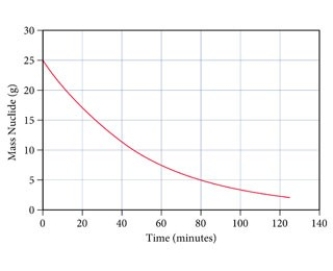 What is the half-life of the decay?
 (Multiple Choice)
4.8/5 (86)
(86) Which of the following nuclides are most likely to decay via beta decay?
(Multiple Choice)
4.7/5 (79)
(79) Which of the following nuclides are most likely to decay via positron emission?
(Multiple Choice)
4.9/5 (89)
(89) 
Filters
- Essay(0)
- Multiple Choice(0)
- Short Answer(0)
- True False(0)
- Matching(0)