



 Chat with AI
Exam 5: The Economics of Health Care

Exam 1: Economics: Foundations and Models219 Questions
Exam 2: Trade-Offs, Comparative Advantage, and the Market System236 Questions
Exam 3: Where Prices Come From: The Interaction of Demand and Supply234 Questions
Exam 4: Economic Efficiency, Government Price Setting, and Taxes212 Questions
Exam 5: The Economics of Health Care166 Questions
Exam 6: Firms, the Stock Market, and Corporate Governance251 Questions
Exam 7: Comparative Advantage and the Gains From International Trade188 Questions
Exam 8: GDP: Measuring Total Production and Income260 Questions
Exam 9: Unemployment and Inflation289 Questions
Exam 10: Economic Growth, the Financial System, and Business Cycles251 Questions
Exam 11: Long-Run Economic Growth: Sources and Policies261 Questions
Exam 12: Aggregate Expenditure and Output in the Short Run304 Questions
Exam 13: Aggregate Demand and Aggregate Supply Analysis284 Questions
Exam 14: Money,Banks,and the Federal Reserve System276 Questions
Exam 15: Monetary Policy278 Questions
Exam 16: Fiscal Policy313 Questions
Exam 17: Inflation, Unemployment, and Federal Reserve Policy257 Questions
Exam 18: Macroeconomics in an Open Economy277 Questions
Exam 19: The International Financial System256 Questions
Select questions type


The health care system in ________ is referred to as a single-payer health care system,and is a system in which the government provides national health insurance to all residents.
(Multiple Choice)
4.7/5  (84)
(84) Which of the following is not part of the "taxes" provision of the Patient Protection and Affordable Care Act (ACA)?
(Multiple Choice)
4.8/5 (90)
(90) Of the following high-income countries,which has the highest female life expectancy at age 65?
(Multiple Choice)
4.9/5 (78)
(78) The United Kingdom has a health care system under which the government owns most of the hospitals and employs most of the doctors.
(True/False)
4.7/5 (63)
(63) In 2017,the average life expectancy at birth in the United Kingdom and other high-income countries was around ________ years.
(Multiple Choice)
4.8/5 (79)
(79) Due to the trend in U.S.out-of-pocket health care spending over the past 50 years,the fraction of the true cost of health care being paid directly by consumers
(Multiple Choice)
4.8/5 (74)
(74) Figure 5-3  Figure 5-3 represents the market for medical services with and without insurance,and the effect of a third-party payer system on the demand for medical services.
-Refer to Figure 5-3.With insurance and a third-party payer system,what price do consumers pay for medical services?
Figure 5-3 represents the market for medical services with and without insurance,and the effect of a third-party payer system on the demand for medical services.
-Refer to Figure 5-3.With insurance and a third-party payer system,what price do consumers pay for medical services? (Multiple Choice)
4.7/5 (77)
(77) Compared to the United States,health care spending per person in other high-income countries has been
(Multiple Choice)
4.9/5 (84)
(84) Figure 5-3 Figure 5-3 represents the market for medical services with and without insurance,and the effect of a third-party payer system on the demand for medical services.
-Refer to Figure 5-3.The efficient price of medical services is
Figure 5-3 represents the market for medical services with and without insurance,and the effect of a third-party payer system on the demand for medical services.
-Refer to Figure 5-3.The efficient price of medical services is (Multiple Choice)
4.9/5 (67)
(67) As a percentage of all spending on health care,out-of-pocket spending has ________ in the United States.
(Multiple Choice)
4.8/5 (83)
(83) In the United States in 2016,the percentage of people who received health insurance through their employer was about
(Multiple Choice)
4.7/5 (71)
(71) In 2017,health care's share of gross domestic product in the United States was about
(Multiple Choice)
4.8/5 (84)
(84) ________ account(s)for between 1 and 4 percent of health care costs in the United States.
(Multiple Choice)
4.8/5 (64)
(64) Briefly describe changes in life expectancy,average height,and infant mortality in the United States since 1850.
(Essay)
4.9/5 (76)
(76) Figure 5-3 Figure 5-3 represents the market for medical services with and without insurance,and the effect of a third-party payer system on the demand for medical services.
-Refer to Figure 5-3.If consumers paid the full price of medical services,the price they would pay is
Figure 5-3 represents the market for medical services with and without insurance,and the effect of a third-party payer system on the demand for medical services.
-Refer to Figure 5-3.If consumers paid the full price of medical services,the price they would pay is (Multiple Choice)
4.8/5 (89)
(89) Figure 5-4 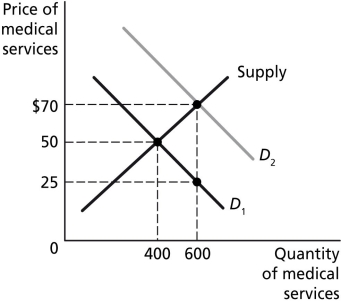 Figure 5-4 represents the supply and demand for medical services with and without a third-party payer.
-Refer to Figure 5-4.Answer the following questions:
1.What would be the equilibrium price and quantity if consumers had to pay the full price of medical services?
2.With insurance acting as a third-party payer,what price will consumers pay for medical service?
3.With insurance acting as a third-party payer,what price will doctors receive for medical service?
4.With insurance acting as a third-party payer,what will be the equilibrium quantity of medical services?
5.With insurance acting as a third-party payer,what will be the value of the deadweight loss?
Figure 5-4 represents the supply and demand for medical services with and without a third-party payer.
-Refer to Figure 5-4.Answer the following questions:
1.What would be the equilibrium price and quantity if consumers had to pay the full price of medical services?
2.With insurance acting as a third-party payer,what price will consumers pay for medical service?
3.With insurance acting as a third-party payer,what price will doctors receive for medical service?
4.With insurance acting as a third-party payer,what will be the equilibrium quantity of medical services?
5.With insurance acting as a third-party payer,what will be the value of the deadweight loss? (Short Answer)
4.8/5 (77)
(77) Figure 5-1  Figure 5-1 represents the market for vaccinations.Vaccinations are considered a benefit to society,and the figure shows both the marginal private benefit and the marginal social benefit from vaccinations.
-Refer to Figure 5-1.The efficient equilibrium price is
Figure 5-1 represents the market for vaccinations.Vaccinations are considered a benefit to society,and the figure shows both the marginal private benefit and the marginal social benefit from vaccinations.
-Refer to Figure 5-1.The efficient equilibrium price is (Multiple Choice)
4.8/5 (64)
(64) Adverse selection refers to the actions people take after they have entered into a transaction that make the other party to the transaction worse off.
(True/False)
4.8/5 (85)
(85) 
Filters
- Essay(0)
- Multiple Choice(0)
- Short Answer(0)
- True False(0)
- Matching(0)