



 Chat with AI
Exam 5: The Economics of Health Care

Exam 1: Economics: Foundations and Models219 Questions
Exam 2: Trade-Offs, Comparative Advantage, and the Market System236 Questions
Exam 3: Where Prices Come From: The Interaction of Demand and Supply234 Questions
Exam 4: Economic Efficiency, Government Price Setting, and Taxes212 Questions
Exam 5: The Economics of Health Care166 Questions
Exam 6: Firms, the Stock Market, and Corporate Governance251 Questions
Exam 7: Comparative Advantage and the Gains From International Trade188 Questions
Exam 8: GDP: Measuring Total Production and Income260 Questions
Exam 9: Unemployment and Inflation289 Questions
Exam 10: Economic Growth, the Financial System, and Business Cycles251 Questions
Exam 11: Long-Run Economic Growth: Sources and Policies261 Questions
Exam 12: Aggregate Expenditure and Output in the Short Run304 Questions
Exam 13: Aggregate Demand and Aggregate Supply Analysis284 Questions
Exam 14: Money,Banks,and the Federal Reserve System276 Questions
Exam 15: Monetary Policy278 Questions
Exam 16: Fiscal Policy313 Questions
Exam 17: Inflation, Unemployment, and Federal Reserve Policy257 Questions
Exam 18: Macroeconomics in an Open Economy277 Questions
Exam 19: The International Financial System256 Questions
Select questions type


Under current U.S.tax laws,individuals do not pay taxes on health insurance benefits they receive from their employers.
(True/False)
4.8/5  (79)
(79) Figure 5-1 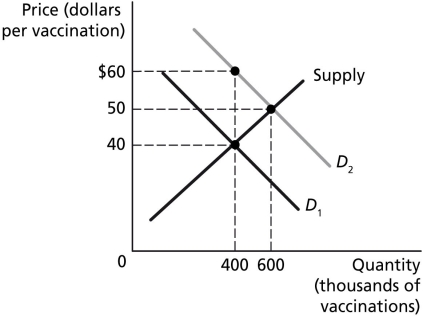 Figure 5-1 represents the market for vaccinations.Vaccinations are considered a benefit to society,and the figure shows both the marginal private benefit and the marginal social benefit from vaccinations.
-Refer to Figure 5-1.The market equilibrium price is
Figure 5-1 represents the market for vaccinations.Vaccinations are considered a benefit to society,and the figure shows both the marginal private benefit and the marginal social benefit from vaccinations.
-Refer to Figure 5-1.The market equilibrium price is (Multiple Choice)
4.9/5 (74)
(74) About ________ of pharmaceutical patents are issued to U.S.firms.
(Multiple Choice)
4.9/5 (82)
(82) In which of the following countries does health insurance not pay for most preventive care procedures?
(Multiple Choice)
4.8/5 (86)
(86) Of the following high-income countries,which has the highest mortality ratio for cancer?
(Multiple Choice)
4.8/5 (77)
(77) On average,people in the United States spend a smaller percentage of their income on health care than do people in most other countries.
(True/False)
4.8/5 (75)
(75) Figure 5-3  Figure 5-3 represents the market for medical services with and without insurance,and the effect of a third-party payer system on the demand for medical services.
-Refer to Figure 5-3.With insurance and a third-party payer system,the equilibrium quantity of medical services is
Figure 5-3 represents the market for medical services with and without insurance,and the effect of a third-party payer system on the demand for medical services.
-Refer to Figure 5-3.With insurance and a third-party payer system,the equilibrium quantity of medical services is (Multiple Choice)
4.7/5 (80)
(80) "Cost disease" refers to the tendency for high productivity in the service sector to lead to lower costs in those industries.
(True/False)
4.8/5 (86)
(86) Economists who support market-based reforms for health care believe that increased competition among providers of health care would
(Multiple Choice)
4.9/5 (90)
(90) Of the following high-income countries,which has the lowest infant mortality rate?
(Multiple Choice)
4.9/5 (79)
(79) The difference between adverse selection and moral hazard is that
(Multiple Choice)
4.7/5 (82)
(82) Under current tax laws,individuals do not pay taxes on health insurance benefits they receive from their employers.As a result
(Multiple Choice)
4.9/5 (92)
(92) In a market with positive externalities,the market equilibrium quantity will be less than the efficient equilibrium quantity.
(True/False)
4.9/5 (90)
(90) Between 1981 and 2015,deaths from kidney disease increased largely due to the effects of
(Multiple Choice)
4.8/5 (72)
(72) Article Summary
An Organisation for Economic Co-operation and Development (OECD)report states that administration costs for health care in the United States are the highest in the developed world,accounting for over 8 percent of spending in the health care sector,compared to a global average of about 3 percent.According to the report,expensive surgeries,high pharmaceutical costs,and corrupt practices increased global health care costs,and poor coordination between health care providers,duplication of tasks,and excessive time spent on paperwork all contributed to higher administrative costs.The report also noted that administrative costs are generally lower under government-managed health care systems than with private insurance,but governments could still significantly cut spending and improve patients' health.
Source: Alanna Petroff,"U.S.health care admin costs are double the average," money.cnn.com,January 11 2017.
-Refer to the Article Summary.The article discusses the high administrative costs of health care in the United States.Even if private insurance companies were more efficient and brought administrative costs down,consumers would ________ the full cost of medical treatment.This would result in the market equilibrium price and quantity of medical services being ________ than the efficient equilibrium price and quantity.
(Multiple Choice)
4.9/5 (81)
(81) Of the following high-income countries,which has the highest male life expectancy at age 65?
(Multiple Choice)
4.7/5 (84)
(84) In the United States,health care spending as a percentage of GDP has declined since 1965.
(True/False)
4.9/5 (66)
(66) Pricing insurance policies is made difficult because buyers have more information than sellers.This difficulty is an example of
(Multiple Choice)
4.7/5 (78)
(78) Typically,the lower the level of income per person in a country,the lower the level of spending per person on health care.This relationship between income and spending indicates that health care is a
(Multiple Choice)
4.8/5 (71)
(71) 
Filters
- Essay(0)
- Multiple Choice(0)
- Short Answer(0)
- True False(0)
- Matching(0)