



 Chat with AI
Exam 5: The Economics of Health Care

Exam 1: Economics: Foundations and Models219 Questions
Exam 2: Trade-Offs, Comparative Advantage, and the Market System236 Questions
Exam 3: Where Prices Come From: The Interaction of Demand and Supply234 Questions
Exam 4: Economic Efficiency, Government Price Setting, and Taxes212 Questions
Exam 5: The Economics of Health Care166 Questions
Exam 6: Firms, the Stock Market, and Corporate Governance251 Questions
Exam 7: Comparative Advantage and the Gains From International Trade188 Questions
Exam 8: GDP: Measuring Total Production and Income260 Questions
Exam 9: Unemployment and Inflation289 Questions
Exam 10: Economic Growth, the Financial System, and Business Cycles251 Questions
Exam 11: Long-Run Economic Growth: Sources and Policies261 Questions
Exam 12: Aggregate Expenditure and Output in the Short Run304 Questions
Exam 13: Aggregate Demand and Aggregate Supply Analysis284 Questions
Exam 14: Money,Banks,and the Federal Reserve System276 Questions
Exam 15: Monetary Policy278 Questions
Exam 16: Fiscal Policy313 Questions
Exam 17: Inflation, Unemployment, and Federal Reserve Policy257 Questions
Exam 18: Macroeconomics in an Open Economy277 Questions
Exam 19: The International Financial System256 Questions
Select questions type


Some economists have argued that certain characteristics of the delivery of health care justify government intervention.One of these characteristics is
(Multiple Choice)
4.9/5  (78)
(78) The health care system in ________ is referred to as socialized medicine,under which the government owns most of the hospitals and employs most of the doctors.
(Multiple Choice)
4.7/5 (88)
(88) ________ tended to increase spending on health care in the United States.
(Multiple Choice)
4.9/5 (83)
(83) In 2016,the average height of adult males in the United States was
(Multiple Choice)
4.9/5 (78)
(78) In ________,health care spending per person is significantly higher than the average for most other countries,even taking into account the effects of higher income per person.
(Multiple Choice)
5.0/5 (80)
(80) Figure 5-1 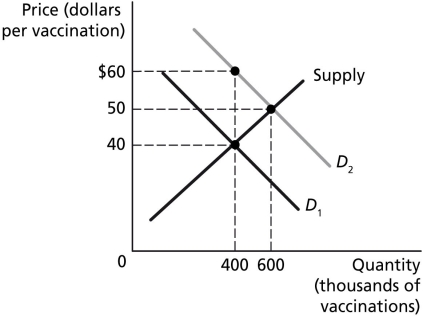 Figure 5-1 represents the market for vaccinations.Vaccinations are considered a benefit to society,and the figure shows both the marginal private benefit and the marginal social benefit from vaccinations.
-Refer to Figure 5-1.At the market equilibrium,the deadweight loss is equal to
Figure 5-1 represents the market for vaccinations.Vaccinations are considered a benefit to society,and the figure shows both the marginal private benefit and the marginal social benefit from vaccinations.
-Refer to Figure 5-1.At the market equilibrium,the deadweight loss is equal to (Multiple Choice)
4.8/5 (75)
(75) Figure 5-1 Figure 5-1 represents the market for vaccinations.Vaccinations are considered a benefit to society,and the figure shows both the marginal private benefit and the marginal social benefit from vaccinations.
-Refer to Figure 5-1.The efficient equilibrium quantity is ________ thousand vaccinations.
Figure 5-1 represents the market for vaccinations.Vaccinations are considered a benefit to society,and the figure shows both the marginal private benefit and the marginal social benefit from vaccinations.
-Refer to Figure 5-1.The efficient equilibrium quantity is ________ thousand vaccinations. (Multiple Choice)
4.8/5 (70)
(70) College education tends to result in a positive externality because the recipient receives the full benefit of the education.
(True/False)
4.8/5 (76)
(76) Figure 5-3  Figure 5-3 represents the market for medical services with and without insurance,and the effect of a third-party payer system on the demand for medical services.
-Refer to Figure 5-3.If consumers paid the full price of medical services,the equilibrium quantity would be
Figure 5-3 represents the market for medical services with and without insurance,and the effect of a third-party payer system on the demand for medical services.
-Refer to Figure 5-3.If consumers paid the full price of medical services,the equilibrium quantity would be (Multiple Choice)
4.8/5 (69)
(69) In 1960,out-of-pocket spending on health care in the United States was
(Multiple Choice)
4.9/5 (81)
(81) Lower deductibles for employer-provided health care will tend to shift the ________ curve for medical services to the ________.
(Multiple Choice)
4.9/5 (84)
(84) Since 1981,deaths from cardiovascular diseases have decreased in the United States.
(True/False)
4.8/5 (73)
(73) Figure 5-1 Figure 5-1 represents the market for vaccinations.Vaccinations are considered a benefit to society,and the figure shows both the marginal private benefit and the marginal social benefit from vaccinations.
-Refer to Figure 5-1.Marginal private benefit is represented by which curve?
Figure 5-1 represents the market for vaccinations.Vaccinations are considered a benefit to society,and the figure shows both the marginal private benefit and the marginal social benefit from vaccinations.
-Refer to Figure 5-1.Marginal private benefit is represented by which curve? (Multiple Choice)
4.8/5 (87)
(87) Briefly describe the types of health care systems in Canada,Japan,and the United Kingdom.
(Essay)
4.9/5 (76)
(76) Which of the following Nobel laureates became known for the study of asymmetric information?
(Multiple Choice)
4.9/5 (69)
(69) An increase in the number of medical procedures performed in doctor's offices rather than in hospital settings will tend to shift the ________ curve for medical services to the ________.
(Multiple Choice)
4.8/5 (83)
(83) Federal and state governments in the United States pay for ________ of health care spending.
(Multiple Choice)
4.8/5 (88)
(88) A goal of ________ is to give patients an incentive to pay more attention to the prices of medical services.This would tend to increase economic efficiency by decreasing the costs of medical services
(Multiple Choice)
5.0/5 (79)
(79) 
Filters
- Essay(0)
- Multiple Choice(0)
- Short Answer(0)
- True False(0)
- Matching(0)