



 Chat with AI
Exam 12: Chemical Bonding

Exam 2: Matter and Energy50 Questions
Exam 3: Measurement and Chemical Calculations48 Questions
Exam 4: Introduction to Gases56 Questions
Exam 5: Atomic Theory: The Nuclear Model of the Atom48 Questions
Exam 6: Chemical Nomenclature45 Questions
Exam 7: Chemical Formula Relationships45 Questions
Exam 8: Chemical Reactions44 Questions
Exam 9: Chemical Change52 Questions
Exam 10: Quantity Relationships in Chemical Reactions42 Questions
Exam 11: Atomic Theory: The Quantum Model of the Atom50 Questions
Exam 12: Chemical Bonding45 Questions
Exam 13: Structure and Shape47 Questions
Exam 14: The Ideal Gas Law and Its Applications47 Questions
Exam 15: Gases, Liquids, and Solids45 Questions
Exam 16: Solutions47 Questions
Exam 17: Acidbase Proton Transferreactions45 Questions
Exam 18: Chemical Equilibrium45 Questions
Exam 19: Oxidationreduction Electron Transferreactions45 Questions
Exam 20: Nuclear Chemistry50 Questions
Exam 21: Organic Chemistry45 Questions
Exam 22: Biochemistry45 Questions
Select questions type


Which of these ions has a Lewis symbol of the following form? 
(Multiple Choice)
4.7/5  (87)
(87) Arrange the following bonds in order of increasing polarity. 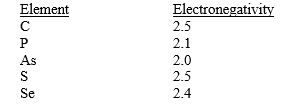
(Multiple Choice)
4.9/5 (60)
(60) Consider the compound represented below. 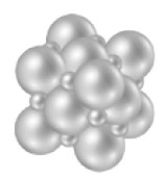 What is most likely the physical state of this substance at room temperature?
 (Multiple Choice)
4.9/5 (83)
(83) If you were to sketch a particulate-level illustration of the electron-sea model of metallic bonding for calcium,and your sketch showed eight calcium nuclei and their associated electrons,how many "free" electrons should also be in your sketch?
(Multiple Choice)
4.9/5 (82)
(82) 
Filters
- Essay(0)
- Multiple Choice(0)
- Short Answer(0)
- True False(0)
- Matching(0)