



 Chat with AI
Exam 12: The Cost of Capital

Exam 1: An Overview of Finance42 Questions
Exam 2: Financial Assets Instruments111 Questions
Exam 3: Financial Markets and the Investment Banking Process47 Questions
Exam 4: Financial Intermediaries and the Banking System98 Questions
Exam 5: The Cost of Money Interest Rates65 Questions
Exam 6: Business Organizations and the Tax Environment96 Questions
Exam 7: Analysis of Financial Statements123 Questions
Exam 8: Financial Planning and Control122 Questions
Exam 9: Time Value of Money132 Questions
Exam 10: Valuation Concepts126 Questions
Exam 11: Risk and Rates of Return104 Questions
Exam 12: The Cost of Capital114 Questions
Exam 13: Capital Budgeting192 Questions
Exam 14: Capital Structure and Dividend Policy Decisions120 Questions
Exam 15: Working Capital Management174 Questions
Exam 16: Investment and Securities102 Questions
Exam 17: Investment Analysis and Valuation Techniques108 Questions
Select questions type


In general,it is not possible for re,the cost of new equity,to be lower than rs,the cost of retained earnings.However,an exception to this rule occurs when the stock price increases just prior to the firm issuing new equity such that it more than offsets the flotation costs and thus,re becomes less than rs.
(True/False)
4.8/5  (71)
(71) Takeda Enterprises has four investment opportunities with the following costs (all costs are paid at t = 0)and estimated internal rates of return (IRR): 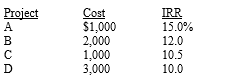 The company wants to maintain a capital structure of 50 percent debt and 50 percent equity.The company anticipates that it can issue up to $2,000 of debt at an interest rate of 10 percent;if it issues more than $2,000 of debt its interest rate will increase to 11 percent.The company's stock price (P0)is currently $90 per share,its expected dividend (
 )is $6,and its dividend growth rate is 5 percent.The company expects to have $3,000 in retained earnings and its tax rate is 30 percent.What percentage flotation cost makes the net present value of accepting Project D zero?
(Hint: Project D will be selected only after Projects A,B,and C have been selected. )
The company wants to maintain a capital structure of 50 percent debt and 50 percent equity.The company anticipates that it can issue up to $2,000 of debt at an interest rate of 10 percent;if it issues more than $2,000 of debt its interest rate will increase to 11 percent.The company's stock price (P0)is currently $90 per share,its expected dividend ( )is $6,and its dividend growth rate is 5 percent.The company expects to have $3,000 in retained earnings and its tax rate is 30 percent.What percentage flotation cost makes the net present value of accepting Project D zero?
(Hint: Project D will be selected only after Projects A,B,and C have been selected. ) (Multiple Choice)
4.9/5 (78)
(78) The steeper the demand curve for a firm's stock,the closer the values of rs and re are to one another,other things held constant.
(True/False)
4.7/5 (80)
(80) The higher the firm's flotation cost for new common equity,the more likely the firm is to use preferred stock that has no flotation cost and retained earnings whose cost is the average return on assets.
(True/False)
4.8/5 (88)
(88) Rollins Corporation
Rollins Corporation is constructing its MCC schedule. Its target capital structure is 20 percent debt, 20 percent preferred stock, and 60 percent common equity. Its bonds have a 12 percent coupon, paid semiannually, a current maturity of 20 years, and sell for $1,000. The firm could sell, at par, $100 preferred stock that pays a 12 percent annual dividend, but flotation costs of 5 percent would be incurred. Rollins' beta is 1.2, the risk-free rate is 10 percent, and the market risk premium is 5 percent. Rollins is a constant growth firm that just paid a dividend of $2.00, sells for $27.00 per share, and has a growth rate of 8 percent. The firm's policy is to use a risk premium of 4 percentage points when using the bond-yield-plus-risk-premium method to find rs. The firm's net income is expected to be $1 million, and its dividend payout ratio is 40 percent. Flotation costs on new common stock total 10 percent, and the firm's marginal tax rate is 40 percent.
-Refer to Rollins Corporation.What is Rollins' retained earnings break point?
(Multiple Choice)
4.8/5 (85)
(85) Becker Glass Corporation
Becker Glass Corporation expects to have earnings before interest and taxes during the coming year of $1,000,000, and it expects its earnings and dividends to grow indefinitely at a constant annual rate of 12.5 percent. The firm has $5,000,000 of debt outstanding bearing a coupon interest rate of 8 percent, and it has 100,000 shares of common stock outstanding. Historically, Becker has paid 50 percent of net earnings to common shareholders in the form of dividends. The current price of Becker's common stock is $40, but it would incur a 10 percent flotation cost if it were to sell new stock. The firm's tax rate is 40 percent.
-Refer to Becker Glass Corporation.What is the firm's cost of retained earnings?
(Multiple Choice)
4.9/5 (80)
(80) The MCC schedule,as developed from the weighted average cost of capital,has a break point that occurs when retained earnings are used up.
(True/False)
4.9/5 (74)
(74) ____ is the portion of net income not paid out in the form of dividends.
(Multiple Choice)
4.9/5 (100)
(100) In capital budgeting and cost of capital analyses,the firm should always consider retained earnings as the first source of capital,because this is a free source of funding to the firm.
(True/False)
4.9/5 (85)
(85) A firm going from a lower to a higher tax bracket could increase its use of debt,yet actually wind up with a lower after-tax cost of debt.
(True/False)
4.9/5 (87)
(87) Rollins Corporation
Rollins Corporation is constructing its MCC schedule. Its target capital structure is 20 percent debt, 20 percent preferred stock, and 60 percent common equity. Its bonds have a 12 percent coupon, paid semiannually, a current maturity of 20 years, and sell for $1,000. The firm could sell, at par, $100 preferred stock that pays a 12 percent annual dividend, but flotation costs of 5 percent would be incurred. Rollins' beta is 1.2, the risk-free rate is 10 percent, and the market risk premium is 5 percent. Rollins is a constant growth firm that just paid a dividend of $2.00, sells for $27.00 per share, and has a growth rate of 8 percent. The firm's policy is to use a risk premium of 4 percentage points when using the bond-yield-plus-risk-premium method to find rs. The firm's net income is expected to be $1 million, and its dividend payout ratio is 40 percent. Flotation costs on new common stock total 10 percent, and the firm's marginal tax rate is 40 percent.
-Refer to Rollins Corporation.What is Rollins' cost of preferred stock?
(Multiple Choice)
4.8/5 (76)
(76) Global Advertising Company
The Global Advertising Company had net income after interest but before taxes of $40,000 this year. The marginal tax rate is 40 percent, and the dividend payout ratio is 30 percent. The company can raise debt at a 12 percent interest rate for any amount of debt less than $8,000. If the firm raises $8,000 or more of debt, a 15 percent interest rate will apply to that new debt. The last dividend paid by Global was $0.90. Global's common stock is selling for $8.59 per share, and its expected growth rate in earnings and dividends is 5 percent. If Global issues new common stock, the flotation cost incurred will be 10 percent. Global plans to finance all capital expenditures with 30 percent debt and 70 percent equity.
-Refer to Global Advertising Company.What is the cost of common equity raised by selling new stock?
(Multiple Choice)
4.8/5 (78)
(78) The firm's cost of external equity capital is the same as the required rate of return on the firm's outstanding common stock.
(True/False)
4.9/5 (102)
(102) Rollins Corporation
Rollins Corporation is constructing its MCC schedule. Its target capital structure is 20 percent debt, 20 percent preferred stock, and 60 percent common equity. Its bonds have a 12 percent coupon, paid semiannually, a current maturity of 20 years, and sell for $1,000. The firm could sell, at par, $100 preferred stock that pays a 12 percent annual dividend, but flotation costs of 5 percent would be incurred. Rollins' beta is 1.2, the risk-free rate is 10 percent, and the market risk premium is 5 percent. Rollins is a constant growth firm that just paid a dividend of $2.00, sells for $27.00 per share, and has a growth rate of 8 percent. The firm's policy is to use a risk premium of 4 percentage points when using the bond-yield-plus-risk-premium method to find rs. The firm's net income is expected to be $1 million, and its dividend payout ratio is 40 percent. Flotation costs on new common stock total 10 percent, and the firm's marginal tax rate is 40 percent.
-Refer to Rollins Corporation.What is the firm's cost of retained earnings using the DCF approach?
(Multiple Choice)
4.7/5 (79)
(79) 
Filters
- Essay(0)
- Multiple Choice(0)
- Short Answer(0)
- True False(0)
- Matching(0)