



 Chat with AI
Exam 13: Oligopoly and Monopolistic Competition

Exam 1: Introduction50 Questions
Exam 2: Supply and Demand141 Questions
Exam 3: Applying the Supply and Demand Model114 Questions
Exam 4: Consumer Choice115 Questions
Exam 5: Applying Consumer Theory108 Questions
Exam 6: Firms and Production117 Questions
Exam 7: Costs114 Questions
Exam 8: Competitive Firms and Markets117 Questions
Exam 9: Applying the Competitive Model146 Questions
Exam 10: General Equilibrium and Economic Welfare112 Questions
Exam 11: Monopoly138 Questions
Exam 12: Pricing and Advertising125 Questions
Exam 13: Oligopoly and Monopolistic Competition118 Questions
Exam 14: Game Theory99 Questions
Exam 15: Factor Markets93 Questions
Exam 16: Interest Rates, Investments, and Capital Markets110 Questions
Exam 17: Uncertainty112 Questions
Exam 18: Externalities, Open-Access, and Public Goods113 Questions
Exam 19: Asymmetric Information109 Questions
Exam 20: Contracts and Moral Hazards97 Questions
Select questions type


The profitability of the second mover in a Stackelberg model is
(Multiple Choice)
4.8/5  (76)
(76) 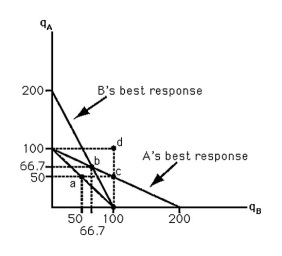 -The above figure shows the reaction functions for two pizza shops in a small isolated town.The Cournot equilibrium is at point
 (Multiple Choice)
4.8/5 (74)
(74) Which of the following market models results in the highest price assuming a fixed number of firms with identical costs and a given demand curve?
(Multiple Choice)
4.9/5 (76)
(76) What strategic advantage compared to a Cournot Oligopoly results in the Stackelberg outcome?
(Multiple Choice)
4.8/5 (64)
(64) Perfect competition and monopolistic competition are similar in that firms in both types of market structure will
(Multiple Choice)
4.8/5 (75)
(75) The Bertrand model is a more plausible model of firm behavior than the Cournot model
(Multiple Choice)
4.9/5 (77)
(77) The Cournot model assumes that firm A maximizes its profit,holding firm B's output constant.
(True/False)
4.8/5 (77)
(77) Suppose Cournot duopolist firms operate with each having a cost of 30qi (i = 1,2)so that each firm's marginal cost is 30.The inverse market demand curve is P = 120 - Q where Q = q1 + q2.At the Nash-Cournot equilibrium,the total quantity,Q,is
(Multiple Choice)
4.7/5 (94)
(94) Because firms selling a homogeneous product set price in response to the (perceived)pricing decision of other firms in the Bertrand Model of oligopoly in equilibrium price exceeds marginal cost.
(True/False)
4.9/5 (84)
(84) Suppose two Cournot duopolist firms operate at zero marginal cost.The market demand is p = a - bQ.Firm 1's best-response function is
(Multiple Choice)
4.8/5 (64)
(64) Minimum efficient scale refers to the lowest level of output at which
(Multiple Choice)
5.0/5 (84)
(84) Suppose Cournot duopolists firms face the same market demand curve,but have differing costs.At the Nash-Cournot equilibrium,the firm with the lower cost will
(Multiple Choice)
4.8/5 (85)
(85) Explain why the intersection of the best-response functions is the Cournot equilibrium.
(Essay)
4.8/5 (68)
(68) The evidence on mergers occurring within the hospital industry suggests that
(Multiple Choice)
4.9/5 (92)
(92) There are only two firms in an industry with demand curves q1 = 30 - P and q2 = 30 - P.Both have no fixed costs and each has a marginal cost of 10 per unit produced.If they behave as profit maximizing price takers,each produces 20 units and sells them at a price of 10 so that each firm makes zero economic profits.Suppose the two firms form a cartel.While firm 1 produces one-half of the profit maximizing cartel output,firm 2 cheats and produces 5 units more.What would happen to the two firms' economic profits?
(Multiple Choice)
4.8/5 (78)
(78) 
Filters
- Essay(0)
- Multiple Choice(0)
- Short Answer(0)
- True False(0)
- Matching(0)