



 Chat with AI
Exam 13: Oligopoly and Monopolistic Competition

Exam 1: Introduction50 Questions
Exam 2: Supply and Demand141 Questions
Exam 3: Applying the Supply and Demand Model114 Questions
Exam 4: Consumer Choice115 Questions
Exam 5: Applying Consumer Theory108 Questions
Exam 6: Firms and Production117 Questions
Exam 7: Costs114 Questions
Exam 8: Competitive Firms and Markets117 Questions
Exam 9: Applying the Competitive Model146 Questions
Exam 10: General Equilibrium and Economic Welfare112 Questions
Exam 11: Monopoly138 Questions
Exam 12: Pricing and Advertising125 Questions
Exam 13: Oligopoly and Monopolistic Competition118 Questions
Exam 14: Game Theory99 Questions
Exam 15: Factor Markets93 Questions
Exam 16: Interest Rates, Investments, and Capital Markets110 Questions
Exam 17: Uncertainty112 Questions
Exam 18: Externalities, Open-Access, and Public Goods113 Questions
Exam 19: Asymmetric Information109 Questions
Exam 20: Contracts and Moral Hazards97 Questions
Select questions type


Suppose the demand for pizza in a small isolated town is p = 10 - Q.There are only two firms,A and B,and each has a cost function TC = 2 + Q.Compare the firms' profits if they behave as Cournot duopolists with their profits if they form a cartel and share the market.
(Essay)
4.8/5  (76)
(76) Television stations have seemingly synchronized their commercial breaks.This is likely an example of
(Multiple Choice)
4.8/5 (71)
(71) In a Bertrand model with identical firms and a non-differentiated product,price will increase in response to
(Multiple Choice)
4.8/5 (73)
(73) There are only two firms in an industry with demand curves q1 = 30 - P and q2 = 30 - P.Both have no fixed costs and each has a marginal cost of 10 per unit produced.If they behave as profit maximizing price takers,each produces 10 units and sells them at a price of 10 so that each firm makes zero economic profits.If they form a cartel,their inverse demand curve is
(Multiple Choice)
4.9/5 (72)
(72) Monopolistic competition and perfect competition differ because
(Multiple Choice)
4.9/5 (84)
(84) In the Cournot model,the output that a firm chooses to produce increases as
(Multiple Choice)
4.9/5 (94)
(94) Brand loyalty in monopolistically competitive markets manifests itself as
(Multiple Choice)
5.0/5 (83)
(83) Suppose two duopolists operate at zero marginal cost.The market demand is p = a - bQ.If firm 1 is the Stackelberg leader,what level of output will it choose?
(Multiple Choice)
4.8/5 (76)
(76) Firms in all types of market structures pay attention to current rival firms' behavior.
(True/False)
4.8/5 (73)
(73) Suppose Cournot duopolist firms operate with each having a cost of 30qi (i = 1,2)so that each firm's marginal cost is 30.The inverse market demand curve is P = 120 - Q where Q = q1 + q2.Suppose there were no barriers to entry and firms continued to enter so long as there were positive economic profits.At the Nash-Cournot equilibrium,the total output,Q,is
(Multiple Choice)
4.9/5 (77)
(77) Explain how long-run economic profits are linked to entry in monopolistic competition and perfect competition.
(Essay)
4.7/5 (68)
(68) Firms A and B are identical,produce identical products,and are the only firms in a market.Firm A's output is higher than Firm B's.This means that Firm B is the
(Multiple Choice)
4.7/5 (86)
(86) 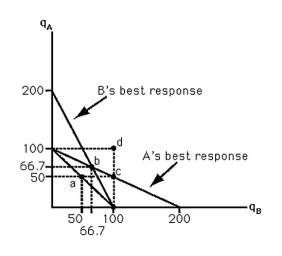 -The above figure shows the reaction functions for two pizza shops in a small isolated town.Compare the Cournot,Stackelberg,cartel,and competitive equilibria in terms of total output and welfare.
 (Essay)
4.9/5 (71)
(71) Is it true that in the long run,a monopolistically competitive firm has market power but earns no profit? Explain.
(Essay)
4.9/5 (76)
(76) If only two identical firms operate in a market,consumers prefer
(Multiple Choice)
4.8/5 (77)
(77) Suppose duopolists face the market inverse demand curve P = 100 - Q,Q = q1 + q2,and both firms have a constant marginal cost of 10.If firm 1 is a Stackelberg leader and firm 2's best response function is q2 = (100 - q1)/2,at the Nash-Stackelberg equilibrium firm 1's output is
(Multiple Choice)
4.8/5 (71)
(71) There are only two firms in an industry with demand curves q1 = 30 - P and q2 = 30 - P.Both have no fixed costs and each has a marginal cost of 10 per unit produced.If they behave as profit maximizing price takers,each produces 20 units and sells them at a price of 10 so that each firm makes zero economic profits.If they formed a cartel and split the production of the output evenly,the profit maximizing quantity produced by each firm is
(Multiple Choice)
5.0/5 (85)
(85) 
Filters
- Essay(0)
- Multiple Choice(0)
- Short Answer(0)
- True False(0)
- Matching(0)