



 Chat with AI
Exam 13: Oligopoly and Monopolistic Competition

Exam 1: Introduction50 Questions
Exam 2: Supply and Demand141 Questions
Exam 3: Applying the Supply and Demand Model114 Questions
Exam 4: Consumer Choice115 Questions
Exam 5: Applying Consumer Theory108 Questions
Exam 6: Firms and Production117 Questions
Exam 7: Costs114 Questions
Exam 8: Competitive Firms and Markets117 Questions
Exam 9: Applying the Competitive Model146 Questions
Exam 10: General Equilibrium and Economic Welfare112 Questions
Exam 11: Monopoly138 Questions
Exam 12: Pricing and Advertising125 Questions
Exam 13: Oligopoly and Monopolistic Competition118 Questions
Exam 14: Game Theory99 Questions
Exam 15: Factor Markets93 Questions
Exam 16: Interest Rates, Investments, and Capital Markets110 Questions
Exam 17: Uncertainty112 Questions
Exam 18: Externalities, Open-Access, and Public Goods113 Questions
Exam 19: Asymmetric Information109 Questions
Exam 20: Contracts and Moral Hazards97 Questions
Select questions type


Assuming a homogeneous product,the Bertrand equilibrium price is
(Multiple Choice)
4.8/5  (73)
(73) Two firms sell 100% orange juice in 10 ounce bottles.The juice is only good for one week.The two firms have contracts for all the oranges produced in a large geographic area.Each firm decides how many bottles of juice to produce at the same time.This market is best described with a
(Multiple Choice)
4.8/5 (80)
(80) Two identical firms that share a market and produce a homogeneous good will find which of the following market outcomes LEAST desirable?
(Multiple Choice)
4.8/5 (85)
(85) The Bertrand model of price setting assumes that a firm chooses its price
(Multiple Choice)
4.9/5 (77)
(77) Assuming Cournot behavior,what happens to the market output,the price of the output,and each firm's output as the number of firms in a market increases?
(Essay)
4.7/5 (73)
(73) Which of the following market structures is (are)capable of earning positive economic profits in the long run?
(Multiple Choice)
4.7/5 (81)
(81) 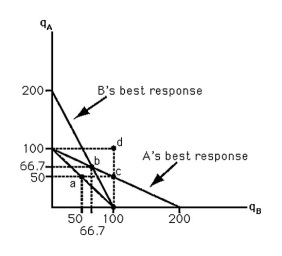 -The above figure shows the reaction functions for two pizza shops in a small isolated town.Firm B producing 100 pizzas and firm A producing 50 pizzas is not a Cournot equilibrium because
 (Multiple Choice)
4.9/5 (76)
(76) Draw a graph that shows the effect on the equilibrium quantities if the government subsidizes one firm in a Cournot duopoly with a per-unit subsidy.Assume that the best-response functions are linear.Explain the new equilibrium quantities.
(Essay)
5.0/5 (74)
(74) If there are 2 identical firms in a market that choose the quantity they produce,total welfare is the highest when there is a cartel.
(True/False)
4.9/5 (62)
(62) Explain why a monopoly or a perfectly competitive firm does not consider a rival firm's behavior,but an oligopoly and a monopolistically competitive firm do.
(Essay)
5.0/5 (79)
(79) Suppose a monopolistically competitive industry evolved into a perfectly competitive industry.Which of the following statements is correct?
(Multiple Choice)
5.0/5 (72)
(72) Suppose the demand for Pepsi-Cola is qp = 50 - 2pp + 1pc.The firm faces a constant marginal cost of m,and pc denotes the price of Coca-Cola.Assuming Bertrand behavior,derive Pepsi-Cola's best-response function and explain how the firm changes price in response to changes in its own marginal cost and changes in Coca-Cola's price.
(Essay)
4.8/5 (79)
(79) Product differentiation allows a firm to charge a higher price because the residual demand curve facing the firm
(Multiple Choice)
4.8/5 (76)
(76)
-The above figure shows the reaction functions for two pizza shops in a small isolated town.The perfect competitive outcome is that
-The above figure shows the reaction functions for two pizza shops in a small isolated town.The perfect competitive outcome is that (Multiple Choice)
4.8/5 (76)
(76) In a Bertrand model,graphically,the intersection of all firms' best-response curves determines
(Multiple Choice)
4.8/5 (86)
(86) Explain why gasoline stations across the street from each other with large signs displaying their prices may "legally" jointly set monopoly prices.
(Essay)
4.9/5 (83)
(83) Suppose the demand for Pepsi-Cola is qp = 54 - 2pp + 1pc.The demand for Coca-Cola is
qc = 54 - 2pc + 1pp.Each firm faces a constant marginal cost of zero.Determine the Bertrand equilibrium prices.What happens to the Bertrand equilibrium prices and profits if increased differentiation causes the demand for Pepsi-Cola to become qp = 104 - 2pp + 1pc while the demand for Coca-Cola remains unchanged?
(Essay)
4.8/5 (91)
(91) 
Filters
- Essay(0)
- Multiple Choice(0)
- Short Answer(0)
- True False(0)
- Matching(0)