



 Chat with AI
Exam 17: Stabilization in an Integrated World Economy

Exam 1: The Nature of Economics347 Questions
Exam 2: Scarcity and the World of Trade-Offs412 Questions
Exam 3: Demand and Supply448 Questions
Exam 4: Extensions of Demand and Supply Analysis399 Questions
Exam 5: Public Spending and Public Choice359 Questions
Exam 6: Funding the Public Sector202 Questions
Exam 7: The Macroeconomy: Unemployment, Inflation, and Deflation412 Questions
Exam 8: Measuring the Economys Performance413 Questions
Exam 9: Global Economic Growth and Development282 Questions
Exam 10: Real GDP and the Price Level in the Long Run290 Questions
Exam 11: Classical and Keynesian Macro Analyses365 Questions
Exam 12: Consumption, Real GDP, and the Multiplier445 Questions
Exam 13: Fiscal Policy273 Questions
Exam 14: Deficit Spending and the Public Debt145 Questions
Exam 15: Money, Banking, and Central Banking517 Questions
Exam 16: Domestic and International Dimensions of Monetary Policy357 Questions
Exam 17: Stabilization in an Integrated World Economy306 Questions
Exam 18: Policies and Prospects for Global Economic Growth216 Questions
Exam 19: Demand and Supply Elasticity413 Questions
Exam 20: Consumer Choice458 Questions
Exam 21: Rents, Profits, and the Financial Environment of Business445 Questions
Exam 22: The Firm: Cost and Output Determination387 Questions
Exam 23: Perfect Competition431 Questions
Exam 24: Monopoly386 Questions
Exam 25: Monopolistic Competition309 Questions
Exam 26: Oligopoly and Strategic Behavior306 Questions
Exam 27: Regulation and Antitrust Policy in a Globalized Economy309 Questions
Exam 28: The Labor Market: Demand, Supply and Outsourcing376 Questions
Exam 29: Unions and Labor Market Monopoly Power318 Questions
Exam 30: Income, Poverty, and Health Care302 Questions
Exam 31: Environmental Economics300 Questions
Exam 32: Comparative Advantage and the Open Economy314 Questions
Exam 33: Exchange Rates and the Balance of Payments300 Questions
Select questions type


Policy making that is carried out in response to a rule is
(Multiple Choice)
4.7/5  (83)
(83) Which of the following statements concerning price rigidity is true?
(Multiple Choice)
5.0/5 (86)
(86) According to A.W. Phillips, an inverse relationship has existed between
(Multiple Choice)
4.9/5 (77)
(77) In the short run, unanticipated inflation typically leads to
(Multiple Choice)
4.9/5 (81)
(81) In the aggregate supply-aggregate demand model, if every person in the economy correctly anticipates the inflation rate, the unemployment rate will
(Multiple Choice)
4.9/5 (83)
(83) Suppose the natural rate of unemployment is 5 percent. If the actual unemployment rate is 7 percent, then the cyclical unemployment rate
(Multiple Choice)
4.9/5 (77)
(77) Which of the following statements is consistent with the rational expectations hypothesis?
(Multiple Choice)
4.9/5 (92)
(92) According to the policy irrelevance proposition, monetary policy can affect real variables
(Multiple Choice)
4.9/5 (71)
(71)  -Refer to the above figure. Unexpected expansionary monetary policy has caused the aggregate demand curve to shift to
 . In the short run,
-Refer to the above figure. Unexpected expansionary monetary policy has caused the aggregate demand curve to shift to . In the short run, (Multiple Choice)
4.9/5 (82)
(82)  -Refer to the above figure. Suppose the economy is in long-run equilibrium at point A, and the government initiates an expansionary monetary policy to increase aggregate demand. Which of the following is a true statement concerning the differences between what happens when the governmental action is unanticipated and when it is anticipated?
 (Multiple Choice)
4.9/5 (78)
(78) Which of the following would NOT cause a real business cycle?
(Multiple Choice)
4.8/5 (80)
(80) 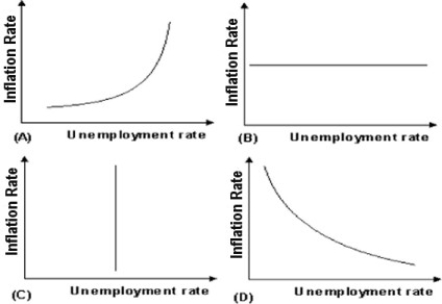 -Use the above figure. The long-run Phillips curve is best depicted by graph
 (Multiple Choice)
4.8/5 (77)
(77) When the actual unemployment rate is greater than the NAIRU, the inflation rate
(Multiple Choice)
4.8/5 (85)
(85) Which one of the following is an example of passive policy making?
(Multiple Choice)
4.8/5 (83)
(83) 
Filters
- Essay(0)
- Multiple Choice(0)
- Short Answer(0)
- True False(0)
- Matching(0)