



 Chat with AI
Exam 17: Stabilization in an Integrated World Economy

Exam 1: The Nature of Economics347 Questions
Exam 2: Scarcity and the World of Trade-Offs412 Questions
Exam 3: Demand and Supply448 Questions
Exam 4: Extensions of Demand and Supply Analysis399 Questions
Exam 5: Public Spending and Public Choice359 Questions
Exam 6: Funding the Public Sector202 Questions
Exam 7: The Macroeconomy: Unemployment, Inflation, and Deflation412 Questions
Exam 8: Measuring the Economys Performance413 Questions
Exam 9: Global Economic Growth and Development282 Questions
Exam 10: Real GDP and the Price Level in the Long Run290 Questions
Exam 11: Classical and Keynesian Macro Analyses365 Questions
Exam 12: Consumption, Real GDP, and the Multiplier445 Questions
Exam 13: Fiscal Policy273 Questions
Exam 14: Deficit Spending and the Public Debt145 Questions
Exam 15: Money, Banking, and Central Banking517 Questions
Exam 16: Domestic and International Dimensions of Monetary Policy357 Questions
Exam 17: Stabilization in an Integrated World Economy306 Questions
Exam 18: Policies and Prospects for Global Economic Growth216 Questions
Exam 19: Demand and Supply Elasticity413 Questions
Exam 20: Consumer Choice458 Questions
Exam 21: Rents, Profits, and the Financial Environment of Business445 Questions
Exam 22: The Firm: Cost and Output Determination387 Questions
Exam 23: Perfect Competition431 Questions
Exam 24: Monopoly386 Questions
Exam 25: Monopolistic Competition309 Questions
Exam 26: Oligopoly and Strategic Behavior306 Questions
Exam 27: Regulation and Antitrust Policy in a Globalized Economy309 Questions
Exam 28: The Labor Market: Demand, Supply and Outsourcing376 Questions
Exam 29: Unions and Labor Market Monopoly Power318 Questions
Exam 30: Income, Poverty, and Health Care302 Questions
Exam 31: Environmental Economics300 Questions
Exam 32: Comparative Advantage and the Open Economy314 Questions
Exam 33: Exchange Rates and the Balance of Payments300 Questions
Select questions type


 -In the above figure, starting at
 , if there is a supply shock that is permanent, the
-In the above figure, starting at , if there is a supply shock that is permanent, the (Multiple Choice)
4.9/5  (70)
(70) New Keynesian inflation dynamics can account for sluggish responses of
(Multiple Choice)
5.0/5 (73)
(73) Assume that the government decides to use fiscal or monetary policy to stimulate the economy and that this action comes as a surprise to most individuals and businesses. In the short run, the result will be
(Multiple Choice)
4.8/5 (89)
(89) A hypothesis that assumes that people combine the effects of past policy changes on economic events and their own judgment about future effects of current and future policy changes is known as
(Multiple Choice)
4.7/5 (69)
(69) Which of the following is the rate of unemployment that occurs after all adjustments in the labor market have occurred?
(Multiple Choice)
4.9/5 (82)
(82) 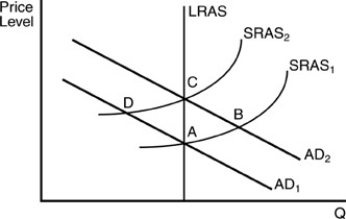 -In the above figure, suppose the economy is initially at a short-run equilibrium at point D and there is an unanticipated increase in the money supply. Which point represents the new short-run equilibrium?
 (Multiple Choice)
4.8/5 (86)
(86)
-In the above figure, suppose the economy is currently in equilibrium at point C. Applying rational expectations theory, what happens if the Fed announces that it is decreasing the money supply and follows through on its statement?
-In the above figure, suppose the economy is currently in equilibrium at point C. Applying rational expectations theory, what happens if the Fed announces that it is decreasing the money supply and follows through on its statement? (Multiple Choice)
4.7/5 (75)
(75) The Federal Reserve is anticipating a contractionary period in the economy. The Fed decides to engage in open market operations to stimulate the economy. This action is
(Multiple Choice)
4.9/5 (90)
(90) In new Keynesian theory, the pattern of inflation exhibited by an economy with growing aggregate demand known as inflation dynamics is
(Multiple Choice)
4.9/5 (74)
(74) The stagflation experienced in the U.S. during the late 1960s and the 1970s showed us that
(Multiple Choice)
4.8/5 (90)
(90) Real business cycle theory emphasizes the effect of ________ on economic performance.
(Multiple Choice)
4.9/5 (82)
(82)  -Refer to the above figure. Unexpected contractionary monetary policy has caused the aggregate demand curve to shift to
 . In the short run,
-Refer to the above figure. Unexpected contractionary monetary policy has caused the aggregate demand curve to shift to . In the short run, (Multiple Choice)
4.7/5 (65)
(65) What did Milton Friedman and E.S. Phelps argue with respect to the Phillips Curve?
(Multiple Choice)
4.8/5 (88)
(88) The rational expectations hypothesis suggests that if wages and prices are flexible,
(Multiple Choice)
4.8/5 (82)
(82) According to some New Keynesian theories, one possible rationale for active policy making is
(Multiple Choice)
4.9/5 (61)
(61) The idea of policy making being undertaken as a response to a change in the economy is referred to as
(Multiple Choice)
4.7/5 (62)
(62) According to the real business cycle theory, an increase in an input price, such as oil, will
(Multiple Choice)
4.7/5 (74)
(74) 
Filters
- Essay(0)
- Multiple Choice(0)
- Short Answer(0)
- True False(0)
- Matching(0)