



 Chat with AI
Exam 16: Domestic and International Dimensions of Monetary Policy

Exam 1: The Nature of Economics347 Questions
Exam 2: Scarcity and the World of Trade-Offs412 Questions
Exam 3: Demand and Supply448 Questions
Exam 4: Extensions of Demand and Supply Analysis399 Questions
Exam 5: Public Spending and Public Choice359 Questions
Exam 6: Funding the Public Sector202 Questions
Exam 7: The Macroeconomy: Unemployment, Inflation, and Deflation412 Questions
Exam 8: Measuring the Economys Performance413 Questions
Exam 9: Global Economic Growth and Development282 Questions
Exam 10: Real GDP and the Price Level in the Long Run290 Questions
Exam 11: Classical and Keynesian Macro Analyses365 Questions
Exam 12: Consumption, Real GDP, and the Multiplier445 Questions
Exam 13: Fiscal Policy273 Questions
Exam 14: Deficit Spending and the Public Debt145 Questions
Exam 15: Money, Banking, and Central Banking517 Questions
Exam 16: Domestic and International Dimensions of Monetary Policy357 Questions
Exam 17: Stabilization in an Integrated World Economy306 Questions
Exam 18: Policies and Prospects for Global Economic Growth216 Questions
Exam 19: Demand and Supply Elasticity413 Questions
Exam 20: Consumer Choice458 Questions
Exam 21: Rents, Profits, and the Financial Environment of Business445 Questions
Exam 22: The Firm: Cost and Output Determination387 Questions
Exam 23: Perfect Competition431 Questions
Exam 24: Monopoly386 Questions
Exam 25: Monopolistic Competition309 Questions
Exam 26: Oligopoly and Strategic Behavior306 Questions
Exam 27: Regulation and Antitrust Policy in a Globalized Economy309 Questions
Exam 28: The Labor Market: Demand, Supply and Outsourcing376 Questions
Exam 29: Unions and Labor Market Monopoly Power318 Questions
Exam 30: Income, Poverty, and Health Care302 Questions
Exam 31: Environmental Economics300 Questions
Exam 32: Comparative Advantage and the Open Economy314 Questions
Exam 33: Exchange Rates and the Balance of Payments300 Questions
Select questions type


Which of the following would NOT be a result of a contractionary monetary policy?
(Multiple Choice)
5.0/5  (83)
(83)  -Refer to the above figure. Which panel is consistent with the Fed selling bonds?
 (Multiple Choice)
4.9/5 (74)
(74) As global financial markets become more intertwined, the Fed has
(Multiple Choice)
5.0/5 (87)
(87) According to the interest-rate-based monetary policy transmission mechanism,
(Multiple Choice)
4.9/5 (63)
(63) Both the precautionary and asset demand for money are influenced by
(Multiple Choice)
4.9/5 (74)
(74) 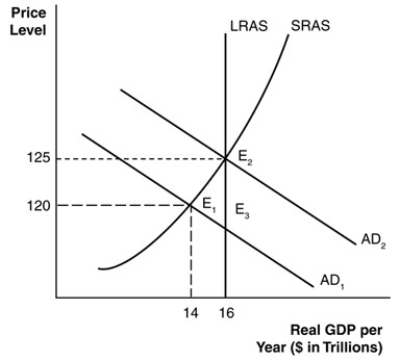 -In the above figure, if the economy is at equilibrium at E1, the Fed would most likely
 (Multiple Choice)
4.8/5 (72)
(72) How is the effect of expansionary monetary policy depicted in an aggregate supply-aggregate demand graph?
(Multiple Choice)
4.9/5 (86)
(86) An appreciation of the U.S. dollar is most likely a result that
(Multiple Choice)
4.9/5 (82)
(82) Which of the following represents the opportunity cost of holding money?
(Multiple Choice)
4.9/5 (80)
(80) The interest-rate-based approach to the monetary policy transmission mechanism says that a change in the money supply influences aggregate demand by
(Multiple Choice)
4.8/5 (85)
(85) Why is it more difficult for the Fed to control the money supply today than it was fifty years ago?
(Essay)
4.9/5 (74)
(74) According to the simple quantity theory of money, which of the following variables are considered either constant or relatively stable?
(Multiple Choice)
4.9/5 (69)
(69) 
Filters
- Essay(0)
- Multiple Choice(0)
- Short Answer(0)
- True False(0)
- Matching(0)