



 Chat with AI
Exam 16: Domestic and International Dimensions of Monetary Policy

Exam 1: The Nature of Economics347 Questions
Exam 2: Scarcity and the World of Trade-Offs412 Questions
Exam 3: Demand and Supply448 Questions
Exam 4: Extensions of Demand and Supply Analysis399 Questions
Exam 5: Public Spending and Public Choice359 Questions
Exam 6: Funding the Public Sector202 Questions
Exam 7: The Macroeconomy: Unemployment, Inflation, and Deflation412 Questions
Exam 8: Measuring the Economys Performance413 Questions
Exam 9: Global Economic Growth and Development282 Questions
Exam 10: Real GDP and the Price Level in the Long Run290 Questions
Exam 11: Classical and Keynesian Macro Analyses365 Questions
Exam 12: Consumption, Real GDP, and the Multiplier445 Questions
Exam 13: Fiscal Policy273 Questions
Exam 14: Deficit Spending and the Public Debt145 Questions
Exam 15: Money, Banking, and Central Banking517 Questions
Exam 16: Domestic and International Dimensions of Monetary Policy357 Questions
Exam 17: Stabilization in an Integrated World Economy306 Questions
Exam 18: Policies and Prospects for Global Economic Growth216 Questions
Exam 19: Demand and Supply Elasticity413 Questions
Exam 20: Consumer Choice458 Questions
Exam 21: Rents, Profits, and the Financial Environment of Business445 Questions
Exam 22: The Firm: Cost and Output Determination387 Questions
Exam 23: Perfect Competition431 Questions
Exam 24: Monopoly386 Questions
Exam 25: Monopolistic Competition309 Questions
Exam 26: Oligopoly and Strategic Behavior306 Questions
Exam 27: Regulation and Antitrust Policy in a Globalized Economy309 Questions
Exam 28: The Labor Market: Demand, Supply and Outsourcing376 Questions
Exam 29: Unions and Labor Market Monopoly Power318 Questions
Exam 30: Income, Poverty, and Health Care302 Questions
Exam 31: Environmental Economics300 Questions
Exam 32: Comparative Advantage and the Open Economy314 Questions
Exam 33: Exchange Rates and the Balance of Payments300 Questions
Select questions type


According to the interest-rate-based monetary policy transmission mechanism,
(Multiple Choice)
4.8/5  (82)
(82) According to the interest-rate-based perspective on the monetary policy transmission mechanism,
(Multiple Choice)
4.8/5 (81)
(81) If you initially pay $1,000 for a bond with an annual interest rate of 5 percent, but then the market interest rate rises to 6 percent,
(Multiple Choice)
4.7/5 (87)
(87) Warren always carries a one hundred dollar bill in case of emergencies. This is an example of the
(Multiple Choice)
4.8/5 (75)
(75) According to the interest-rate-based transmission mechanism, a decrease in the money supply will
(Multiple Choice)
4.8/5 (84)
(84) Describe and explain the relationship between the price of bonds and the interest rate.
(Essay)
4.8/5 (73)
(73) Which of the following actions by the Fed would lead to an increase in the money supply?
(Multiple Choice)
4.9/5 (69)
(69) An open market sale of government securities by the Fed will cause which of the following?
(Multiple Choice)
4.7/5 (67)
(67) It has been observed that a change in monetary policy in the United States
(Multiple Choice)
4.8/5 (83)
(83) Suppose the actual federal funds rate is below the rate implied by a particular inflation goal. In this situation, the Taylor rule implies that
(Multiple Choice)
4.9/5 (84)
(84) As nominal Gross Domestic Product (GDP) rises, people will wish to
(Multiple Choice)
4.8/5 (70)
(70) How would expansionary monetary policy affect the AD curve?
(Multiple Choice)
4.7/5 (72)
(72) 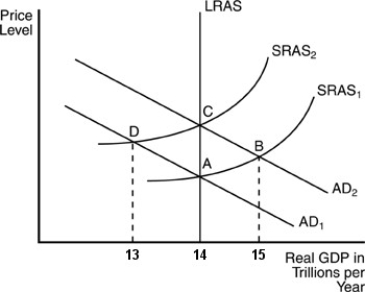 -Look at the above figure. Suppose the economy was initially in equilibrium at point A. What point would represent the short-run equilibrium if the Fed makes an open market purchase of bonds?
 (Multiple Choice)
4.9/5 (86)
(86) When households hold money for unplanned expenditures and emergencies, it is called
(Multiple Choice)
4.9/5 (82)
(82) It is the responsibility of the Trading Desk at the Federal Reserve Bank of New York to implement policies in the form of
(Multiple Choice)
4.8/5 (70)
(70)  -In the above figure, assume the economy starts out in equilibrium at point d. If the Fed increases the money supply so that the new aggregate demand curve is AD3, then the long-run equilibrium will be at point
 (Multiple Choice)
4.9/5 (81)
(81) 
Filters
- Essay(0)
- Multiple Choice(0)
- Short Answer(0)
- True False(0)
- Matching(0)