



 Chat with AI
Exam 26: Short-Term Finance and Planning

Exam 1: Introduction to Corporate Finance67 Questions
Exam 2: Financial Statements and Cash Flow94 Questions
Exam 3: Financial Statements Analysis and Financial Models120 Questions
Exam 4: Discounted Cash Flow Valuation134 Questions
Exam 5: Net Present Value and Other Investment Rules105 Questions
Exam 6: Making Capital Investment Decisions101 Questions
Exam 7: Risk Analysis, Real Options, and Capital Budgeting99 Questions
Exam 8: Interest Rates and Bond Valuation69 Questions
Exam 9: Stock Valuation77 Questions
Exam 10: Risk and Return: Lessons From Market History84 Questions
Exam 11: Return and Risk: the Capital Asset Pricing Model Capm136 Questions
Exam 12: An Alternative View of Risk and Return: The Arbitrage Pricing Theory51 Questions
Exam 13: Risk, Cost of Capital, and Valuation59 Questions
Exam 14: Efficient Capital Markets and Behavioral Challenges65 Questions
Exam 15: Long-Term Financing46 Questions
Exam 16: Capital Structure: Basic Concepts91 Questions
Exam 17: Capital Structure: Limits to the Use of Debt74 Questions
Exam 18: Valuation and Capital Budgeting for the Levered Firm57 Questions
Exam 19: Dividends and Other Payouts90 Questions
Exam 20: Raising Capital73 Questions
Exam 21: Leasing55 Questions
Exam 22: Options and Corporate Finance95 Questions
Exam 23: Options and Corporate Finance: Extensions and Applications46 Questions
Exam 24: Warrants and Convertibles58 Questions
Exam 25: Derivatives and Hedging Risk66 Questions
Exam 26: Short-Term Finance and Planning124 Questions
Exam 27: Cash Management59 Questions
Exam 28: Credit and Inventory Management61 Questions
Exam 29: Mergers, Acquisitions, and Divestitures83 Questions
Exam 30: Financial Distress52 Questions
Exam 31: International Corporate Finance95 Questions
Select questions type


Your firm collects 30% of sales in the month of sale,55% of sales in the month following the month of sale and 13% of sales in the second month following the month of sale. Given this,you will collect _____ sales during the month of June.
(Multiple Choice)
4.9/5  (68)
(68) Your firm has a net cash inflow for the quarter of $60. The beginning cash balance is $35. Company policy is to maintain a minimum cash balance of $15 and borrow only the amount that is necessary to maintain that balance. How much does your firm need to borrow or how much can it repay on its loans to have a zero cumulative surplus?
(Multiple Choice)
4.8/5 (74)
(74) Jordan and Sons has an inventory period of 33 days,an accounts payable period of 41 days and an accounts receivable period of 27 days. Management is considering offering a 5% discount if its credit customers pay for their purchases within 10 days. If the new discount is offered the accounts receivable period is expected to decline by 13 days. If the new discount is offered,the operating cycle will decrease from _____ days to _____ days.
(Multiple Choice)
4.8/5 (69)
(69) Which of the following are associated with a restrictive short-term financial policy?
I. large investments in marketable securities
II. liberal credit terms for customers
III. minimal cash balances
IV. minimal credit sales
(Multiple Choice)
4.8/5 (86)
(86) Which of the following actions will tend to decrease the inventory period?
I. discontinuing all slow-selling merchandise
II. selling obsolete inventory below cost just to get rid of it
III. buying raw materials only as they are needed in the manufacturing process
IV. producing goods on demand versus for inventory
(Multiple Choice)
4.9/5 (88)
(88) As the CFO of Jonathan's Auto Recycling,you plan to implement a system whereby customers who pay their bills on time will receive a 10% rebate on their purchases. Those who pay earlier than required will receive a 15% rebate. Explain the impact of this proposal on the firm.
(Essay)
4.7/5 (95)
(95) Costs of the firm that rise with increased levels of investment in its current assets are called _____ costs.
(Multiple Choice)
4.8/5 (84)
(84) Blue Moon Corporation's Balance Sheet and Income Statement as shown below: 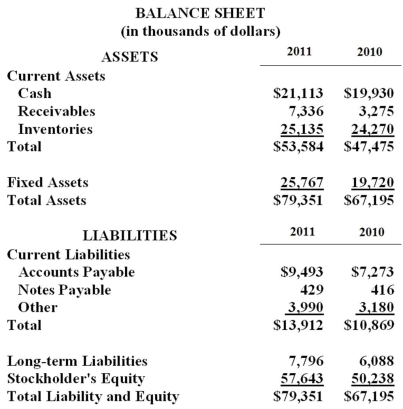
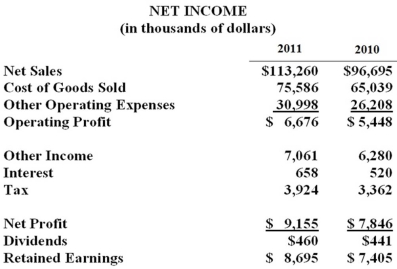 The average inventory for the Blue Moon Corporation in 2011 is __________.
 (Multiple Choice)
5.0/5 (81)
(81) The length of time between the acquisition of inventory and the collection of cash from receivables is called the:
(Multiple Choice)
4.9/5 (87)
(87) Your bank offers you a $70,000 line of credit with an interest rate of 2.75% per quarter. The loan agreement also requires that 5% of the unused portion of the credit line be deposited in a non-interest bearing account as a compensating balance. Your short-term investments are paying ½ of 1% per month. What is your effective annual interest rate on this arrangement if you do not borrow any money on this credit line during the year? Assume that both the funds you borrow and the funds you invest use compound interest.
(Multiple Choice)
4.9/5 (81)
(81) As of the beginning of the quarter,you have a cash balance of $250. During the quarter you pay your suppliers $310. Your accounts receivable collections are $420. You also pay an interest payment of $30 and a tax bill of $180. In addition,you borrow $75. What is your cash balance at the end of the quarter?
(Multiple Choice)
4.7/5 (91)
(91) ABC Manufacturing historically produced products that were held in inventory until they could be sold to a customer. The firm is now changing its policy and only producing a product when it receives an actual order from a customer. All else equal,this change will:
(Multiple Choice)
4.8/5 (72)
(72) Birds Unlimited has a 45 day accounts payable period. The firm has expected sales of $1,800,$2,100,$2,400 and $2,800,respectively,by quarter for the next calendar year. The cost of goods sold for a quarter is equal to 65% of the next quarter sales. What is the amount of the projected cash disbursements for accounts payable for Quarter 2 of the next year? Assume that a year has 360 days.
(Multiple Choice)
4.9/5 (81)
(81) 
Filters
- Essay(0)
- Multiple Choice(0)
- Short Answer(0)
- True False(0)
- Matching(0)