



 Chat with AI
Exam 26: Short-Term Finance and Planning

Exam 1: Introduction to Corporate Finance67 Questions
Exam 2: Financial Statements and Cash Flow94 Questions
Exam 3: Financial Statements Analysis and Financial Models120 Questions
Exam 4: Discounted Cash Flow Valuation134 Questions
Exam 5: Net Present Value and Other Investment Rules105 Questions
Exam 6: Making Capital Investment Decisions101 Questions
Exam 7: Risk Analysis, Real Options, and Capital Budgeting99 Questions
Exam 8: Interest Rates and Bond Valuation69 Questions
Exam 9: Stock Valuation77 Questions
Exam 10: Risk and Return: Lessons From Market History84 Questions
Exam 11: Return and Risk: the Capital Asset Pricing Model Capm136 Questions
Exam 12: An Alternative View of Risk and Return: The Arbitrage Pricing Theory51 Questions
Exam 13: Risk, Cost of Capital, and Valuation59 Questions
Exam 14: Efficient Capital Markets and Behavioral Challenges65 Questions
Exam 15: Long-Term Financing46 Questions
Exam 16: Capital Structure: Basic Concepts91 Questions
Exam 17: Capital Structure: Limits to the Use of Debt74 Questions
Exam 18: Valuation and Capital Budgeting for the Levered Firm57 Questions
Exam 19: Dividends and Other Payouts90 Questions
Exam 20: Raising Capital73 Questions
Exam 21: Leasing55 Questions
Exam 22: Options and Corporate Finance95 Questions
Exam 23: Options and Corporate Finance: Extensions and Applications46 Questions
Exam 24: Warrants and Convertibles58 Questions
Exam 25: Derivatives and Hedging Risk66 Questions
Exam 26: Short-Term Finance and Planning124 Questions
Exam 27: Cash Management59 Questions
Exam 28: Credit and Inventory Management61 Questions
Exam 29: Mergers, Acquisitions, and Divestitures83 Questions
Exam 30: Financial Distress52 Questions
Exam 31: International Corporate Finance95 Questions
Select questions type


ABC,Inc. has a beginning receivables balance on January 1st of $430. Sales for January through April are $240,$250,$330 and $350,respectively. The accounts receivable period is 60 days. How much did the firm collect in the month of March? Assume that a year has 360 days.
(Multiple Choice)
4.7/5  (66)
(66) D & F,Inc. expects sales of $620,$650,$730 and $780 for the months of April through July,respectively. The firm collects 20% of sales in the month of sale,50% in the month following the month of sale and 28% in the second month following the month of sale. The remaining 2% of sales is never collected. How much money does the firm expect to collect in the month of July?
(Multiple Choice)
4.7/5 (78)
(78) Which of the following actions will tend to decrease the accounts receivable period?
I. loosening the standards for granting credit to customers
II. increasing the discount for early payment by credit customers
III. increasing the finance charges applied to all customer balances outstanding over thirty days
IV. granting discounts for cash sales
(Multiple Choice)
4.9/5 (76)
(76) An increase in which one of the following is most apt to be an indicator of an accounts receivable policy that is too restrictive?
(Multiple Choice)
4.8/5 (73)
(73) A firm currently has a 36 day cash cycle. Assume that the firm changes its operations such that it decreases its receivables period by 4 days,increases its inventory period by 1 day and decreases its payables period by 2 days. What will the length of the cash cycle be after these changes?
(Multiple Choice)
4.7/5 (84)
(84) A restrictive short-term financial policy,as compared to a more flexible policy,tends to: I. cause a firm to lose sales due to a lack of inventory on hand.
II) increase the sales of a firm due to the firm's credit availability and terms.
III) increase the probability that a firm will face a cash-out situation.
IV) increase the ability of a firm to charge premium prices.
(Multiple Choice)
4.8/5 (92)
(92) A prearranged credit agreement with a bank typically open for two or more years is called a:
(Multiple Choice)
5.0/5 (86)
(86) Which one of the following will increase the accounts payable period,all else constant?
(Multiple Choice)
4.8/5 (82)
(82) Your bank offers you a $40,000 line of credit with an interest rate of 2.35% per quarter. The loan agreement also requires that 5% of the unused portion of the credit line be deposited in a non-interest bearing account as a compensating balance. Your short-term investments are paying 1.75% per quarter. What is your effective annual interest rate if you borrow the whole $40,000 for the entire year? Assume that both the funds you borrow and the funds you invest use compound interest.
(Multiple Choice)
4.8/5 (74)
(74) A prearranged,short-term bank loan made on a formal or informal basis,and typically reviewed for renewal annually,is called a:
(Multiple Choice)
4.8/5 (78)
(78) Your firm currently has an operating cycle of 64 days. You are analyzing some operational changes which are expected to decrease the accounts receivable period by 3 days and decrease the inventory period by 2 days. The accounts payable turnover rate is expected to increase from 7 to 9 times per year. If all of these changes are adopted,what will your firm's new operating cycle be?
(Multiple Choice)
4.8/5 (93)
(93) Blue Moon Corporation's Balance Sheet and Income Statement as shown below: 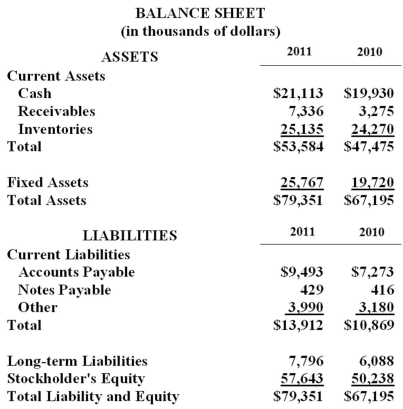
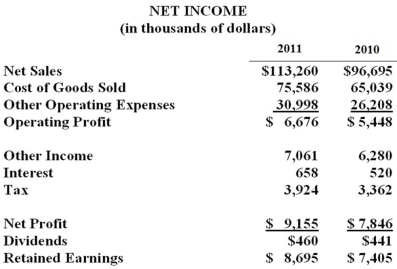 Blue Moon Corporation's cash cycle for 2011 is:
 (Multiple Choice)
4.9/5 (79)
(79) Your firm has a line of credit with your local bank for $50,000. The loan agreement calls for interest of 9% with a 5% compensating balance requirement which is based on the total amount borrowed. What is the effective interest rate if you need $42,750 for one year to cover your operating expenses?
(Multiple Choice)
4.9/5 (91)
(91) On April 1st,your firm had a beginning cash balance of $280. Your sales for March were $460 and your April sales were $510. During April you had cash expenses of $130 and payments on your accounts payable of $210. Your accounts receivable period is 30 days. What is your firm's beginning cash balance on May 1st?
(Multiple Choice)
4.8/5 (81)
(81) Blue Moon Corporation's Balance Sheet and Income Statement as shown below: 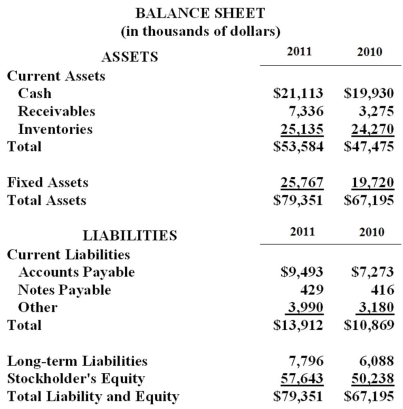
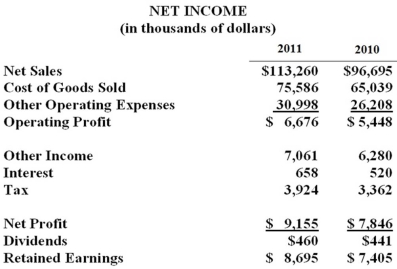 The operating cycle for 2011 for Blue Moon Corporation is:
 (Multiple Choice)
5.0/5 (93)
(93) The primary difference between a line of credit and a revolving credit arrangement is the:
(Multiple Choice)
4.9/5 (91)
(91) A compensating balance: I. is required when a firm acquires bank financing other than a line of credit.
II) increases the cost of short-term bank financing.
III) represents an opportunity cost to the lending institution.
IV) is often used as a means of paying for banking services received.
(Multiple Choice)
4.8/5 (68)
(68) Your bank offers you a $100,000 line of credit with an interest rate of 2.5% per quarter. The loan agreement also requires that 4% of the unused portion of the credit line be deposited in a non-interest bearing account as a compensating balance. Your short-term investments are paying 1.25% per quarter. What is your effective annual interest rate if you borrow the whole $100,000 for the entire year? Assume that both the funds you borrow and the funds you invest use compound interest.
(Multiple Choice)
4.8/5 (70)
(70) 
Filters
- Essay(0)
- Multiple Choice(0)
- Short Answer(0)
- True False(0)
- Matching(0)