



 Chat with AI
Exam 20: Working Capital Management

Exam 1: Goals and Governance of the Firm99 Questions
Exam 2: Financial Markets and Institutions65 Questions
Exam 3: Accounting and Finance124 Questions
Exam 4: Measuring Corporate Performance123 Questions
Exam 5: The Time Value of Money129 Questions
Exam 6: Valuing Bonds130 Questions
Exam 7: Valuing Stocks145 Questions
Exam 8: Net Present Value and Other Investment Criteria130 Questions
Exam 9: Using Discounted Cash-Flow Analysis to Make Investment Decisions127 Questions
Exam 10: Project Analysis 130 Questions
Exam 11: Introduction to Risk, Return, and the Opportunity Cost of Capital127 Questions
Exam 12: Risk, Return, and Capital Budgeting123 Questions
Exam 13: The Weighted-Average Cost of Capital and Company Valuation131 Questions
Exam 14: Introduction to Corporate Financing and Governance122 Questions
Exam 15: Venture Capital, Ipos, and Seasoned Offerings127 Questions
Exam 16: Debt Policy123 Questions
Exam 17: Payout Policy110 Questions
Exam 18: Long-Term Financial Planning129 Questions
Exam 19: Short-Term Financial Planning132 Questions
Exam 20: Working Capital Management140 Questions
Exam 21: Mergers, Acquisitions, and Corporate Control120 Questions
Exam 22: International Financial Management100 Questions
Exam 23: Options122 Questions
Exam 24: Risk Management125 Questions
Exam 25: Conclusion127 Questions
Exam 26: What We Do and Do Not Know About Finance122 Questions
Select questions type


If a firm decided to speed up its collection from its customers by reducing the receivables period and kept the inventory period and payable period the same, then:
(Multiple Choice)
4.8/5  (87)
(87) Which of the following would not be considered a use of cash?
(Multiple Choice)
4.8/5 (80)
(80) A firm faces a liquidity crunch and must decide between borrowing from a bank at 12% interest and stretching its payables for one quarter.If it stretches the payables it will forgo a 2% discount for timely payment.Based solely on cash flows, which would you suggest?
(Multiple Choice)
4.8/5 (80)
(80) Ignoring the risk of theft, cash balances cannot spoil, yet managers are concerned with carrying costs.Why?
(Multiple Choice)
4.9/5 (70)
(70) What was the sales volume in the current quarter if beginning accounts receivable, at $5,000, was $1,000 higher than ending, and $20,000 was collected?
(Multiple Choice)
4.9/5 (77)
(77) If a firm increases its accounts payable period, other things equal, it increases the cash conversion cycle.
(True/False)
4.8/5 (80)
(80) Calculate the accounts receivable period for a firm with annual sales of $10 million and average accounts receivable of $2 million.
(Multiple Choice)
4.7/5 (80)
(80) What is the cash conversion cycle for a firm with $3 million average inventories, $1.5 million average accounts payable, a receivables period of 45 days, and an annual cost of goods sold of $18 million?
(Multiple Choice)
4.9/5 (81)
(81) Company which sees a customer pay a $2,500 bill resulting from a previous sale will see no change in its net working capital.
(True/False)
4.9/5 (86)
(86) When a loan is secured by receivables, the firm assigns the receivables to the bank.If the firm fails to repay the loan, the bank can collect the receivables from the firm's customers and use the cash to pay off the debt.The risk of default on the receivables is now borne by the bank.
(True/False)
4.9/5 (72)
(72) Which of the following would not be included as a source of short-term financing?
(Multiple Choice)
4.8/5 (92)
(92) A firm sells its accounts receivable to a factor at a 5% discount.If the average collection period is 1 month, determine the effective annual rate of interest on the factoring.
(Multiple Choice)
4.8/5 (88)
(88) If a firm's current ratio exceeds 1.0, what happens as a result of paying cash to reduce accounts payable?
(Multiple Choice)
4.8/5 (63)
(63) What motivation is provided for managers not to follow the relaxed strategy of long- versus short-term financing?
(Multiple Choice)
5.0/5 (87)
(87) Issuing additional long-term debt of $5 million and buying new long-term assets worth $5 million will result in a net cash flow of:
(Multiple Choice)
4.9/5 (78)
(78) Which of the following is least likely to be correct for a firm that repeatedly stretches its payables?
(Multiple Choice)
4.9/5 (80)
(80) Calculate the Cash Conversion and Operating cycle, given the following information: 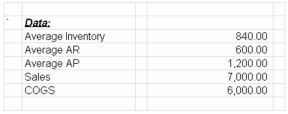
(Multiple Choice)
4.8/5 (78)
(78) A firm's inventory period can be estimated by the ratio of average inventory to daily output.
(True/False)
4.8/5 (79)
(79) 
Filters
- Essay(0)
- Multiple Choice(0)
- Short Answer(0)
- True False(0)
- Matching(0)