



 Chat with AI
Exam 20: Working Capital Management

Exam 1: Goals and Governance of the Firm99 Questions
Exam 2: Financial Markets and Institutions65 Questions
Exam 3: Accounting and Finance124 Questions
Exam 4: Measuring Corporate Performance123 Questions
Exam 5: The Time Value of Money129 Questions
Exam 6: Valuing Bonds130 Questions
Exam 7: Valuing Stocks145 Questions
Exam 8: Net Present Value and Other Investment Criteria130 Questions
Exam 9: Using Discounted Cash-Flow Analysis to Make Investment Decisions127 Questions
Exam 10: Project Analysis 130 Questions
Exam 11: Introduction to Risk, Return, and the Opportunity Cost of Capital127 Questions
Exam 12: Risk, Return, and Capital Budgeting123 Questions
Exam 13: The Weighted-Average Cost of Capital and Company Valuation131 Questions
Exam 14: Introduction to Corporate Financing and Governance122 Questions
Exam 15: Venture Capital, Ipos, and Seasoned Offerings127 Questions
Exam 16: Debt Policy123 Questions
Exam 17: Payout Policy110 Questions
Exam 18: Long-Term Financial Planning129 Questions
Exam 19: Short-Term Financial Planning132 Questions
Exam 20: Working Capital Management140 Questions
Exam 21: Mergers, Acquisitions, and Corporate Control120 Questions
Exam 22: International Financial Management100 Questions
Exam 23: Options122 Questions
Exam 24: Risk Management125 Questions
Exam 25: Conclusion127 Questions
Exam 26: What We Do and Do Not Know About Finance122 Questions
Select questions type


Which of the following statements is correct concerning marketable securities on a firm's balance sheet?
(Multiple Choice)
4.9/5  (76)
(76) What is the annual cost of goods for a firm, with accounts payable period of 35 days and average accounts payable of $600,000.
(Multiple Choice)
5.0/5 (82)
(82) A firm sells its $1,000,000 receivables to a factor for $960,000.Average collection period is one month.The effective annual rate is:
(Multiple Choice)
4.7/5 (79)
(79) Which of the following situations will improve the current ratio if it is initially less than 1.0?
(Multiple Choice)
4.9/5 (95)
(95) Calculate the value of Accounts Receivable, given the following information: 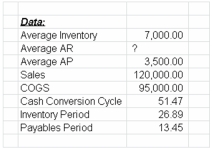
(Multiple Choice)
4.9/5 (94)
(94) Calculate the cash balance given the following information: 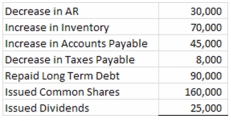
(Multiple Choice)
4.8/5 (80)
(80) Determine the value of Accounts Payable given the following information: 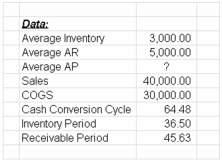
(Multiple Choice)
4.7/5 (76)
(76) Select the best loan terms from the banks below.The firm needs to obtain $500,000 in cash:
Bank A: 10% stated rate, 20% compensating balance that earns no interest.
Bank B: 12.5% stated rate, no compensating balance.
Bank C: 11% stated rate, 15% compensating balance that earns 2.5% interest.
(Essay)
4.9/5 (94)
(94) An increase in short-term interest rates will increase the carrying costs of the firm.
(True/False)
4.9/5 (77)
(77) A firm borrows $100,000 from the bank, but has to maintain a compensating balance of $20,000 with the bank.The annual interest rate for the loan is 12%.What is the effective annual rate if the interest is compounded monthly?
(Multiple Choice)
4.8/5 (90)
(90) Ignoring defaults, what is the approximate effective cost of factoring if receivables are sold at a 2% discount and the average collection period is 1 month?
(Multiple Choice)
4.8/5 (78)
(78) A firm borrows $200,000 from the bank, but has to maintain a compensating balance of $15,000 with the bank.The annual interest rate for the loan is 13%.What is the effective annual rate if the interest is compounded annually?
(Multiple Choice)
4.8/5 (85)
(85) Your accountant suspects a mistake in the computation of the payables period, which has been reported at 54.75 days.Calculate the correct payables period, given the following: annual sales = $1,200,000, annual cost of goods sold = $700,000, average accounts payable = $105,000.
(Multiple Choice)
4.9/5 (83)
(83) A firm needs spare cash to deal with capital budget appropriations, dividend payments, and other large outlays.The interest rate on bank loans is simply quoted as:
(Multiple Choice)
4.9/5 (92)
(92) A firm can reduce the cash conversion cycle by selling fewer goods on credit.
(True/False)
4.9/5 (86)
(86) How high can accounts receivable be allowed to grow before the firm's receivables period exceeds 50 days if annual sales equal $5 million and the cash conversion cycle equals 75 days?
(Multiple Choice)
4.8/5 (83)
(83) Company that pays $5,000 previously owed to one of its suppliers will see no change in its net working capital.
(True/False)
4.8/5 (75)
(75) 
Filters
- Essay(0)
- Multiple Choice(0)
- Short Answer(0)
- True False(0)
- Matching(0)