



 Chat with AI
Exam 20: Working Capital Management

Exam 1: Goals and Governance of the Firm99 Questions
Exam 2: Financial Markets and Institutions65 Questions
Exam 3: Accounting and Finance124 Questions
Exam 4: Measuring Corporate Performance123 Questions
Exam 5: The Time Value of Money129 Questions
Exam 6: Valuing Bonds130 Questions
Exam 7: Valuing Stocks145 Questions
Exam 8: Net Present Value and Other Investment Criteria130 Questions
Exam 9: Using Discounted Cash-Flow Analysis to Make Investment Decisions127 Questions
Exam 10: Project Analysis 130 Questions
Exam 11: Introduction to Risk, Return, and the Opportunity Cost of Capital127 Questions
Exam 12: Risk, Return, and Capital Budgeting123 Questions
Exam 13: The Weighted-Average Cost of Capital and Company Valuation131 Questions
Exam 14: Introduction to Corporate Financing and Governance122 Questions
Exam 15: Venture Capital, Ipos, and Seasoned Offerings127 Questions
Exam 16: Debt Policy123 Questions
Exam 17: Payout Policy110 Questions
Exam 18: Long-Term Financial Planning129 Questions
Exam 19: Short-Term Financial Planning132 Questions
Exam 20: Working Capital Management140 Questions
Exam 21: Mergers, Acquisitions, and Corporate Control120 Questions
Exam 22: International Financial Management100 Questions
Exam 23: Options122 Questions
Exam 24: Risk Management125 Questions
Exam 25: Conclusion127 Questions
Exam 26: What We Do and Do Not Know About Finance122 Questions
Select questions type


Although commercial paper is unsecured, the companies that issue this short-term security are:
(Multiple Choice)
4.8/5  (77)
(77) How do firms develop a short-term financing plan that meets their need for cash?
(Essay)
4.9/5 (71)
(71) A firm needs spare cash because during economic downturns, sales may fall below expectations while outflows could prove higher than was budgeted.Firms sell their accounts receivable at a discount for the purpose of:
(Multiple Choice)
4.8/5 (74)
(74) Calculate the Cash Conversion and Operating cycle, given the following information: 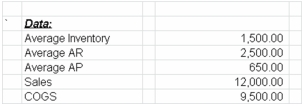
(Multiple Choice)
4.7/5 (80)
(80) A firm's inventory and accounts payable periods are 80 and 42 days respectively.How long can the firm's receivables period be in order to have no longer than a 65 day cash conversion cycle?
(Multiple Choice)
4.8/5 (80)
(80) When managers are continually short-term lenders they are said to follow a:
(Multiple Choice)
4.7/5 (87)
(87) A firm borrows $100,000 from the bank, but has to maintain a compensating balance of $20,000 with the bank.The annual interest rate for the loan is 12%.What is the effective annual rate if the interest is compounded semi-annually?
(Multiple Choice)
4.9/5 (99)
(99) With a line of credit, a firm can borrow and repay whenever it wants so long as the balance does not exceed the credit limit.
(True/False)
4.8/5 (87)
(87) When financial managers take action to minimize the carrying costs of current assets, they:
(Multiple Choice)
4.9/5 (76)
(76) If managers could automatically change each term in the equation of the cash conversion cycle, which of the following would be expected to provide the most benefit?
(Multiple Choice)
4.8/5 (80)
(80) What happens to a firm whose uses of cash exceed its sources of cash during an accounting period?
(Multiple Choice)
4.9/5 (86)
(86) Once the firm has sold its receivables, the factors bear all the responsibility for collecting on the account.
(True/False)
4.9/5 (73)
(73) What is the cash conversion cycle for a firm with a receivables period of 40 days, a payables period of 30 days, and an inventory period of 60 days?
(Multiple Choice)
5.0/5 (90)
(90) Field warehousing is a system of protecting the borrower against spoiled or stolen inventory.
(True/False)
4.9/5 (69)
(69) When product demand is high, firms following a "middle of the road policy" for long- versus short-term financing will:
(Multiple Choice)
4.7/5 (79)
(79) Which of the following is correct for a firm that reduces its accounts receivable balance from the previous quarter?
(Multiple Choice)
4.8/5 (82)
(82) When a firm finances long-term assets with short-term sources of funding, it:
(Multiple Choice)
4.8/5 (73)
(73) The factoring firm bears responsibility for default on accounts receivable purchased from a firm.
(True/False)
5.0/5 (80)
(80) 
Filters
- Essay(0)
- Multiple Choice(0)
- Short Answer(0)
- True False(0)
- Matching(0)