



 Chat with AI
Exam 11: Monetary Policy

Exam 1: Economics: Foundations and Models148 Questions
Exam 2: Trade-Offs, Comparative Advantage, and the Market System314 Questions
Exam 3: Where Prices Come From: The Interaction of Supply and Demand314 Questions
Exam 4: GDP: Measuring Total Production and Income277 Questions
Exam 5: Unemployment and Inflation300 Questions
Exam 6: Economic Growth, The Financial System, and Business Cycles262 Questions
Exam 7: Long-Run Economic Growth: Sources and Policies280 Questions
Exam 8: Aggregate Expenditure and Output in the Short Run315 Questions
Exam 9: Aggregate Demand and Aggregate Supply Analysis246 Questions
Exam 10: Money, Banks, and the Bank of Canada285 Questions
Exam 11: Monetary Policy281 Questions
Exam 12: Fiscal Policy303 Questions
Exam 13: Inflation, Unemployment, and Bank of Canada Policy265 Questions
Exam 14: Macroeconomics in an Open Economy280 Questions
Exam 15: The International Financial System228 Questions
Select questions type


Changes in interest rates affect all four components of aggregate demand.
(True/False)
4.8/5  (88)
(88) Using the money demand and money supply model, show and explain why the Bank of Canada cannot achieve a target for both the money supply and an interest rate.
(Essay)
4.8/5 (77)
(77) Use a graph to show the effects of a contractionary monetary policy to reduce inflation and move an economy back to potential real GDP.Explain what happens to aggregate demand, real GDP, and the price level.
(Essay)
4.9/5 (74)
(74) Which of the following correctly describes a monetary target the Bank of Canada has focused on?
(Multiple Choice)
4.8/5 (79)
(79) Figure 11.7  Alt text for Figure 11.7: In figure 11.7, a graph shows movement in the money market.
Long description for Figure 11.7: The x-axis is labelled, quantity of money, M (billions of dollars), with value 500 marked.The y-axis is labelled, interest rate, i, with values 4 and 5% marked.3 lines are shown; MD1, MD2, and MS.Line MD1 begins in the top left corner and slopes down to the end of the x-axis.Line MD2 follows the same slope as line MD1, but is plotted to the right.Line MS is perpendicular to the x-axis, and begins from the value 500.Line MD1 meets line MS at point A (500, 4), a little more than half way along both lines.Line MD2 meets line MS at point B (500, 5%), approximately 3 quarters of the way along both lines.These points of intersection are connected to their respective coordinates on the y-axis using dotted lines.
-Refer to Figure 11.7.In the figure above, the movement from point A to point B in the money market would be caused by
Alt text for Figure 11.7: In figure 11.7, a graph shows movement in the money market.
Long description for Figure 11.7: The x-axis is labelled, quantity of money, M (billions of dollars), with value 500 marked.The y-axis is labelled, interest rate, i, with values 4 and 5% marked.3 lines are shown; MD1, MD2, and MS.Line MD1 begins in the top left corner and slopes down to the end of the x-axis.Line MD2 follows the same slope as line MD1, but is plotted to the right.Line MS is perpendicular to the x-axis, and begins from the value 500.Line MD1 meets line MS at point A (500, 4), a little more than half way along both lines.Line MD2 meets line MS at point B (500, 5%), approximately 3 quarters of the way along both lines.These points of intersection are connected to their respective coordinates on the y-axis using dotted lines.
-Refer to Figure 11.7.In the figure above, the movement from point A to point B in the money market would be caused by (Multiple Choice)
4.8/5 (82)
(82) A borrower defaults on a loan when he stops making payments on the loan.
(True/False)
4.9/5 (82)
(82) The leader of the monetarist school and major proponent of a monetary growth rule was
(Multiple Choice)
4.9/5 (86)
(86) Suppose the Bank of Canada increases the money supply.Which of the following is true?
(Multiple Choice)
4.9/5 (90)
(90) Table 11.7  -Refer to Table 11.7.Suppose the table above illustrates the values of real and potential GDP and the price level if the Bank of Canada does not change its current policy to be more contractionary or expansionary.Suppose that the Bank of Canada uses an appropriate policy and is successful in keeping real GDP at potential in 2015.State whether each of the following will be higher or lower than if the Bank of Canada had taken no action:
a.real GDP
b.potential real GDP
c.the price level
d.the unemployment rate
-Refer to Table 11.7.Suppose the table above illustrates the values of real and potential GDP and the price level if the Bank of Canada does not change its current policy to be more contractionary or expansionary.Suppose that the Bank of Canada uses an appropriate policy and is successful in keeping real GDP at potential in 2015.State whether each of the following will be higher or lower than if the Bank of Canada had taken no action:
a.real GDP
b.potential real GDP
c.the price level
d.the unemployment rate (Essay)
4.9/5 (89)
(89) The core personal consumption expenditures price index excludes
(Multiple Choice)
4.9/5 (66)
(66) If money demand is extremely sensitive to changes in the interest rate, the money demand curve becomes almost horizontal.If the Bank of Canada expands the money supply under these circumstances, then the interest rate will
(Multiple Choice)
4.8/5 (66)
(66) The Taylor rule links the Bank of Canada's target for the
(Multiple Choice)
4.9/5 (100)
(100) Table 11.4  -Refer to Table 11.4.Consider the hypothetical information in the table above for potential real GDP, real GDP, and the price level in 2017 and in 2018 if the Bank of Canada does not use monetary policy.If the Bank of Canada uses monetary policy successfully to keep real GDP at its potential level in 2018, which of the following will be lower than if the Bank of Canada had taken no action?
 (Multiple Choice)
4.9/5 (86)
(86) Contractionary monetary policy refers to the Bank of Canada's decreasing the money supply and decreasing interest rates to decrease real GDP.
(True/False)
4.9/5 (76)
(76) In the following table, fill in the columns for your return on investment if the price of your house increases or decreases by 40 percent, based on the down payments specified in the first column.
Return on Your Investment From 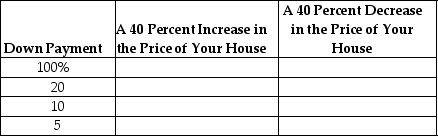
(Essay)
4.8/5 (62)
(62) Your income will increase if the Bank of Canada buys a Canada savings bond from you and pays you with a cheque.
(True/False)
4.8/5 (91)
(91) 
Filters
- Essay(0)
- Multiple Choice(0)
- Short Answer(0)
- True False(0)
- Matching(0)