



 Chat with AI
Exam 11: Monetary Policy

Exam 1: Economics: Foundations and Models148 Questions
Exam 2: Trade-Offs, Comparative Advantage, and the Market System314 Questions
Exam 3: Where Prices Come From: The Interaction of Supply and Demand314 Questions
Exam 4: GDP: Measuring Total Production and Income277 Questions
Exam 5: Unemployment and Inflation300 Questions
Exam 6: Economic Growth, The Financial System, and Business Cycles262 Questions
Exam 7: Long-Run Economic Growth: Sources and Policies280 Questions
Exam 8: Aggregate Expenditure and Output in the Short Run315 Questions
Exam 9: Aggregate Demand and Aggregate Supply Analysis246 Questions
Exam 10: Money, Banks, and the Bank of Canada285 Questions
Exam 11: Monetary Policy281 Questions
Exam 12: Fiscal Policy303 Questions
Exam 13: Inflation, Unemployment, and Bank of Canada Policy265 Questions
Exam 14: Macroeconomics in an Open Economy280 Questions
Exam 15: The International Financial System228 Questions
Select questions type


The dynamic aggregate demand and aggregate supply model accounts for the price level rising every year.
(True/False)
4.9/5  (83)
(83) Expansionary monetary policy refers to the ________ to increase real GDP.
(Multiple Choice)
4.8/5 (90)
(90) Contractionary monetary policy on the part of the Bank of Canada results in
(Multiple Choice)
4.8/5 (87)
(87) The Bank of Canada uses the rate of change in the CPI rather than the GDP deflator to measure inflation because
(Multiple Choice)
4.9/5 (95)
(95) When the Bank of Canada increases the money supply, people spend more because interest rates fall.
(True/False)
4.7/5 (75)
(75) Maintaining a strong dollar in international currency markets is not one of the four monetary policy goals of the Bank of Canada listed in the textbook.
(True/False)
4.8/5 (80)
(80) Monetary policy could be procyclical if the Bank of Canada
(Multiple Choice)
4.9/5 (85)
(85) The Bank of Canada can simultaneously reduce the inflation rate and stimulate growth through lowering interest rates.
(True/False)
4.8/5 (81)
(81) In the Taylor rule, does the target for the overnight interest rate respond differently for a recession caused by a decrease in aggregate demand and for a recession caused by a decrease in short-run aggregate supply? Explain whether there is or is not a difference in how the target for the overnight interest rate changes.
(Essay)
4.9/5 (78)
(78) Use the money demand and money supply model to show graphically and explain the effect on interest rates of the Bank of Canada's open market purchase of government securities.
(Essay)
4.9/5 (77)
(77) Figure 11.8 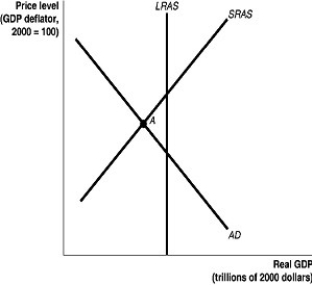 Alt text for Figure 11.8: In figure 11.8, a graph comparing real GDP and price level.
Long description for Figure 11.8: The x-axis is labelled, real GDP (trillions of 2000 dollars), and the y-axis is labelled, price level (GDP deflator, 2000 = 100).3 lines are shown; AD, LRAS, SRAS.Line AD begins in the top left corner and slopes down to the bottom center.Line SRAS begins in the bottom left corner and slopes up to the top right corner.Line LRAS is perpendicular to the x-axis, and intersects the lines AD and SRAS.The point of intersection of the lines AD and SRAS is marked as A.
-Refer to Figure 11.8.In the figure above, if the economy is at point A, the appropriate monetary policy by the Bank of Canada would be to
Alt text for Figure 11.8: In figure 11.8, a graph comparing real GDP and price level.
Long description for Figure 11.8: The x-axis is labelled, real GDP (trillions of 2000 dollars), and the y-axis is labelled, price level (GDP deflator, 2000 = 100).3 lines are shown; AD, LRAS, SRAS.Line AD begins in the top left corner and slopes down to the bottom center.Line SRAS begins in the bottom left corner and slopes up to the top right corner.Line LRAS is perpendicular to the x-axis, and intersects the lines AD and SRAS.The point of intersection of the lines AD and SRAS is marked as A.
-Refer to Figure 11.8.In the figure above, if the economy is at point A, the appropriate monetary policy by the Bank of Canada would be to (Multiple Choice)
4.8/5 (83)
(83) Figure 11.4  Alt text for Figure 11.4: In figure 11.4, a graph shows shift in money demand curve.
Long description for 11.4: The x-axis is labelled, quantity of money, M (billions of dollars).The y-axis is labelled, interest rate, i.2 lines are shown; Money demand 1 and Money demand 2.Line Money, demand 1, begins in the top left corner and slopes down to the end of the x-axis.Line Money, demand 2, follows the same slope as line Money, demand 1, but is plotted to the right.The area between the lines Money, demand 1, and Money, demand 2, is indicated by a right pointing arrow.
-Refer to Figure 11.4.In the figure above, the money demand curve would move from Money demand1 to Money demand2 if
Alt text for Figure 11.4: In figure 11.4, a graph shows shift in money demand curve.
Long description for 11.4: The x-axis is labelled, quantity of money, M (billions of dollars).The y-axis is labelled, interest rate, i.2 lines are shown; Money demand 1 and Money demand 2.Line Money, demand 1, begins in the top left corner and slopes down to the end of the x-axis.Line Money, demand 2, follows the same slope as line Money, demand 1, but is plotted to the right.The area between the lines Money, demand 1, and Money, demand 2, is indicated by a right pointing arrow.
-Refer to Figure 11.4.In the figure above, the money demand curve would move from Money demand1 to Money demand2 if (Multiple Choice)
4.7/5 (80)
(80) If the Bank of Canada targets the interest rate and the money demand curve shifts to the left, then the Bank of Canada
(Multiple Choice)
4.7/5 (86)
(86) Over the past decade, many economists have proposed that the United States should adopt inflation targeting, following the leads of many other central banks, including the Bank of Canada.
(True/False)
4.8/5 (85)
(85) Table 11.8  -Refer to Table 11.8.Suppose the table above illustrates the values of real and potential GDP and the price level if the Bank of Canada does not change its current policy to be more contractionary or expansionary.If the Bank of Canada wants to keep real GDP at its potential level in 2015, should the Bank of Canada use a contractionary or expansionary policy? Should it raise or lower its interest rate target? How should it conduct open market operations to achieve its goal?
 (Essay)
4.9/5 (69)
(69) Which of the following will lead to a decrease in the equilibrium interest rate in the economy?
(Multiple Choice)
4.9/5 (69)
(69) The situation in which short-term interest rates are pushed to zero, leaving the central bank unable to lower them further is known as
(Multiple Choice)
4.8/5 (75)
(75) 
Filters
- Essay(0)
- Multiple Choice(0)
- Short Answer(0)
- True False(0)
- Matching(0)