



 Chat with AI
Exam 11: Monetary Policy

Exam 1: Economics: Foundations and Models148 Questions
Exam 2: Trade-Offs, Comparative Advantage, and the Market System314 Questions
Exam 3: Where Prices Come From: The Interaction of Supply and Demand314 Questions
Exam 4: GDP: Measuring Total Production and Income277 Questions
Exam 5: Unemployment and Inflation300 Questions
Exam 6: Economic Growth, The Financial System, and Business Cycles262 Questions
Exam 7: Long-Run Economic Growth: Sources and Policies280 Questions
Exam 8: Aggregate Expenditure and Output in the Short Run315 Questions
Exam 9: Aggregate Demand and Aggregate Supply Analysis246 Questions
Exam 10: Money, Banks, and the Bank of Canada285 Questions
Exam 11: Monetary Policy281 Questions
Exam 12: Fiscal Policy303 Questions
Exam 13: Inflation, Unemployment, and Bank of Canada Policy265 Questions
Exam 14: Macroeconomics in an Open Economy280 Questions
Exam 15: The International Financial System228 Questions
Select questions type


Figure 11.6  Alt text for Figure 11.6: In figure 11.6, a graph shows movement in the money market.
Long description for Figure 11.6: The x-axis is labelled, quantity of money, M (billions of dollars), with values 900 and 950 marked.The y-axis is labelled, interest rate, i, with values 3 and 4% marked.3 lines are shown; MS1, MS2, and MD.Line MD begins in the top left corner and slopes down to the end of the x-axis.Line MS1 is perpendicular to the x-axis, and begins from the value 950.Line MS2 is perpendicular to the x-axis, and begins from the value 900, to the left of line MS1.Line MD intersects line MS1 at point A (950, 3), approximately 3 quarters of the way along both lines.Line MD meets line MS2 at point B (900, 4%), more than half way along both lines.These points of intersection are connected to their respective coordinates on the y-axis using dotted lines.
-Refer to Figure 11.6.In the figure above, the movement from point A to point B in the money market would be caused by
Alt text for Figure 11.6: In figure 11.6, a graph shows movement in the money market.
Long description for Figure 11.6: The x-axis is labelled, quantity of money, M (billions of dollars), with values 900 and 950 marked.The y-axis is labelled, interest rate, i, with values 3 and 4% marked.3 lines are shown; MS1, MS2, and MD.Line MD begins in the top left corner and slopes down to the end of the x-axis.Line MS1 is perpendicular to the x-axis, and begins from the value 950.Line MS2 is perpendicular to the x-axis, and begins from the value 900, to the left of line MS1.Line MD intersects line MS1 at point A (950, 3), approximately 3 quarters of the way along both lines.Line MD meets line MS2 at point B (900, 4%), more than half way along both lines.These points of intersection are connected to their respective coordinates on the y-axis using dotted lines.
-Refer to Figure 11.6.In the figure above, the movement from point A to point B in the money market would be caused by (Multiple Choice)
4.9/5  (92)
(92) According to the Taylor rule, does the target for the overnight interest rate respond differently for an increase in inflation caused by an increase in aggregate demand and for an increase in inflation caused by a decrease in short-run aggregate supply? Explain whether there is or is not a difference in how the target for the overnight interest rate changes.
(Essay)
4.9/5 (83)
(83) Which of the following statements about inflation targeting is true?
(Multiple Choice)
4.8/5 (90)
(90) Most of the pressure for a monetary growth rule has disappeared because since 1980,
(Multiple Choice)
4.8/5 (72)
(72) Which of the following characterizes the Bank of Canada's ability to prevent recessions?
(Multiple Choice)
4.8/5 (76)
(76) In reality, the Bank of Canada is unable to use monetary policy to keep real GDP exactly at its potential level.
(True/False)
4.8/5 (96)
(96) Why is the Bank of Canada limited to targeting the money supply or the interest rate, but not both simultaneously?
(Essay)
4.9/5 (84)
(84) Use the money demand and money supply model to show graphically and briefly explain the effect on the interest rate if real GDP increases.
(Essay)
4.7/5 (75)
(75) Using the Taylor rule, if the current inflation rate exceeds the target inflation rate and real GDP exceeds potential GDP, then the overnight interest target rate ________ the sum of the current inflation rate plus the equilibrium real overnight interest rate.
(Multiple Choice)
4.8/5 (87)
(87) Buying a house during a recession may be a good idea if your job is secure because the Bank of Canada often
(Multiple Choice)
5.0/5 (81)
(81) Figure 11.5  Alt text for Figure 11.5: In figure 11.5, a graph shows movement in money demand curve.
Long description for Figure 11.5: The x-axis is labelled, quantity of money, M (billions of dollars).The y-axis is labelled, interest rate, i.Line MD1 begins in the top left corner and slopes down to the bottom center.Points A and B are marked along line MD1.Point A is close to the bottom of the line, and point B is close to the top of the line.
-Refer to Figure 11.5.In the figure above, a movement from point A to point B would be caused by
Alt text for Figure 11.5: In figure 11.5, a graph shows movement in money demand curve.
Long description for Figure 11.5: The x-axis is labelled, quantity of money, M (billions of dollars).The y-axis is labelled, interest rate, i.Line MD1 begins in the top left corner and slopes down to the bottom center.Points A and B are marked along line MD1.Point A is close to the bottom of the line, and point B is close to the top of the line.
-Refer to Figure 11.5.In the figure above, a movement from point A to point B would be caused by (Multiple Choice)
4.7/5 (76)
(76) Which of the following is not an argument against inflation targeting?
(Multiple Choice)
4.8/5 (80)
(80) Under the monetary growth rule proposed by the monetarists, the money supply would grow each year at a constant rate equal to the long-run rate of growth of
(Multiple Choice)
4.9/5 (84)
(84) In October 2008, U.S.Congress passed the Troubled Asset Relief Program (TARP), under which the U.S.Treasury Department provided ________ to banks in exchange for ________.
(Multiple Choice)
4.8/5 (75)
(75) Suppose the Bank of Canada decreases the money supply.In response, households and firms will ________ short term assets and this will drive ________ interest rates.
(Multiple Choice)
4.7/5 (83)
(83) Which of the following statements about inflation targeting is true?
(Multiple Choice)
4.8/5 (82)
(82) Figure 11.15 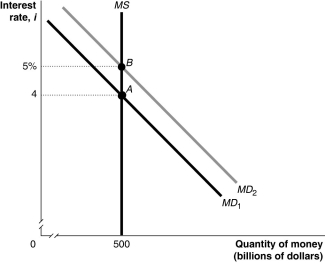 Alt text for Figure 11.15: In figure 11.15, a graph comparing quantity of money and interest rate.
Long description for Figure 11.15: The x-axis is labelled, quantity of money (billions of dollars).The y-axis is labelled, interest rate, i.3 lines are shown; MD1, MD2, and MS.Line MD1 begins at the top left corner and slopes down to the end of the x-axis.Line MD2 follows the same slope as MD1, but is plotted to the right.Line MS is perpendicular to the x-axis, and begins from the x-axis value 500.Line MD1 intersects line MS at point A (500, 4).Line MD2 intersects line MS at point B (500, 5%).Points A and B are connected to their respective coordinates on the y-axis with dotted lines.
-Refer to Figure 11.15.In the figure above, if the economy in Year 1 is at point A and expected in Year 2 to be at point B, then the appropriate monetary policy by the Bank of Canada would be to
Alt text for Figure 11.15: In figure 11.15, a graph comparing quantity of money and interest rate.
Long description for Figure 11.15: The x-axis is labelled, quantity of money (billions of dollars).The y-axis is labelled, interest rate, i.3 lines are shown; MD1, MD2, and MS.Line MD1 begins at the top left corner and slopes down to the end of the x-axis.Line MD2 follows the same slope as MD1, but is plotted to the right.Line MS is perpendicular to the x-axis, and begins from the x-axis value 500.Line MD1 intersects line MS at point A (500, 4).Line MD2 intersects line MS at point B (500, 5%).Points A and B are connected to their respective coordinates on the y-axis with dotted lines.
-Refer to Figure 11.15.In the figure above, if the economy in Year 1 is at point A and expected in Year 2 to be at point B, then the appropriate monetary policy by the Bank of Canada would be to (Multiple Choice)
4.9/5 (88)
(88) Would the Bank of Canada respond more aggressively with interest rate cuts in a recession caused by a decrease in spending, as in the 2008-2009 recession, than in a recession caused by an increase in oil prices, as in the 1974-75 recession?
(Essay)
4.7/5 (87)
(87) 
Filters
- Essay(0)
- Multiple Choice(0)
- Short Answer(0)
- True False(0)
- Matching(0)