



 Chat with AI
Exam 16: The Monetary System

Exam 1: Ten Principles of Economics347 Questions
Exam 2: Thinking Like an Economist535 Questions
Exam 3: Interdependence and the Gains From Trade442 Questions
Exam 4: The Market Forces of Supply and Demand569 Questions
Exam 5: Elasticity and Its Application503 Questions
Exam 6: Supply, Demand, and Government Policies556 Questions
Exam 7: Consumers, Producers, and the Efficiency of Markets460 Questions
Exam 8: Application: The Costs of Taxation422 Questions
Exam 9: Application: International Trade409 Questions
Exam 10: Measuring a Nations Income428 Questions
Exam 11: Measuring the Cost of Living436 Questions
Exam 12: Production and Growth417 Questions
Exam 13: Saving, Investment, and the Financial System473 Questions
Exam 14: The Basic Tools of Finance419 Questions
Exam 15: Unemployment571 Questions
Exam 16: The Monetary System423 Questions
Exam 17: Money Growth and Inflation388 Questions
Exam 18: Open-Economy Macroeconomic Models448 Questions
Exam 19: A Macroeconomic Theory of the Open Economy374 Questions
Exam 20: Aggregate Demand and Aggregate Supply471 Questions
Exam 21: The Influence of Monetary and Fiscal Policy on Aggregate Demand416 Questions
Exam 22: The Short-Run Trade-Off Between Inflation and Unemployment400 Questions
Exam 23: Six Debates Over Macroeconomic Policy235 Questions
Select questions type


In the months of November and December, people in the United States hold a larger part of their money in the form of currency because they intend to shop and travel for the holidays. As a result, other things the same, the money supply increases.
(True/False)
4.8/5  (86)
(86) Sam wants to trade eggs for sausage. Sally wants to trade sausage for eggs. Sam and Sally have a double-coincidence of wants.
(True/False)
4.9/5 (80)
(80) When the Fed purchases $200 worth of government bonds from the public, the U.S. money supply eventually increases by
(Multiple Choice)
5.0/5 (73)
(73) If the reserve ratio is 20 percent, how much money can be created from $100 of reserves? Show your work.
(Essay)
4.9/5 (93)
(93) Table 16-3. 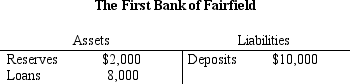 -Refer to Table 16-3. The reserve ratio for this bank is
 (Multiple Choice)
4.8/5 (91)
(91) The president of each regional Federal Reserve Bank is appointed by
(Multiple Choice)
4.7/5 (79)
(79) When the Federal Reserve conducts open-market operations to increase the money supply, it
(Multiple Choice)
4.9/5 (86)
(86) Suppose banks decide to hold more excess reserves relative to deposits. Other things the same, this action will cause the
(Multiple Choice)
4.8/5 (79)
(79) John and Jane decide to go on a vacation. As a result, they withdraw $2,500 from their savings account. As a result of this transfer by itself
(Multiple Choice)
4.8/5 (87)
(87) The money supply of Granov is $10,000 in a 100-percent-reserve banking system. If the Central Bank of Granov decreases the reserve requirement ratio to 10 percent, the money supply could increase by no more than $9,000.
(True/False)
4.8/5 (81)
(81) The interest rate the Fed charges on loans it makes to banks is called
(Multiple Choice)
4.8/5 (71)
(71) If the federal funds rate were below the level the Federal Reserve had targeted, the Fed could move the rate back towards its target by
(Multiple Choice)
4.8/5 (78)
(78) If the reserve ratio is 12.5 percent, then $2,000 of additional reserves can create up to
(Multiple Choice)
4.8/5 (77)
(77) Which of the following is a liability of a bank and an asset of its customers?
(Multiple Choice)
4.9/5 (62)
(62) At one time, people in a certain country had no access to banks; they relied exclusively on currency. Then, a fractional-reserve banking system was created. As a result, the money supply
(Multiple Choice)
4.8/5 (87)
(87) You use U.S. currency to pay the owner of a restaurant for a delicious meal. The currency
(Multiple Choice)
4.9/5 (74)
(74) Dollar bills, rare paintings, and emerald necklaces are all
(Multiple Choice)
5.0/5 (87)
(87) Bottles of very fine wine are less liquid than demand deposits.
(True/False)
4.8/5 (74)
(74) 
Filters
- Essay(0)
- Multiple Choice(0)
- Short Answer(0)
- True False(0)
- Matching(0)