



 Chat with AI
Exam 16: The Monetary System

Exam 1: Ten Principles of Economics347 Questions
Exam 2: Thinking Like an Economist535 Questions
Exam 3: Interdependence and the Gains From Trade442 Questions
Exam 4: The Market Forces of Supply and Demand569 Questions
Exam 5: Elasticity and Its Application503 Questions
Exam 6: Supply, Demand, and Government Policies556 Questions
Exam 7: Consumers, Producers, and the Efficiency of Markets460 Questions
Exam 8: Application: The Costs of Taxation422 Questions
Exam 9: Application: International Trade409 Questions
Exam 10: Measuring a Nations Income428 Questions
Exam 11: Measuring the Cost of Living436 Questions
Exam 12: Production and Growth417 Questions
Exam 13: Saving, Investment, and the Financial System473 Questions
Exam 14: The Basic Tools of Finance419 Questions
Exam 15: Unemployment571 Questions
Exam 16: The Monetary System423 Questions
Exam 17: Money Growth and Inflation388 Questions
Exam 18: Open-Economy Macroeconomic Models448 Questions
Exam 19: A Macroeconomic Theory of the Open Economy374 Questions
Exam 20: Aggregate Demand and Aggregate Supply471 Questions
Exam 21: The Influence of Monetary and Fiscal Policy on Aggregate Demand416 Questions
Exam 22: The Short-Run Trade-Off Between Inflation and Unemployment400 Questions
Exam 23: Six Debates Over Macroeconomic Policy235 Questions
Select questions type


If the reserve ratio is 9 percent, then a decrease in reserves of $6,000 can cause the money supply to fall by as much as
(Multiple Choice)
4.7/5  (87)
(87) Table 16-3. 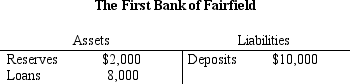 -Refer to Table 16-3. Starting from the situation as depicted by the T-account, if someone deposits $500 into the First Bank of Fairfield, and if the bank makes new loans so as to keep its reserve ratio unchanged, then the amount of new loans that it makes will be
 (Multiple Choice)
4.8/5 (74)
(74) Which of the following might explain why the United States has so much currency per person?
(Multiple Choice)
4.7/5 (78)
(78) Scenario 16-1.The monetary policy of Namdian is determined by the Namdian Central Bank. The local currency is the dia. Namdian banks collectively hold 100 million dias of required reserves, 25 million dias of excess reserves, 250 million dias of Namdian Treasury Bonds, and their customers hold 1,000 million dias of deposits. Namdians prefer to use only demand deposits and so the money supply consists of demand deposits.
-Refer to Scenario 16-1 . Suppose the Central Bank of Namdia purchases 25 million dias of Namdian Treasury Bonds from banks. Suppose also that both the reserve requirement and the percentage of deposits held as excess reserves stay the same. By how much would the money supply of Namdia change?
(Multiple Choice)
4.9/5 (70)
(70) Table 16-5.  -Refer to Table 16-5. From the table it follows that the Bank of Pleasantville operates in a
 (Multiple Choice)
4.8/5 (78)
(78) If $300 of new reserves generates $800 of new money in the economy, then the reserve ratio is
(Multiple Choice)
4.8/5 (72)
(72) Any item that people can use to transfer purchasing power from the present to the future is called
(Multiple Choice)
5.0/5 (79)
(79) If the reserve ratio is 4 percent, then $81,250 of new money can be generated by
(Multiple Choice)
5.0/5 (81)
(81) If a bank desires to hold no excess reserves, the reserve requirement is 5 percent, and it receives a new deposit of $1,000
(Multiple Choice)
4.8/5 (69)
(69) If the reserve ratio is 12.5 percent, then $5,600 of money can be generated by
(Multiple Choice)
4.9/5 (93)
(93) If the reserve requirement is 5 percent, a bank desires to hold no excess reserves, and it receives a new deposit of $400, it
(Multiple Choice)
5.0/5 (77)
(77) Consider five individuals with different occupations. Allen praparas taxes wants ribs Betty does dry cleaning wants campute fixed Cakin fixas canguters wants bread Diedre bakes bread wants taxes pregared Eric Garbecues ribs wants dry cleaning In a barter system which of the following pairs has a double coincidence of wants?
(Multiple Choice)
4.8/5 (71)
(71) 
Filters
- Essay(0)
- Multiple Choice(0)
- Short Answer(0)
- True False(0)
- Matching(0)