



 Chat with AI
Exam 14: The Basic Tools of Finance

Exam 1: Ten Principles of Economics347 Questions
Exam 2: Thinking Like an Economist535 Questions
Exam 3: Interdependence and the Gains From Trade442 Questions
Exam 4: The Market Forces of Supply and Demand569 Questions
Exam 5: Elasticity and Its Application503 Questions
Exam 6: Supply, Demand, and Government Policies556 Questions
Exam 7: Consumers, Producers, and the Efficiency of Markets460 Questions
Exam 8: Application: The Costs of Taxation422 Questions
Exam 9: Application: International Trade409 Questions
Exam 10: Measuring a Nations Income428 Questions
Exam 11: Measuring the Cost of Living436 Questions
Exam 12: Production and Growth417 Questions
Exam 13: Saving, Investment, and the Financial System473 Questions
Exam 14: The Basic Tools of Finance419 Questions
Exam 15: Unemployment571 Questions
Exam 16: The Monetary System423 Questions
Exam 17: Money Growth and Inflation388 Questions
Exam 18: Open-Economy Macroeconomic Models448 Questions
Exam 19: A Macroeconomic Theory of the Open Economy374 Questions
Exam 20: Aggregate Demand and Aggregate Supply471 Questions
Exam 21: The Influence of Monetary and Fiscal Policy on Aggregate Demand416 Questions
Exam 22: The Short-Run Trade-Off Between Inflation and Unemployment400 Questions
Exam 23: Six Debates Over Macroeconomic Policy235 Questions
Select questions type


Susan put $375 into an account and one year later had $405. What interest rate was paid on Susan's deposit?
(Multiple Choice)
4.8/5  (86)
(86) What is the future value of $750 one year from today if the interest rate is 2.5 percent?
(Multiple Choice)
4.8/5 (74)
(74) A firm has three different investment options, each costing $10 million. Option A will generate $12 million in revenue at the end of one year. Option B will generate $15 million in revenue at the end of two years. Option C will generate $18 million in revenue at the end of three years. Which option should the firm choose?
(Multiple Choice)
4.7/5 (92)
(92) Suppose you are deciding whether to buy a particular bond. If you buy the bond and hold it for 4 years, then at that time you will receive a payment of $10,000. If the interest rate is 6 percent, you will buy the bond if its price today is no greater than
(Multiple Choice)
4.9/5 (91)
(91) The possibility of speculative bubbles in the stock market arises in part because
(Multiple Choice)
4.7/5 (86)
(86) At which interest rate is the present value of $35.00 two years from today equal to about $30.00 today?
(Multiple Choice)
4.8/5 (85)
(85) At an annual interest rate of 10 percent, about how many years will it take $100 to triple in value?
(Multiple Choice)
4.9/5 (68)
(68) What is the present value of a payment of $200 to be made one year from today if the interest rate is 10 percent?
(Multiple Choice)
4.9/5 (87)
(87) Figure 14-5. On the graph, x represents risk and y represents return. 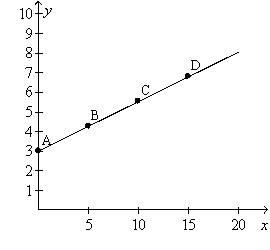 -Refer to Figure 14-5. Point A represents a situation in which
 (Multiple Choice)
4.7/5 (86)
(86) What is the present value of a payment of $150 one year from today if the interest rate is 6 percent?
(Multiple Choice)
5.0/5 (70)
(70) You have a contract with someone who has agreed to pay you $20,000 in four years. She offers to pay you now instead. For which of the following interest rates and payments would you take the money today?.
(Multiple Choice)
4.9/5 (66)
(66) ZZL Corporation has the opportunity to undertake an investment project that will cost $20,000 today. If the interest rate is 20 percent and if the project will yield the company $30,000 in 3 years, then ZZL will undertake the project.
(True/False)
4.8/5 (72)
(72) In the 1990s, Fed Chair Alan Greenspan believed that the market was
(Multiple Choice)
4.9/5 (82)
(82) In the 1990s, Fed Chairperson Alan Greenspan questioned whether the stock market
(Multiple Choice)
4.8/5 (72)
(72) Kayla faces risks and she pays a fee to ABC Company; in return, ABC Company agrees to accept some or all of Kayla's risks. ABC Company is
(Multiple Choice)
4.9/5 (79)
(79) Braden says that $400 saved for one year at 4 percent interest has a smaller future value than $400 saved for two years at 2 percent interest. Lefty says that the present value of $400 to be received one year from today if the interest rate is 4 percent exceeds the present value of $400 to be received two years from today if the interest rate is 2 percent.
(Multiple Choice)
4.8/5 (77)
(77) 
Filters
- Essay(0)
- Multiple Choice(0)
- Short Answer(0)
- True False(0)
- Matching(0)