



 Chat with AI
Exam 14: The Basic Tools of Finance

Exam 1: Ten Principles of Economics347 Questions
Exam 2: Thinking Like an Economist535 Questions
Exam 3: Interdependence and the Gains From Trade442 Questions
Exam 4: The Market Forces of Supply and Demand569 Questions
Exam 5: Elasticity and Its Application503 Questions
Exam 6: Supply, Demand, and Government Policies556 Questions
Exam 7: Consumers, Producers, and the Efficiency of Markets460 Questions
Exam 8: Application: The Costs of Taxation422 Questions
Exam 9: Application: International Trade409 Questions
Exam 10: Measuring a Nations Income428 Questions
Exam 11: Measuring the Cost of Living436 Questions
Exam 12: Production and Growth417 Questions
Exam 13: Saving, Investment, and the Financial System473 Questions
Exam 14: The Basic Tools of Finance419 Questions
Exam 15: Unemployment571 Questions
Exam 16: The Monetary System423 Questions
Exam 17: Money Growth and Inflation388 Questions
Exam 18: Open-Economy Macroeconomic Models448 Questions
Exam 19: A Macroeconomic Theory of the Open Economy374 Questions
Exam 20: Aggregate Demand and Aggregate Supply471 Questions
Exam 21: The Influence of Monetary and Fiscal Policy on Aggregate Demand416 Questions
Exam 22: The Short-Run Trade-Off Between Inflation and Unemployment400 Questions
Exam 23: Six Debates Over Macroeconomic Policy235 Questions
Select questions type


On the Internet you find the following offers for opening an online account. Which of them is the best offer if you have $2,000 to save for two years?
(Multiple Choice)
4.8/5  (71)
(71) At which interest rate is the present value of $168.54 two years from today equal to $150 today?
(Multiple Choice)
4.8/5 (69)
(69) Which of the following make(s) insurance premiums higher than otherwise?
(Multiple Choice)
4.8/5 (77)
(77) If asset markets are driven by the "animal spirits" of investors, then
(Multiple Choice)
4.7/5 (81)
(81) Which of the following is the correct expression for finding the present value of a $1,000 payment one year from today if the interest rate is 6 percent?
(Multiple Choice)
4.8/5 (76)
(76) Suppose that Albert can buy a bond for $1,000 that matures in two years and pays Albert $1,102.5 with certainty. He is indifferent between this bond and one that has some risk but on which the interest rate is 3% higher. How much, to the nearest penny, does the riskier bond pay in two years?
(Multiple Choice)
4.9/5 (82)
(82) Robert put $15,000 into an account with a fixed interest rate two years ago and now the account balance is $16,695.38. What rate of interest did Robert earn?
(Multiple Choice)
4.8/5 (74)
(74) Which of the following is correct concerning diversification?
(Multiple Choice)
4.8/5 (91)
(91) Adverse selection is illustrated by people who take greater risks after they purchase insurance.
(True/False)
4.7/5 (79)
(79) The market for insurance is one example of reducing risk by using diversification.
(True/False)
4.8/5 (80)
(80) Figure 14-1. The figure shows a utility function. 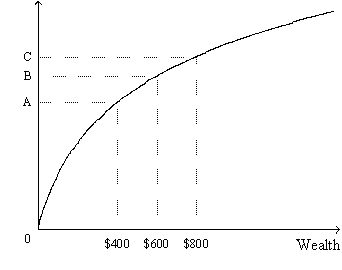 -Refer to Figure 14-1. Which distance along the vertical axis represents the marginal utility of an increase in wealth from $600 to $800?
 (Multiple Choice)
4.8/5 (74)
(74) PZX Corporation has the opportunity to undertake an investment project that will cost $10,000 today and yield the company $13,310 in 3 years. PZX will forgo the project if the interest rate is higher than 10 percent.
(True/False)
4.9/5 (84)
(84) Suppose that interest rates unexpectedly rise and that Carter Corporation announces that revenues from last quarter were down but not as much as the public had anticipated they would be down. According to the efficient markets hypothesis, which of the these things make the price of Carter Corporation Stock fall?
(Multiple Choice)
4.8/5 (79)
(79) A scholarship gives you $1,000 today and promises to pay you $1,000 one year from today. What is the present value of these payments?
(Multiple Choice)
4.9/5 (72)
(72) An increase in the interest rate causes a decrease in the future value of $1,000 that you have in a bank account today.
(True/False)
4.7/5 (75)
(75) Recently, Lisa's wealth increased by $500. If her wealth were to increase by another $500 in the near future, then her utility would increase, but not by as much as it increased with the recent increase to her wealth. Based on this information, Lisa's utility function
(Multiple Choice)
4.8/5 (75)
(75) If you deposit $900 into an account for two years and the interest rate is 4%, how much do you have at the end of the two years?
(Multiple Choice)
4.9/5 (73)
(73) 
Filters
- Essay(0)
- Multiple Choice(0)
- Short Answer(0)
- True False(0)
- Matching(0)