



 Chat with AI
Exam 7: Causal Research Design: Experimentation

Exam 1: Introduction to Marketing Research75 Questions
Exam 2: Defining the Marketing Research Problem and Developing an Approach74 Questions
Exam 3: Research Design91 Questions
Exam 4: Exploratory Research Design: Secondary Data86 Questions
Exam 5: Exploratory Research Design: Qualitative Research103 Questions
Exam 6: Descriptive Research Design: Survey and Observation82 Questions
Exam 7: Causal Research Design: Experimentation114 Questions
Exam 8: Measurement and Scaling: Fundamentals and Comparative Scaling84 Questions
Exam 9: Measurement and Scaling: Noncomparative Scaling Techniques115 Questions
Exam 10: Questionnaire and Form Design117 Questions
Exam 11: Sampling: Design and Procedures96 Questions
Exam 12: Sampling: Final and Initial Sample Size Determination71 Questions
Exam 13: Fieldwork55 Questions
Exam 14: Data Preparation126 Questions
Exam 15: Frequency Distribution, Cross-Tabulation, and Hypothesis Testing154 Questions
Exam 16: Analysis of Variance and Covariance83 Questions
Exam 17: Correlation and Regression92 Questions
Exam 18: Discriminant and Logit Analysis59 Questions
Exam 19: Factor Analysis70 Questions
Exam 20: Cluster Analysis73 Questions
Exam 21: Multidimensional Scaling and Conjoint Analysis111 Questions
Exam 22: Structural Equation Modeling and Path Analysis92 Questions
Exam 23: Report Preparation and Presentation75 Questions
Exam 24: International Marketing Research80 Questions
Select questions type


To control for extraneous variables, a researcher may conduct an experiment in an artificial environment. This enhances external validity, but it may limit the generalizability of the results, thereby reducing internal validity.
(True/False)
4.8/5  (85)
(85) Matching is a method of controlling extraneous variables that involve matching test units on a set of key background variables before assigning them to the treatment conditions.
(True/False)
4.8/5 (80)
(80) Independent variables are variables or alternatives that are manipulated and whose effects are measured and compared.
(True/False)
4.9/5 (78)
(78) ________ result when the researcher is unable to achieve full manipulation of scheduling or allocation of treatments to test units but can still apply part of the apparatus of true experimentation.
(Multiple Choice)
4.9/5 (81)
(81) In an after-the-fact examination of a situation, we can confidently rule out all other causal factors.
(True/False)
4.9/5 (73)
(73) When more than one variable must be controlled, the researcher must use true experimental designs.
(True/False)
4.8/5 (71)
(71) The everyday meaning of causality is more appropriate to marketing research than is the scientific meaning.
(True/False)
4.8/5 (69)
(69) Which of the following is an ethical concern associated with doing experiments?
(Multiple Choice)
4.9/5 (84)
(84) The internal and external validity of field experiments conducted overseas is generally lower than in the United States.
(True/False)
4.9/5 (89)
(89) Pretest-posttest control group and Solomon four-group designs are ________ distinguished by the fact that the researcher can randomly assign test units to experimental groups and also randomly assign treatments to experimental groups.
(Multiple Choice)
4.7/5 (83)
(83) Extraneous variables are also called confounding variables because unless they are controlled for, they affect the independent variable and thus confound the results.
(True/False)
4.8/5 (75)
(75) Only causal designs are truly appropriate for inferring cause-and-effect relationships.
(True/False)
4.8/5 (79)
(79) The one-group pretest-posttest is a type of ________. These designs do not control for extraneous factors by randomization.
(Multiple Choice)
4.8/5 (88)
(88) History (H)refers to the occurrence of events before the experiment.
(True/False)
5.0/5 (88)
(88) 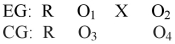 In the pretest-posttest control group design shown above, selection bias is eliminated by ________.
 (Multiple Choice)
4.8/5 (71)
(71) There is no problem developing experimental designs that have high levels of both internal and external validity.
(True/False)
4.8/5 (79)
(79) A ________ design to measure the effectiveness of a test commercial for Sears would be implemented as follows. Two groups of respondents would be recruited on the basis of convenience. Only the experimental group would be exposed to the TV program containing the test (Sears)commercial. Then attitudes toward the department store of both the experimental and control group respondents would be measured. The effectiveness of the test commercial is measured as O1 - O2.
(Multiple Choice)
4.9/5 (89)
(89) Experimentation is becoming increasingly important in marketing research, but there are limitations of time, cost, and administration of an experiment.
(True/False)
4.9/5 (84)
(84) The conditions that must be satisfied before making causal inferences include all of the following except ________.
(Multiple Choice)
4.7/5 (73)
(73) 
Filters
- Essay(0)
- Multiple Choice(0)
- Short Answer(0)
- True False(0)
- Matching(0)