



 Chat with AI
Exam 2: Choice, opportunity Costs, and Specialization

Exam 1: Economics: The World Around You90 Questions
Exam 2: Choice, opportunity Costs, and Specialization95 Questions
Exam 3: Markets, Demand and Supply, and the Price System98 Questions
Exam 4: The Market System and the Private and Public Sector100 Questions
Exam 5: Elasticity: Demand and Supply132 Questions
Exam 6: Consumer Choice142 Questions
Exam 7: Supply: The Costs of Doing Business106 Questions
Exam 8: Profit Maximization122 Questions
Exam 9: Perfect Competition135 Questions
Exam 10: Monopoly118 Questions
Exam 11: Monopolistic Competition and Oligopoly114 Questions
Exam 12: Antitrust and Regulation100 Questions
Exam 13: Market Failures, Government Failures, and Rent Seeking121 Questions
Exam 14: Resource Markets112 Questions
Exam 15: The Labor Market117 Questions
Exam 16: Capital Markets100 Questions
Exam 17: The Land Market and Natural Resources55 Questions
Exam 18: Aging, Social Security and Health Care88 Questions
Exam 19: Income Distribution,Poverty and Government Policy115 Questions
Exam 20: World Trade Equilibrium112 Questions
Exam 21: International Trade Restrictions109 Questions
Exam 22: Exchange Rates and Financial Links Between Countries132 Questions
Select questions type


Given below is the production possibilities schedule for a small island nation in South Pacific that produces capital and consumer goods.
Table 2.2
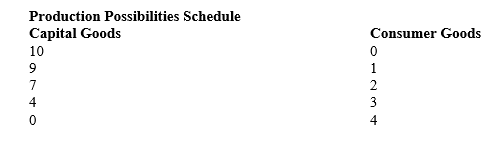 -Refer to Table 2.2.Identify the correct statement.
 (Multiple Choice)
4.7/5  (80)
(80) If an economy is operating at a point outside the PPC,either the society has resources that are not being fully used or production is not efficient.
(True/False)
4.9/5 (72)
(72) Assume that a doctor makes $200 per hour,a lawyer $250 per hour,an architect $140 per hour,a professor $50 per hour,and a waiter $35 per hour.Which of these professionals is most likely to spend time to negotiate with a car dealer?
(Multiple Choice)
4.8/5 (71)
(71) The table given below represents the output per hour of cookies and chilies in Ohio and Iowa. Table 2.4
 -Refer to Table 2.4.Identify the correct statement.
 (Multiple Choice)
4.9/5 (76)
(76) Which of the following would not cause any kind of an outward shift of a nation's production possibilities curve [PPC]?
(Multiple Choice)
4.8/5 (77)
(77) The giving up of a good or activity in order to obtain some other good or activity is called:
(Multiple Choice)
4.9/5 (81)
(81) One of the reasons for China's real per capita GDP being far lower than that of Taiwan in 2000 was the lack of private property rights in the former nation.
(True/False)
4.9/5 (64)
(64) A nation's production possibilities curve [PPC] will shift outward if its workers receive better training.
(True/False)
4.9/5 (75)
(75) Public property rights refer to the right of ownership that is absolutely necessary for trade to occur and are ensured by a legal system of laws and courts.
(True/False)
4.8/5 (80)
(80) The figure given below represents the PPC in two nations - Germany and Korea, producing only two goods cars and food.
Figure 2.4
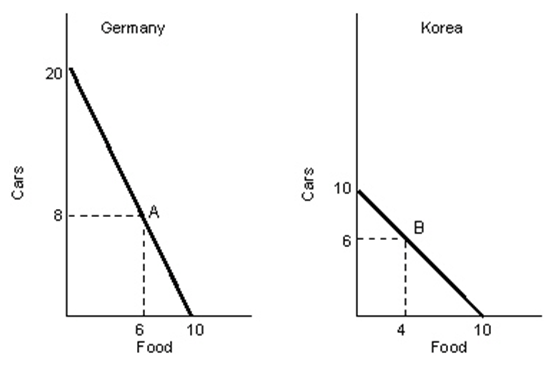 -Refer to Figure 2.4.What would be the marginal opportunity cost of producing one unit of food in Korea assuming the economy is at point B?
 (Multiple Choice)
4.9/5 (79)
(79) Gains from trade can be realized if each country specializes in its comparative advantage good.
(True/False)
4.9/5 (66)
(66) If an individual can produce a good or service with a lower opportunity cost than another individual,then he or she is said to have the comparative advantage.
(True/False)
4.9/5 (91)
(91) If you have a choice between studying and doing another activity,you will devote your time to studying as long as the additional benefit of studying is greater than the additional cost of studying.
(True/False)
4.8/5 (79)
(79) Free trade leads to an overall improvement in the standard of living in a country because everything is produced at the lowest possible cost.
(True/False)
4.8/5 (75)
(75) 
Filters
- Essay(0)
- Multiple Choice(0)
- Short Answer(0)
- True False(0)
- Matching(0)