



 Chat with AI
Exam 4: The Market System and the Private and Public Sector

Exam 1: Economics: The World Around You90 Questions
Exam 2: Choice, opportunity Costs, and Specialization95 Questions
Exam 3: Markets, Demand and Supply, and the Price System98 Questions
Exam 4: The Market System and the Private and Public Sector100 Questions
Exam 5: Elasticity: Demand and Supply132 Questions
Exam 6: Consumer Choice142 Questions
Exam 7: Supply: The Costs of Doing Business106 Questions
Exam 8: Profit Maximization122 Questions
Exam 9: Perfect Competition135 Questions
Exam 10: Monopoly118 Questions
Exam 11: Monopolistic Competition and Oligopoly114 Questions
Exam 12: Antitrust and Regulation100 Questions
Exam 13: Market Failures, Government Failures, and Rent Seeking121 Questions
Exam 14: Resource Markets112 Questions
Exam 15: The Labor Market117 Questions
Exam 16: Capital Markets100 Questions
Exam 17: The Land Market and Natural Resources55 Questions
Exam 18: Aging, Social Security and Health Care88 Questions
Exam 19: Income Distribution,Poverty and Government Policy115 Questions
Exam 20: World Trade Equilibrium112 Questions
Exam 21: International Trade Restrictions109 Questions
Exam 22: Exchange Rates and Financial Links Between Countries132 Questions
Select questions type


Scenario 4-1 In a given year,country A exported $12 million worth of goods to country B and $6 million worth of goods to country C; country B exported $4 million worth of goods to country A and $7 million worth of goods to country C; and country C exported $5 million worth of goods to country A and $2 million worth of goods to country B.
-According to Scenario 4-1,country A has net exports of:
(Multiple Choice)
4.8/5  (79)
(79) Consumption or household spending of an economy comprises of both consumer spending and business spending.
(True/False)
4.9/5 (74)
(74) Which among the following industrial countries has the highest per capita income as measured by the World Bank in 2009?
(Multiple Choice)
4.9/5 (75)
(75) Which of the following sectors in the economy accounted for about 70% of the spending in the U.S.during 2009?
(Multiple Choice)
4.9/5 (69)
(69) Which of the following institutions form the private sector in an economy?
(Multiple Choice)
4.7/5 (76)
(76) If total U.S.trade consists of $10 billion in electronics imports from Japan and $9 billion in automobile exports to Germany,then the U.S.net export account will be negative.
(True/False)
4.9/5 (79)
(79) Which of the following will invariably be illustrated by a circular flow of income diagram?
(Multiple Choice)
4.8/5 (85)
(85) The owner of a sole proprietorship has limited liability,while stockholders of corporations have unlimited liability.
(True/False)
4.8/5 (90)
(90) Which of the following situations is an example of creative destruction?
(Multiple Choice)
4.7/5 (77)
(77) The figure given below represents the equilibrium price and output in the market for restaurant meals and delivery meals. Figure 4.1 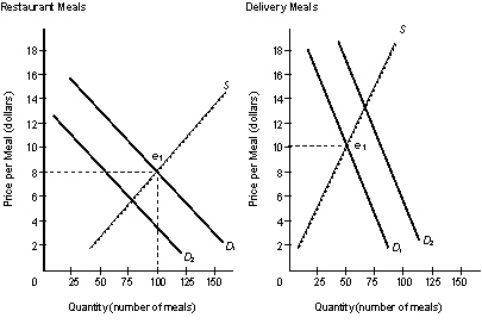 - Refer to Figure 4.1.Which of the following is represented by this figure?
 (Multiple Choice)
4.8/5 (82)
(82) According to the World Development Report published by the World Bank,developing countries greatly outnumber industrial countries.
(True/False)
4.9/5 (83)
(83) Which of the following is true of investment spending in the U.S.economy?
(Multiple Choice)
4.8/5 (66)
(66) Which of the following statements about transfer payments is true?
(Multiple Choice)
4.9/5 (89)
(89) In a market system,which of the following factors determines a consumers's ability to pay for a good or service?
(Multiple Choice)
4.9/5 (71)
(71) The figure given below represents the circular flow of income between households,firms,financial intermediaries,and foreign countries. Figure 4.2 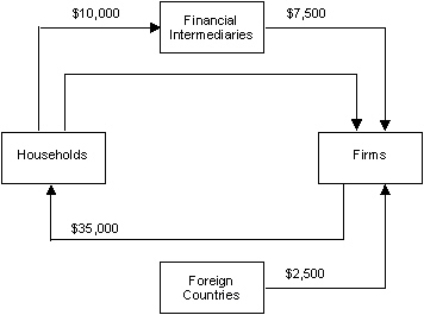 - Refer to Figure 4.2.Suppose households reduce saving to $7,000.Everything else held constant,consumption spending must now be:
 (Multiple Choice)
4.9/5 (77)
(77) The resources owned by firms that shut down in the process of creative destruction:
(Multiple Choice)
4.9/5 (75)
(75) Which of the following is not considered a financial intermediary?
(Multiple Choice)
4.9/5 (78)
(78) The figure given below represents the circular flow of income between households,firms,financial intermediaries,and foreign countries. Figure 4.2 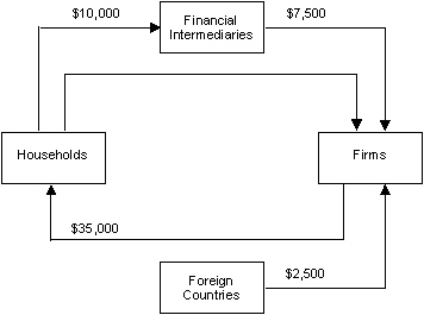 -Refer to Figure 4.2.What is the total savings of the household sector?
 (Multiple Choice)
4.9/5 (74)
(74) 
Filters
- Essay(0)
- Multiple Choice(0)
- Short Answer(0)
- True False(0)
- Matching(0)