



 Chat with AI
Exam 8: Profit Maximization

Exam 1: Economics: The World Around You90 Questions
Exam 2: Choice, opportunity Costs, and Specialization95 Questions
Exam 3: Markets, Demand and Supply, and the Price System98 Questions
Exam 4: The Market System and the Private and Public Sector100 Questions
Exam 5: Elasticity: Demand and Supply132 Questions
Exam 6: Consumer Choice142 Questions
Exam 7: Supply: The Costs of Doing Business106 Questions
Exam 8: Profit Maximization122 Questions
Exam 9: Perfect Competition135 Questions
Exam 10: Monopoly118 Questions
Exam 11: Monopolistic Competition and Oligopoly114 Questions
Exam 12: Antitrust and Regulation100 Questions
Exam 13: Market Failures, Government Failures, and Rent Seeking121 Questions
Exam 14: Resource Markets112 Questions
Exam 15: The Labor Market117 Questions
Exam 16: Capital Markets100 Questions
Exam 17: The Land Market and Natural Resources55 Questions
Exam 18: Aging, Social Security and Health Care88 Questions
Exam 19: Income Distribution,Poverty and Government Policy115 Questions
Exam 20: World Trade Equilibrium112 Questions
Exam 21: International Trade Restrictions109 Questions
Exam 22: Exchange Rates and Financial Links Between Countries132 Questions
Select questions type


When the average revenue falls,marginal revenue also falls and is less than the average revenue.
(True/False)
4.8/5  (75)
(75) A monopolistically competitive firm faces a relatively steeper demand curve than a perfectly competitive firm.
(True/False)
4.7/5 (72)
(72) Which among the following does not determine the shape of the demand curve under different market structures?
(Multiple Choice)
4.9/5 (82)
(82) Steve is about to start up a business in a monopolistically competitive market.Which of the following can he expect?
(Multiple Choice)
4.9/5 (76)
(76) The following graph shows the demand and cost curves of an imperfectly competitive firm.MC and ATC represent the marginal cost curve and the average cost curve respectively. Figure 8.1 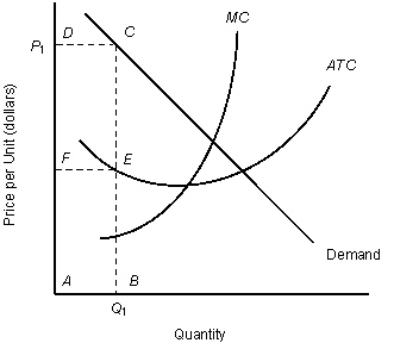 -Refer to Figure 8.1.At price P1 the firm sells quantity Q1,and total cost is shown by:
 (Multiple Choice)
4.9/5 (93)
(93) A perfectly competitive firm charges a price which is greater than its marginal cost.
(True/False)
5.0/5 (80)
(80) In contrast to both perfect competition and monopolistic competition,an oligopoly market structure is characterized by:
(Multiple Choice)
4.8/5 (86)
(86) The firm will always maximize profit where average total costs are minimized.
(True/False)
4.8/5 (85)
(85) When the average cost curve lies below the average revenue curve at the profit maximizing level of output,it implies that the firm is suffering losses.
(True/False)
4.8/5 (79)
(79) A perfectly competitive firm cannot affect the market price by raising or reducing its supply.
(True/False)
4.8/5 (87)
(87) Assume that a firm's marginal revenue curve intersects the rising portion of its marginal cost curve at 500 units of output.At this output level,a profit-maximizing firm's total cost of production is $1,000.If the price of the product is $5 per unit,the total revenue earned by the firm will be:
(Multiple Choice)
4.9/5 (95)
(95) Each firm under perfect competition charges different prices for their products.
(True/False)
4.9/5 (85)
(85) The figure given below shows the cost curves of a firm. Figure 8.3 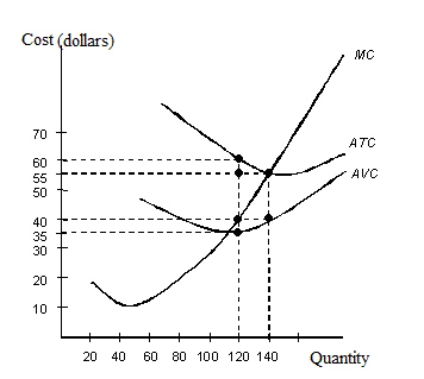 ATC: Average Total Cost
AVC: Average Variable Cost
MC: Marginal Cost
-In Figure 8.3,what is the total cost of producing 140 units of the output?
ATC: Average Total Cost
AVC: Average Variable Cost
MC: Marginal Cost
-In Figure 8.3,what is the total cost of producing 140 units of the output? (Multiple Choice)
4.8/5 (88)
(88) The following graph shows the demand and cost curves of an imperfectly competitive firm.MC and ATC represent the marginal cost curve and the average cost curve respectively. Figure 8.1 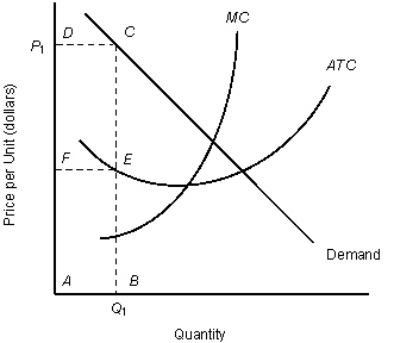 - In Table 8.1,in order to maximize profits,the firm should increase output until the ____ unit of output.
 (Multiple Choice)
4.8/5 (91)
(91) 
Filters
- Essay(0)
- Multiple Choice(0)
- Short Answer(0)
- True False(0)
- Matching(0)