



 Chat with AI
Exam 10: Monopoly

Exam 1: Economics: The World Around You90 Questions
Exam 2: Choice, opportunity Costs, and Specialization95 Questions
Exam 3: Markets, Demand and Supply, and the Price System98 Questions
Exam 4: The Market System and the Private and Public Sector100 Questions
Exam 5: Elasticity: Demand and Supply132 Questions
Exam 6: Consumer Choice142 Questions
Exam 7: Supply: The Costs of Doing Business106 Questions
Exam 8: Profit Maximization122 Questions
Exam 9: Perfect Competition135 Questions
Exam 10: Monopoly118 Questions
Exam 11: Monopolistic Competition and Oligopoly114 Questions
Exam 12: Antitrust and Regulation100 Questions
Exam 13: Market Failures, Government Failures, and Rent Seeking121 Questions
Exam 14: Resource Markets112 Questions
Exam 15: The Labor Market117 Questions
Exam 16: Capital Markets100 Questions
Exam 17: The Land Market and Natural Resources55 Questions
Exam 18: Aging, Social Security and Health Care88 Questions
Exam 19: Income Distribution,Poverty and Government Policy115 Questions
Exam 20: World Trade Equilibrium112 Questions
Exam 21: International Trade Restrictions109 Questions
Exam 22: Exchange Rates and Financial Links Between Countries132 Questions
Select questions type


The figure given below shows the cost and revenue curves of a monopolist. Figure 10.9 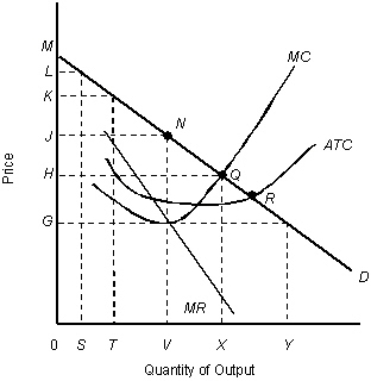 D: Average revenue
MR: Marginal revenue
ATC: Average total cost
MC: Marginal cost
-Refer to Figure 10.9.Suppose that the market is perfectly competitive.The consumer surplus would be represented by the area _____.
D: Average revenue
MR: Marginal revenue
ATC: Average total cost
MC: Marginal cost
-Refer to Figure 10.9.Suppose that the market is perfectly competitive.The consumer surplus would be represented by the area _____. (Multiple Choice)
5.0/5  (68)
(68) Airlines can increase profits by charging higher fares to business customers because those customers have a more elastic demand for airline travel.
(True/False)
4.9/5 (88)
(88) The figure below shows the market equilibrium (point B) at the intersection of demand and supply curves under perfect competition. Figure 10.5  D: Market demand curve
S: Market supply curve
-Refer to Figure 10.5.Which of the following regions on the graph represents consumer surplus in a perfectly competitive market?
D: Market demand curve
S: Market supply curve
-Refer to Figure 10.5.Which of the following regions on the graph represents consumer surplus in a perfectly competitive market? (Multiple Choice)
4.9/5 (68)
(68) The figure below shows the market equilibrium (point B) at the intersection of demand and supply curves under perfect competition. Figure 10.5  D: Market demand curve
S: Market supply curve
-Refer to Figure 10.5.Assume that the curve labeled S represents the monopolist's marginal-cost curve and the curve labeled D represents the monopolist's demand curve.Which of the following will represent the consumer surplus?
D: Market demand curve
S: Market supply curve
-Refer to Figure 10.5.Assume that the curve labeled S represents the monopolist's marginal-cost curve and the curve labeled D represents the monopolist's demand curve.Which of the following will represent the consumer surplus? (Multiple Choice)
4.8/5 (70)
(70) A monopoly firm never incurs a loss as it is the sole supplier of the good in the market.
(True/False)
4.8/5 (75)
(75) The perfectly competitive market structure results in economic efficiency because:
(Multiple Choice)
5.0/5 (81)
(81) The table given below shows the price,marginal revenue and marginal cost of a monopolist at different levels of the output.The firm does not incur a fixed cost of production. Table 10.4
 - Refer to Table 10.4.Assuming that the monopolist is maximizing profits,the price the monopolist will charge is _____.
 (Multiple Choice)
4.8/5 (77)
(77) If a monopolist is producing the output level at which price equals average total cost in the short run,then the firm is earning a normal profit.
(True/False)
4.9/5 (83)
(83) Why does a efficiency loss arise under monopoly rather than under perfect competition?
(Multiple Choice)
4.9/5 (68)
(68) The following figures show the demand and cost curves of a perfectly competitive and a monopoly firm respectively. Figure 10.7  D: Average Revenue
AC: Average cost
MC: Marginal cost
MR: Marginal cost
-Calculate the deadweight loss in Figure 10.7,if the perfectly competitive industry is monopolized after it had been producing an output of 10,000 units?
D: Average Revenue
AC: Average cost
MC: Marginal cost
MR: Marginal cost
-Calculate the deadweight loss in Figure 10.7,if the perfectly competitive industry is monopolized after it had been producing an output of 10,000 units? (Multiple Choice)
4.9/5 (76)
(76) Compared with a perfectly competitive market with similar cost conditions,a monopolist will have:
(Multiple Choice)
4.8/5 (91)
(91) The following table shows the units of the output sold at different price levels by Gizmo's Inc. Table 10.1
 -Refer to Table 10.1.At what level of output is total revenue maximized?
 (Multiple Choice)
5.0/5 (85)
(85) The table given below shows the prices charged and marginal cost incurred by a monopolist for different units of the output. Table 10.3
 - What is the profit-maximizing output level for the monopoly firm described in Table 10.3,if the firm is earning a positive economic profit?
 (Multiple Choice)
4.9/5 (81)
(81) If a monopolist is producing at the profit-maximizing level of output what price will it charge?
(Multiple Choice)
4.7/5 (69)
(69) A clothing store can sell two shirts for $20 each or three shirts for $18 each.At a quantity of three shirts sold,marginal revenue is _____.
(Multiple Choice)
4.8/5 (82)
(82) 
Filters
- Essay(0)
- Multiple Choice(0)
- Short Answer(0)
- True False(0)
- Matching(0)