



 Chat with AI
Exam 13: Market Failures, Government Failures, and Rent Seeking

Exam 1: Economics: The World Around You90 Questions
Exam 2: Choice, opportunity Costs, and Specialization95 Questions
Exam 3: Markets, Demand and Supply, and the Price System98 Questions
Exam 4: The Market System and the Private and Public Sector100 Questions
Exam 5: Elasticity: Demand and Supply132 Questions
Exam 6: Consumer Choice142 Questions
Exam 7: Supply: The Costs of Doing Business106 Questions
Exam 8: Profit Maximization122 Questions
Exam 9: Perfect Competition135 Questions
Exam 10: Monopoly118 Questions
Exam 11: Monopolistic Competition and Oligopoly114 Questions
Exam 12: Antitrust and Regulation100 Questions
Exam 13: Market Failures, Government Failures, and Rent Seeking121 Questions
Exam 14: Resource Markets112 Questions
Exam 15: The Labor Market117 Questions
Exam 16: Capital Markets100 Questions
Exam 17: The Land Market and Natural Resources55 Questions
Exam 18: Aging, Social Security and Health Care88 Questions
Exam 19: Income Distribution,Poverty and Government Policy115 Questions
Exam 20: World Trade Equilibrium112 Questions
Exam 21: International Trade Restrictions109 Questions
Exam 22: Exchange Rates and Financial Links Between Countries132 Questions
Select questions type


When a particular resource is commonly used,it tends to get underutilized.
(True/False)
4.8/5  (86)
(86) When a divergence between social costs and private costs exists,then:
(Multiple Choice)
4.9/5 (84)
(84) Moral hazard is the term used to describe the situation in which:
(Multiple Choice)
4.9/5 (80)
(80) A tradable government permit for the atmospheric release of a ton of sulfur dioxide can help reduce acid rain.
(True/False)
4.9/5 (92)
(92) The figure below shows the demand and supply curves in the market for elementary education. Figure 13.1
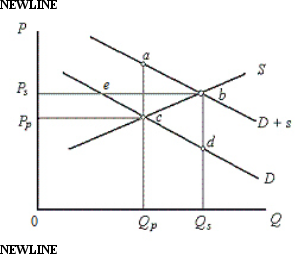 In the figure,
D: Private demand curve for elementary education
D + s: Demand curve which includes public benefits
S: Supply curve of education
Price and Quantity have been taken on vertical and horizontal axes respectively.
-According to Figure 13.1,the outcome of an unregulated,unsubsidized market would be:
In the figure,
D: Private demand curve for elementary education
D + s: Demand curve which includes public benefits
S: Supply curve of education
Price and Quantity have been taken on vertical and horizontal axes respectively.
-According to Figure 13.1,the outcome of an unregulated,unsubsidized market would be: (Multiple Choice)
4.8/5 (80)
(80) The good for which neither the principle of mutual excludability nor the principle of rivalry applies is referred to as a:
(Multiple Choice)
4.8/5 (72)
(72) Which of the following is an example of a positive externality?
(Multiple Choice)
4.9/5 (80)
(80) The owner of a good has the right to decide how that good is used and to restrict others from using that good.This idea is known as:
(Multiple Choice)
4.9/5 (72)
(72) Private property rights help to ensure an efficient use of resources,because owners of the resources must bear the costs of inefficient use.
(True/False)
4.8/5 (94)
(94) When the commons are converted into privately owned resources:
(Multiple Choice)
4.8/5 (84)
(84) If the government is successful in internalizing the external costs of production in a market,then:
(Multiple Choice)
4.8/5 (89)
(89) Which of the following is not a problem with a public good?
(Multiple Choice)
4.8/5 (76)
(76) It is often impossible for a business firm to determine its private costs of production.
(True/False)
4.8/5 (80)
(80) When the people creating an externality are made to pay for the externality by the government,the externality is said to be internalized.
(True/False)
4.9/5 (80)
(80) Co-payments and deductibles provide a means of reducing moral hazard problems because they allow each party in the transaction to share in the costs.
(True/False)
4.7/5 (81)
(81) When consumers have perfect information about the quality of the products they purchase,the problem of adverse selection is likely to arise.
(True/False)
4.7/5 (77)
(77) As opposed to economists like Tinbergen and Galbraith,the "public choice" school argues that:
(Multiple Choice)
4.9/5 (91)
(91) 
Filters
- Essay(0)
- Multiple Choice(0)
- Short Answer(0)
- True False(0)
- Matching(0)