



 Chat with AI
Exam 14: Resource Markets

Exam 1: Economics: The World Around You90 Questions
Exam 2: Choice, opportunity Costs, and Specialization95 Questions
Exam 3: Markets, Demand and Supply, and the Price System98 Questions
Exam 4: The Market System and the Private and Public Sector100 Questions
Exam 5: Elasticity: Demand and Supply132 Questions
Exam 6: Consumer Choice142 Questions
Exam 7: Supply: The Costs of Doing Business106 Questions
Exam 8: Profit Maximization122 Questions
Exam 9: Perfect Competition135 Questions
Exam 10: Monopoly118 Questions
Exam 11: Monopolistic Competition and Oligopoly114 Questions
Exam 12: Antitrust and Regulation100 Questions
Exam 13: Market Failures, Government Failures, and Rent Seeking121 Questions
Exam 14: Resource Markets112 Questions
Exam 15: The Labor Market117 Questions
Exam 16: Capital Markets100 Questions
Exam 17: The Land Market and Natural Resources55 Questions
Exam 18: Aging, Social Security and Health Care88 Questions
Exam 19: Income Distribution,Poverty and Government Policy115 Questions
Exam 20: World Trade Equilibrium112 Questions
Exam 21: International Trade Restrictions109 Questions
Exam 22: Exchange Rates and Financial Links Between Countries132 Questions
Select questions type


If the marginal factor cost is greater than the marginal revenue product of a resource,the producer can increase profits by laying off some units of the resource.
(True/False)
4.7/5  (79)
(79) The figure given below represents the marginal revenue product (MRP) and the marginal factor cost (MFC) of a resource in the resource market. Figure 14.3 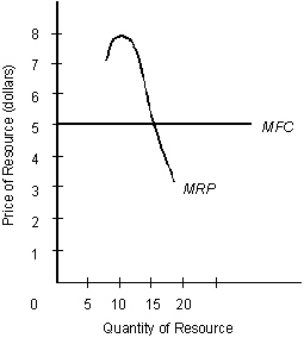 Consider the resource market shown in Figure 14.3.Given that the resource market is perfectly competitive,determine the equilibrium price of the resource.
 (Multiple Choice)
4.8/5 (73)
(73) After hiring 151 units of the variable input (say labor) a firm determines the MFC to be $0.33 and the MRP to be $0.30.The firm should:
(Multiple Choice)
4.8/5 (80)
(80) The figure given below represents equilibrium in the labor market. Figure 14.5 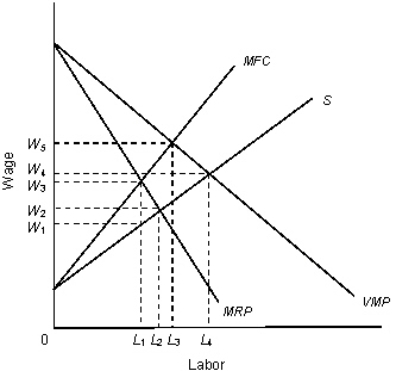 In the figure,
VMP: Value of marginal product curve
MRP: Marginal revenue product curve
MFC: Marginal factor cost
S: Supply curve of labor
Refer to Figure 14.5.What wage rate will this firm pay?
In the figure,
VMP: Value of marginal product curve
MRP: Marginal revenue product curve
MFC: Marginal factor cost
S: Supply curve of labor
Refer to Figure 14.5.What wage rate will this firm pay? (Multiple Choice)
4.9/5 (86)
(86) The following table shows the total output produced by different units of a resource.Assume that the resource and output markets are both perfectly competitive.The equilibrium price of the resource is $15.00,and the equilibrium price of the product is $0.50. Table 14.2
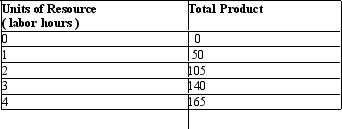 Marginal revenue product (MRP) of a resource is the product of the marginal product of the resource and the marginal revenue.
Refer to Table 14.2.What is the marginal-factor cost for the third unit of the resource?
Marginal revenue product (MRP) of a resource is the product of the marginal product of the resource and the marginal revenue.
Refer to Table 14.2.What is the marginal-factor cost for the third unit of the resource? (Multiple Choice)
4.9/5 (68)
(68) During the recession witnessed in early 2001,many firms laid off their employees and downsized.The reason for this decrease in the demand for employees was:
(Multiple Choice)
4.8/5 (70)
(70) If a resource is purchased and sold in a perfectly competitive market:
(Multiple Choice)
4.9/5 (78)
(78) Because of their derived nature,resource markets are completely different from any other type of market studied by economists.
(True/False)
4.9/5 (76)
(76) A firm under any market structure maximizes profits at a point where:
(Multiple Choice)
4.9/5 (84)
(84) The market-supply-of-resource curve slopes upward,indicating that as the price of a resource rises,the quantity supplied of the resource rises,everything else held constant.
(True/False)
4.9/5 (73)
(73) The profit-maximizing number of workers for a monopsony to employ is derived at the point where the marginal-revenue product of labor is equal to the marginal-factor cost of labor.
(True/False)
4.9/5 (82)
(82) If the price of a product increases,the demand for the resource used in producing that product decreases.
(True/False)
4.9/5 (82)
(82) 
Filters
- Essay(0)
- Multiple Choice(0)
- Short Answer(0)
- True False(0)
- Matching(0)